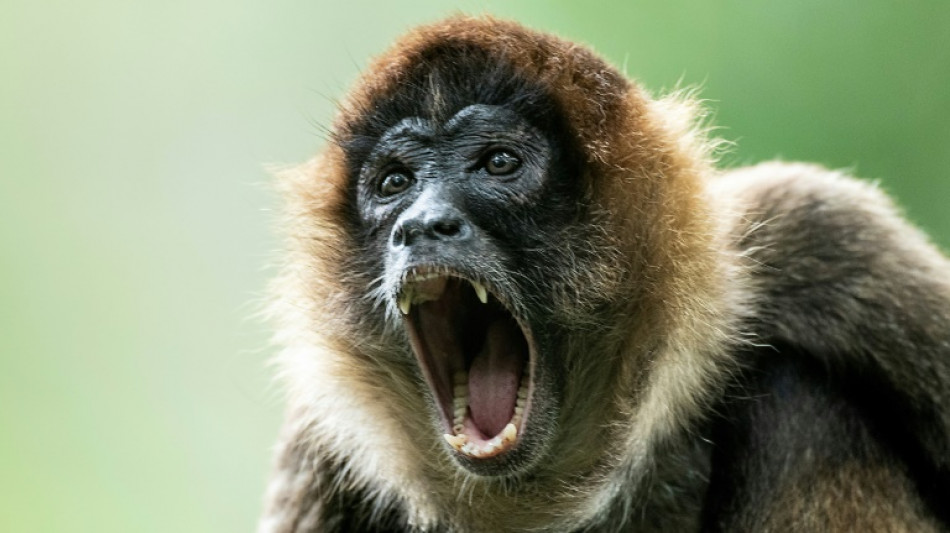
Revealed: Why monkeys are better at yodelling than humans / Photo: Ezequiel BECERRA - AFP/File

 Kenya's economy faces climate change risks: World Bank

 'Beginning of the end': Relief but no party as French wildfire winds down

 Southern Europe 'becoming more flammable' in hotter climate, experts say

 Mammoth bones found on parched bed of Danube in Bulgaria

 MEXC Lists Grvt (GRVT) with $60,000 Worth of GRVT and 10,000 USDT in Airdrop+ Rewards

 George and Amal Clooney flee French home due to wildfire

 MEXC Ventures Supports Alpha Arena's APAC Debut at Coinfest Bali

 AI data centre supplier Zhongji InnoLight slips on Hong Kong debut

 May, June heatwaves caused 2,877 extra deaths in England: govt

 BMW profit down a third as carmaker plans job cuts

 Seoul extends losses as most Asian markets drop, oil rises again

 Gambling.com Group Is Now Grandstand

 Meet the astronomer digging into the Milky Way's 'fossils'

 AI data centre supplier Zhongji InnoLight falls on Hong Kong debut

 Samsung operating profit up 1,800% in second quarter on AI boom

 Japanese population below 120 million for first time in decades

 US actor Jared Leto denies latest accusations of sexual assault

 Danube drops to 'historic lows' as fresh heatwave hits

 BTS pulls out of Grammys after Asian pop category introduction

 OpenAI says rogue AI agent attack hit other companies

 How an AFP beach snap became emblem of Europe's wildfire summer

 TRX Spot and Perpetuals Listing Launches on Backpack, Expanding Access to the TRON Ecosystem

 Nepal's tiger numbers climb 20 percent to estimated 429: survey

 FIFA's plans to sell $4.2bn stake in its tournaments widely criticised

 BMW aims to cut 8,000 jobs by end 2027: company source

Yodellers of the world, you never stood a chance: Monkeys will always be better at yodelling than humans because they have a "cheap trick" hidden in their voice box, scientists revealed Thursday.
When monkeys howl -- or yodellers yodel -- they rapidly switch back and forth between low and high frequency sounds.
This is in contrast to opera singers, who are trained to precisely control how they gradually move from note to note, in a way that is pleasing to listen to.
Yodellers and monkeys, however, make bigger jumps far more abruptly, creating vocal breaks that sound like Tarzan's yell.
When yodelling, a human might be able to jump an octave, which doubles the frequency.
Monkeys can manage three and half octaves, according to a new study.
A "cheap trick" in their larynx means these monkeys will always beat humans, senior study author Jacob Dunn of the UK's Anglia Ruskin University told AFP.
Both humans and monkeys have a pair of vocal folds in their larynx which vibrate to create sound.
But monkeys have an additional pair of membranes that gives them a far wider pitch range, the international team of researchers discovered.
This is thought to give monkeys, which are social creatures, a more complex way of communicating with each other.
All other primates, and even ancient human ancestors, appear to have this special tissue, Dunn said.
At some during our evolution, humans seem to have lost these membranes, he added.
But the shame of being inferior yodellers may have been worth the trade-off.
To be able to speak clearly, humans needed a "streamlined" larynx -- and these membranes would have gotten in the way, Dunn explained.
"If you put a human brain on the primate larynx" it would struggle to speak intelligibly because of the membranes and other things like air sacs, he said.
For the study, the researchers put sensors on the necks of some monkeys at Bolivia's La Senda Verde Wildlife Sanctuary.
This allowed them to see what was going on in the larynx of black and gold howler monkeys, tufted capuchins, black-capped squirrel monkeys and Peruvian spider monkeys.
The spider monkey was the best yodeller, managing around four octaves, Dunn said.
The researchers also studied the larynges of dead monkeys and used computer modelling to analyse the frequencies.
The study was published in the journal Philosophical Transactions of the Royal Society B.
H.Müller--CPN