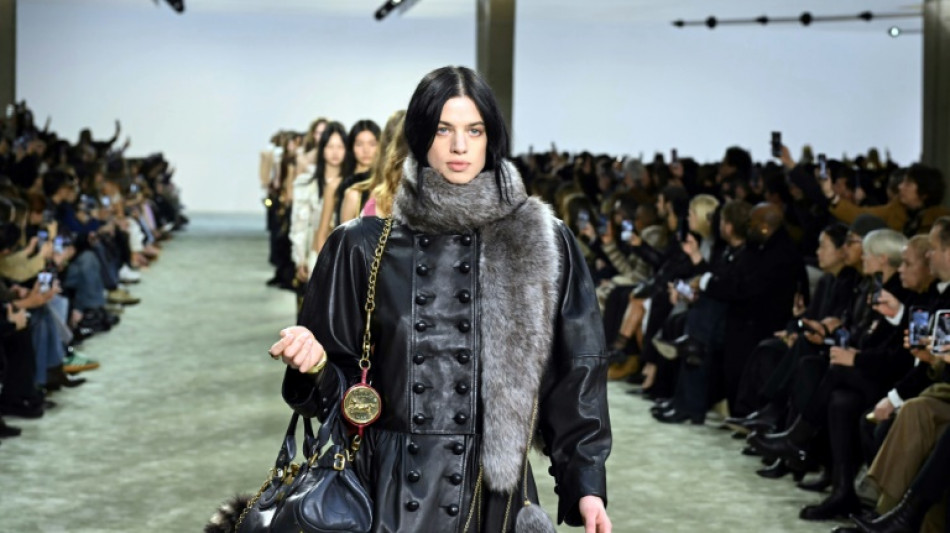
From 'mob wives' to millennials: Faux fur is now a fashion staple / Photo: Bertrand GUAY - AFP

 Three killed by storm in southern India

 Two hundred 'Cruise for life' passengers stranded in Cambodia
 Billionaire Ambani's Jio jumps 21% in market debut after record India IPO

 Sri Lanka's Tamil farmers fight to reclaim land after civil war
 'They don't care about us': Trump food aid cuts leave Americans struggling and angry

 Palestinian activist Khalil returns to Columbia after US detention

 Youths testify about 'despair' in unprecedented Canadian climate trial

 Storied Paris department store seeks bankruptcy protection

 Boeing shares tumble after it releases cautious growth forecast
 Boeing reports smaller loss as it aims for stable output growth

 Dangote, Nigeria's oil tycoon rewriting Africa's story

 Kane says Ballon d'Or win 'feels like a dream' as tributes pour in

 Mercedes-Benz cuts 2026 profit outlook on tough China market

Thanks to the "mob wife" style trend and advances in manufacturing technology that make it look like the real thing, fake fur has conquered catwalks and the high street.
The look is set to last, with the Fall/Winter 2025 shows at Paris Womenswear Fashion Week over the last 10 days showcasing the material in almost every conceivable way.
Whether it was via stoles, long luxuriant coats, or embellishments on jackets or accessories, the fur look once associated with mob wives, Jackie Kennedy, Elizabeth Taylor and European aristocrats has been thoroughly revived.
The high-end imitation version is now so realistic that many observers are unable to distinguish it from the real thing, providing a boon for manufacturers such as France-based Ecopel.
"Since last winter, every brand, from luxury houses to mainstream labels like Zara, has been offering an unprecedented number of faux fur pieces," Ecopel CEO and founder Christopher Sarfati, who supplies around 300 brands, told AFP.
The fur look had almost disappeared due to concerns about animal welfare, with major brands such as Saint Laurent, Gucci and Chanel dropping it altogether and London Fashion Week introducing a ban on its catwalks.
Real fur isn't banned in Paris, and charities including PETA and the Brigitte Bardot Foundation protested last week in the French capital about the "return of fur".
They worry that the ubiquity of replica fur will spark interest in real animal skins in the fashion industry, reversing the decades-long decline of a product that became a byword for cruelty.
- Upcycling -
"I think faux fur is cooler. It's more beautiful. And we don't approve of animal cruelty," said Bryn Taubensee and Patric DiCaprio, designers of the US-based Vaquera label, which presented a very fur-heavy collection this week in Paris.
Leading French fashion journalist Matthieu Bobard Deliere said: "I think you can count the brands still using real fur on the runways on one hand."
According to Ecopel, which closely monitors the market, 89 percent of fur seen at Milan Fashion Week was faux, compared to 62 percent in New York.
Two brands which featured real fur during Paris Fashion Week -- newcomer Hodakova run by Swedish designer Ellen Hodakova Larsson and Gabriela Hearst from Uruguay -- both said they were upcycling existing skins.
Some designers argue that this is more environmentally friendly, as they are not relying on faux fur which is usually made from polyester and other oil-based synthetic fibres.
"Repurposed vintage mink was unstitched and then painstakingly reassembled by hand in a family-run atelier," Hearst said of the mink coat that featured in her show.
The Parisian fur store Sam Rone told AFP that its sales have increased since last year.
Second-hand fur is in high demand, especially among Gen Z, which loves vintage fashion, with some now rummaging through their grandmothers' wardrobes.
If real fur has animal cruelty drawbacks and fake fur is polluting, the solution for the ethically minded consumer would appear to be new non-plastic varieties being developed.
Ecopel claims to have found a solution with the launch of 100-percent plant-based faux fur.
"Brands will no longer be able to say 'We don’t use faux fur because it’s made of polyester and petroleum'," Sarfati explained.
A.Leibowitz--CPN