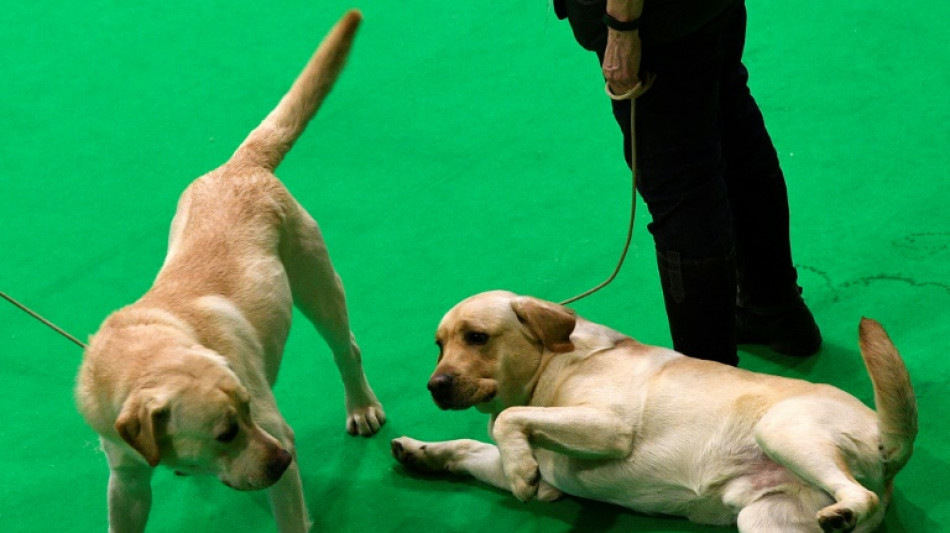
Chunky canines: Study reveals dog obesity gene shared by humans / Photo: Oli SCARFF - AFP/File

 Kenya's economy faces climate change risks: World Bank

 Milei demands expulsion of foreigners expressing 'hate' against Argentina

 Italy's Po River valley on drought alert

 Prada profits pinched as growth hard to chase

 Stocks climb on earnings and rates, oil retreats

 US economic growth slows in second quarter, missing expectations

 Russia adds Telegram founder Durov to 'terrorist' blacklist

 Stocks diverge on earnings, as oil steadies

 Eurozone economy grows despite Middle East war

 Singapore group will develop 'most promising' Ebola vaccine

 Shell profit surges as Mideast war fuels oil prices

 Car maker Stellantis says back in profit in second quarter

 Samsung quarterly operating profit up 1,800% on AI boom

 South Korean stocks bounce after rout, oil holds gains on Mideast woes

 South Korea's women web sleuths fight AI deepfake porn

 Anything but programmable: New cost-efficient EC-power-supply-series for the DIN rail by CAMTEC PS

 Meta misses profit expectations, sticks to massive AI spending

 Campari - king of the spritz - hopes to conquer American heartland

 Air France-KLM and Lufthansa bid for Portugal's TAP airline

 Profits soar at Airbus as it delivers more planes

 Rheinmetall shares surge after armsmaker reports record profit

 FIFA hit by furious backlash over plans to sell stake in competitions

 MEXC Integrates World-Check to Fortify Institutional Grade Compliance Architecture

 Spain returns wildfire evacuees as France braces for worsening weather

 Russia seeks arrest of Telegram chief Durov

Obesity is on the rise not just in humans but in dogs, whose history of selective breeding makes them an ideal species for studying the balance between genetics, diet, and lifestyle in weight gain.
In a new paper published Thursday in Science, researchers identified a gene strongly linked to obesity in pet pooches -- and found it is also associated with weight gain in humans.
"The prevailing attitude towards obesity is that people are just a bit rubbish about controlling what they eat, whereas actually, our data shows that if you're a high-risk individual, it takes more effort to keep you slim," lead author Eleanor Raffan, a researcher in the University of Cambridge's Department of Physiology, Development, and Neuroscience, told AFP.
A veterinarian as well as a scientist, Raffan has long sought to study animal genetics to uncover broader biological insights that apply across species, including our own.
For this study, she and her colleagues focused on British Labrador Retrievers.
"Anyone who knows dogs will understand that starting with Labradors is a good idea because they're very prone to getting obese," she said. "They've got this reputation for being really foodie dogs, really obsessed by food."
The team collected slobber samples from 241 dogs and conducted a genome-wide association study, which examines an organism's entire set of genes to identify areas linked to a specific trait.
The top five genes were also present in humans, with the one exerting the strongest influence called DENND1B.
They also assessed how much the dogs pestered their owners for food and whether they were fussy eaters.
"Low-risk dogs tended to remain a healthy weight, irrespective of how their owners managed their food and exercise," said Raffan. "But if you were a high-genetic-risk dog, then if your owners were complacent about diet and exercise, you were likely to get really, really overweight."
For Raffan, the study has two major takeaways.
First, it sheds new light on how DENND1B affects a brain pathway responsible for regulating energy balance and appetite. Known as the leptin-melanocortin pathway, this system is a key target for some anti-obesity drugs.
"Only by understanding biology and the nuances of it can we possibly improve our treatment and management of obesity," she said.
Second, the study allowed researchers to quantify genetic risk for obesity in individual dogs -- and the level of effort required to keep them at a healthy weight. This is easier to measure in dogs than in humans, since their diet and exercise are entirely controlled by their owners.
"We shouldn't be rude to owners of overweight dogs," Raffan emphasized.
"It's not that they're hopeless individuals who don't care about their pets. It's just that they've got animals who persistently seek out opportunities to eat, and just a little bit extra every day is enough to cause weight gain over time."
A.Agostinelli--CPN