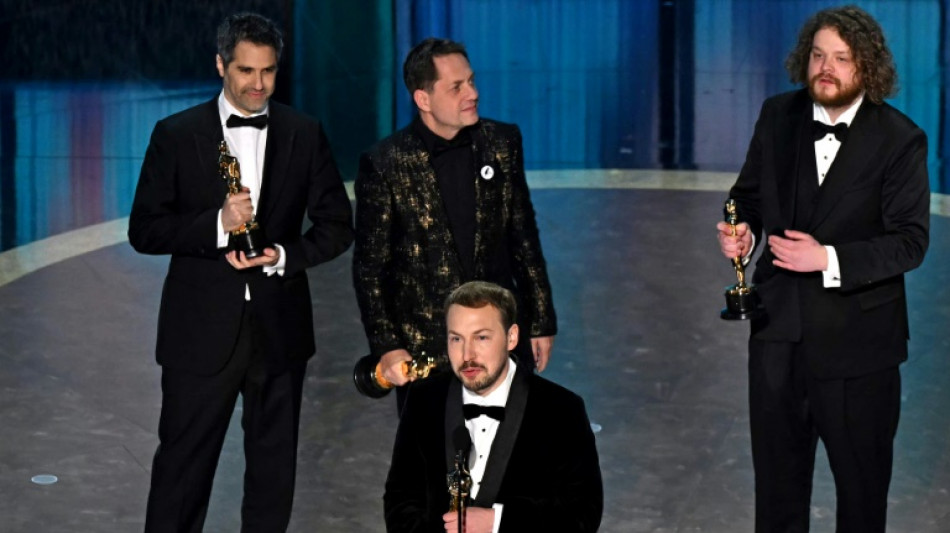
'Flow', Latvia's trailblazing animation, wins Oscar / Photo: Patrick T. Fallon - AFP

 Kenya's economy faces climate change risks: World Bank

 Milei demands expulsion of foreigners expressing 'hate' against Argentina

 Italy's Po River valley on drought alert

 Prada profits pinched as growth hard to chase

 Stocks climb on earnings and rates, oil retreats

 US economic growth slows in second quarter, missing expectations

 Russia adds Telegram founder Durov to 'terrorist' blacklist

 Stocks diverge on earnings, as oil steadies

 Eurozone economy grows despite Middle East war

 Singapore group will develop 'most promising' Ebola vaccine

 Shell profit surges as Mideast war fuels oil prices

 Car maker Stellantis says back in profit in second quarter

 Samsung quarterly operating profit up 1,800% on AI boom

 South Korean stocks bounce after rout, oil holds gains on Mideast woes

 South Korea's women web sleuths fight AI deepfake porn

 Anything but programmable: New cost-efficient EC-power-supply-series for the DIN rail by CAMTEC PS

 Meta misses profit expectations, sticks to massive AI spending

 Campari - king of the spritz - hopes to conquer American heartland
 Air France-KLM and Lufthansa bid for Portugal's TAP airline

 Profits soar at Airbus as it delivers more planes

 Rheinmetall shares surge after armsmaker reports record profit
 FIFA hit by furious backlash over plans to sell stake in competitions

 MEXC Integrates World-Check to Fortify Institutional Grade Compliance Architecture
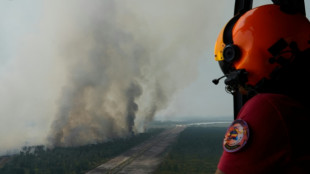 Spain returns wildfire evacuees as France braces for worsening weather

 Russia seeks arrest of Telegram chief Durov

"Flow", a dialogue-free tale of animals surviving disaster, scored Sunday's Oscar for best animated feature, capping a remarkable awards season for the Latvian film made on a minuscule budget.
The moving film follows a solitary black cat who, confronted with a sudden flood, reluctantly embarks on a journey in the company of an unlikely menagerie including a buoyant golden retriever and an unruffled capybara.
Independent Latvian filmmaker Gints Zilbalodis's work bested "Inside Out 2", "Memoir of a Snail", "Wallace & Gromit: Vengeance Most Fowl" and "The Wild Robot" to claim the prize, the first ever for Latvia.
Zilbalodis acknowledged that achievement onstage in accepting his statuette, while also nodding to a core tenet of the film: "We're all in the same boat, we must overcome our differences and find ways to work together -- thank you."
For Zilbalodis, the story reflects his own experience: that of an individualist -- he made his first film on his own -- learning to work in a team.
"This is a story about a character who starts out being very independent, and then has to learn how to trust others and how to collaborate," Zilbalodis told AFP in an interview before the Oscars.
To Zilbalodis, the endeavour paid off: with a modest budget of $3.6 million, "Flow" has won audiences and critics alike, all while making history for Latvian cinema.
Its Oscar nominations in the best animated feature and international film categories were a first for any film in the Baltic country of 1.8 million people.
"Flow" won a Golden Globe in January; it was then the highest prize ever for a Latvian film, drawing more than 15,000 fans to the museum in Riga where Zilbalodis displayed the statuette.
The film opens with the cat discovering that people have deserted their dwellings and water is approaching the nearby meadows.
Against this apocalyptic background, the cat forms an unlikely comradeship with a dog, a capybara, a secretary bird and a lemur -- all displaying the distinctive features of their species.
As they board a sailboat amid surging water, the pack learns how to cooperate and respect each other's needs and boundaries.
- 'Tickle the capybara' -
Zilbalodis created the film on Blender, a free open-source software, and modelled his animal characters after careful observation of their traits.
While not a word is uttered throughout the film, the protagonists make their own sounds that the filmmaker recorded from real-life animals -- with one notable exception.
The capybara needed "extra assistance", Zilbalodis said, explaining that to record it, the crew visited a zoo, only to find that capybaras are normally silent.
"A zookeeper had to actually go in and tickle the capybara," Zilbalodis said.
The result was not what the crew expected -- a high-pitched sound that the "Flow" team judged incompatible with the laid-back capybara.
Ultimately, the alternative sound actor they opted for was a baby camel.
"Flow", only the second animated film in Oscar history to be nominated in both the animated and international feature categories, continues to break records.
Latvia's film centre has said more than 300,000 people saw it in cinemas, making it the most-viewed film in Latvian history, surpassing "Avatar" and "Titanic".
Zilbalodis said he partly attributed this success to the "innocence" of the animals.
"This just shows that we can connect with these types of characters, because we have a lot more in common than we might think," he said.
"We all share the same fears and instincts and needs."
Ng.A.Adebayo--CPN