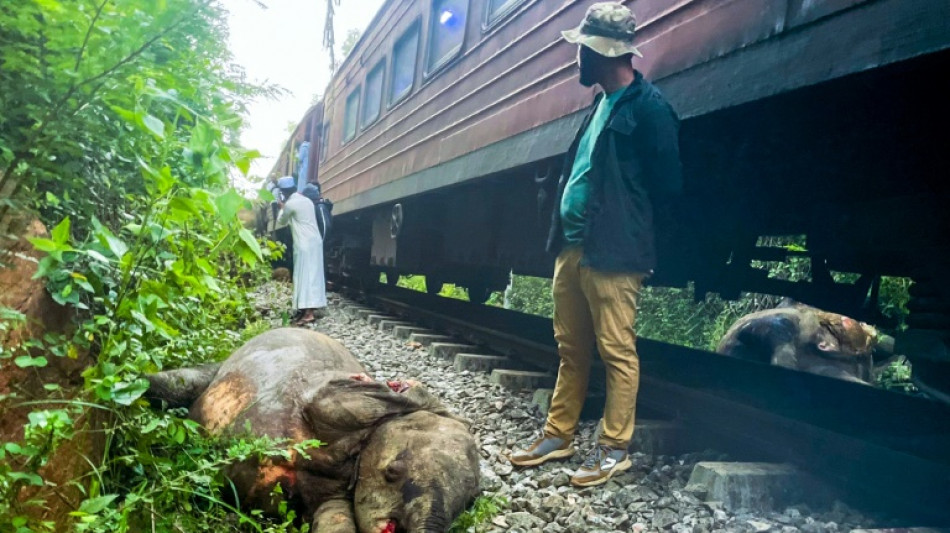
Sri Lanka passenger train kills six elephants / Photo: - - AFP

 Kenya's economy faces climate change risks: World Bank

 Apple tops estimates in CEO Cook's final quarter, but shares fall

 Milei demands expulsion of foreigners expressing 'hate' against Argentina

 Italy's Po River valley on drought alert

 Prada profits pinched as growth hard to chase

 Stocks climb on earnings and rates, oil retreats

 US economic growth slows in second quarter, missing expectations

 Russia adds Telegram founder Durov to 'terrorist' blacklist

 Stocks diverge on earnings, as oil steadies

 Eurozone economy grows despite Middle East war

 Singapore group will develop 'most promising' Ebola vaccine

 Shell profit surges as Mideast war fuels oil prices

 Car maker Stellantis says back in profit in second quarter

 Samsung quarterly operating profit up 1,800% on AI boom

 South Korean stocks bounce after rout, oil holds gains on Mideast woes

 South Korea's women web sleuths fight AI deepfake porn

 Anything but programmable: New cost-efficient EC-power-supply-series for the DIN rail by CAMTEC PS

 Meta misses profit expectations, sticks to massive AI spending

 Campari - king of the spritz - hopes to conquer American heartland

 Air France-KLM and Lufthansa bid for Portugal's TAP airline

 Profits soar at Airbus as it delivers more planes

 Rheinmetall shares surge after armsmaker reports record profit

 FIFA hit by furious backlash over plans to sell stake in competitions

 MEXC Integrates World-Check to Fortify Institutional Grade Compliance Architecture
 Spain returns wildfire evacuees as France braces for worsening weather

A Sri Lankan passenger train derailed Thursday after smashing into a family of elephants, with no passengers injured but six animals killed in the island's worst such wildlife accident, police said.
The express train was travelling near a wildlife reserve at Habarana, some 180 kilometres (110 miles) east of the capital Colombo, when it hit the herd before dawn.
Videos shot of the aftermath showed one elephant standing guard over an injured youngster lying beside the tracks, with the tips of their trunks curled together.
"Three baby elephants were among the six killed," government spokesman and media minister Nalinda Jayatissa told reporters.
"Elephants being runover by trains is something that is not uncommon, but our attention is focused on this case because of the sheer numbers."
Local police said two other elephants escaped with serious injuries.
Jayatissa said the government was working on a new mechanism to reduce the number of wild animals hit by trains in sparsely populated jungle areas of the island.
"All systems that were in place, like reducing speed, have failed," he said.
Killing or harming elephants is a criminal offence in Sri Lanka, which has an estimated 7,000 wild elephants.
The animals are considered national treasures, partly due to their significance in Buddhist culture.
In August 2016, three elephant calves and their mother were run over by an express train and killed at Cheddikulam, about 260 kilometres (162 miles) north of Colombo.
One the baby elephants was dragged about 300 meters (990 feet) along the track after being hit by the train which was allowed to travel at speeds up to 100 kilometres an hour (60 mph).
Two baby elephants and their pregnant mother were killed in a similar accident by a train in Habarana, the scene of Thursday's tragedy, in September 2018.
Since then, the authorities ordered train drivers to observe speed limits to minimise injury to elephants when going through areas where they cross the lines.
- Growing conflict -
The elephant deaths comes days after the authorities expressed concern over the growing impact of conflict between humans and elephants due to habitat encroachment.
Farmers scratching a living from smallholder plots often fight back against elephants raiding their crops.
Deputy environment minister Anton Jayakody told AFP on Sunday that 150 people and 450 elephants were killed in clashes in 2023.
"We are planning to introduce multiple barriers -- these may include electric fences, trenches, or other deterrents -- to make it more difficult for wild elephants to stray into villages," he said.
A study last year in the Journal of Threatened Taxa detailed how Asian elephants loudly mourn and bury their dead calves, reminiscent of human funeral rites.
Asian elephants are recognised as endangered by the International Union for Conservation of Nature.
An estimated 26,000 of them live in the wild, mostly in India with some in Southeast Asia, surviving for an average of 60-70 years outside captivity.
D.Goldberg--CPN