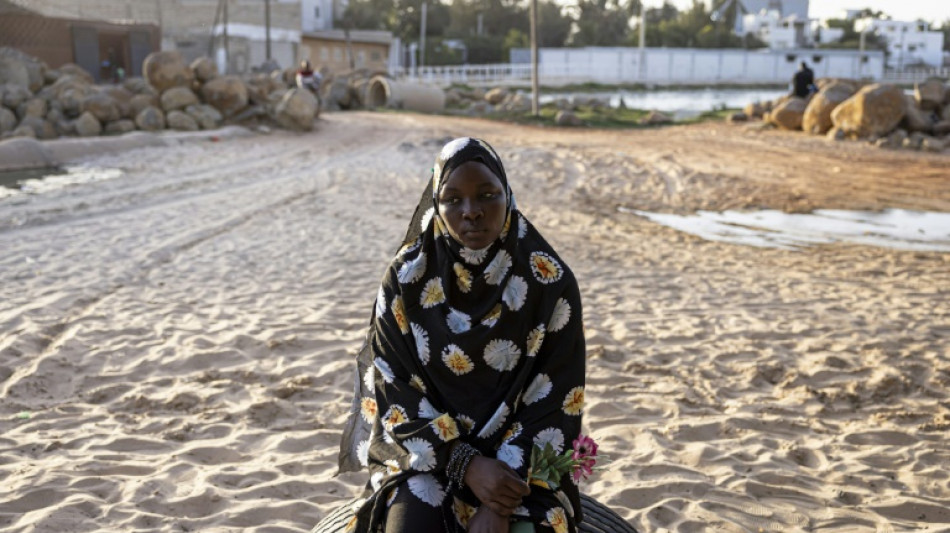
Flowers in the sand: families mourn Senegal migrants lost at sea / Photo: PATRICK MEINHARDT - AFP

 Kenya's economy faces climate change risks: World Bank

 Apple tops estimates in CEO Cook's final quarter, but shares fall

 Milei demands expulsion of foreigners expressing 'hate' against Argentina

 Italy's Po River valley on drought alert

 Prada profits pinched as growth hard to chase

 Stocks climb on earnings and rates, oil retreats

 US economic growth slows in second quarter, missing expectations

 Russia adds Telegram founder Durov to 'terrorist' blacklist

 Stocks diverge on earnings, as oil steadies

 Eurozone economy grows despite Middle East war

 Singapore group will develop 'most promising' Ebola vaccine

 Shell profit surges as Mideast war fuels oil prices

 Car maker Stellantis says back in profit in second quarter

 Samsung quarterly operating profit up 1,800% on AI boom

 South Korean stocks bounce after rout, oil holds gains on Mideast woes

 South Korea's women web sleuths fight AI deepfake porn

 Anything but programmable: New cost-efficient EC-power-supply-series for the DIN rail by CAMTEC PS

 Meta misses profit expectations, sticks to massive AI spending

 Campari - king of the spritz - hopes to conquer American heartland
 Air France-KLM and Lufthansa bid for Portugal's TAP airline

 Profits soar at Airbus as it delivers more planes

 Rheinmetall shares surge after armsmaker reports record profit
 FIFA hit by furious backlash over plans to sell stake in competitions

 MEXC Integrates World-Check to Fortify Institutional Grade Compliance Architecture

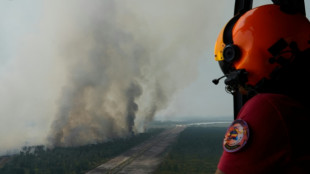 Spain returns wildfire evacuees as France braces for worsening weather

Fatou Fall defiantly faced the ocean and sadly laid a flower on Mbao beach near Senegal's capital Dakar in memory of her husband -- one of many who left on perilous clandestine crossings for Europe but never returned.
The young widow was one of many of those left behind paying a low-key tribute to the country's migrants, whose dreams of a better life abroad were never fulfilled.
Barefoot on the sand, Fall contemplated sadly the flowers tossed about by the waves.
Around her, the beauty of the sparkling sea, colourful wooden pirogues and the deceptive gentleness of the surroundings hid the daily reality of the pain of loss.
"Migrate to live, not to die!" proclaimed a banner hung from the trees at the end of the beach by a local support group for migrants and their families.
As night fell on Thursday, religious leaders and relatives of the missing said a prayer and read from the Koran before scattering flowers silently in the sea.
The ceremony was part of "Commemor-action", an international drive to support the families of those who have died or disappeared while trying to migrate.
Wearing a long dress, Fatou Fall, 27, travelled the 80 kilometres (nearly 50 miles) north to Mbao from her home in Mbour, another coastal town hit by tragedy.
She had only been married for 18 months when her husband, her cousin and two other relatives drowned about four kilometres off Mbour when their boat capsized.
- Thrown overboard -
"My husband wanted to support his parents but it was difficult for him to find a job. Even people with qualifications can't do it," an emotional Fall told AFP.
"He decided to get in the boat. We were also hoping for a better life and we let him go," she sighed, adding that it was "important" to attend Thursday's event.
Senegal is one of the main departure points for thousands of Africans attempting the dangerous Atlantic route to Europe via the Spanish Canary Islands on overcrowded and often dilapidated boats.
Thousands have died in recent years and Senegal, where even young graduates struggle to find jobs, has been hit hard.
Municipal worker Seyni Ndoye, 55, said he came to Mbao to "share the memory" of his son Hassan, who was 20 when he boarded a boat with several friends.
Survivors told him that Hassan lost his life after a week at sea without eating, when his boat drifted off the coast of Cape Verde for about 10 days.
People on board did not want to keep his body and he was thrown overboard. "It's very painful," he said.
- Families 'ignored' -
Tragedies at sea involving migrants remain a taboo subject and source of shame in Senegal, compounding the isolation and dismay of families searching for their loved ones.
Support groups for families exist in places such as Mbour, St Louis and Joal but raising awareness and the work of the associations remains difficult.
"In Senegal, the families of the dead and disappeared are ignored, they don't have the right to information or to research," said Ibrahima Konate, 31, who founded the Association for Solidarity of Migrants and Deprived Families (ASMFD).
"No one helps these families: the police, the government say that it's not their job, that they didn't send their children on migrant routes, even though it's the situation in Senegal that's forcing these young people to leave," he added.
"The families have a lot of difficulty accepting a bereavement without any information," Saliou Diouf, who founded the group "Boza Fi" ("Freedom Here" in the local Wolof language), told AFP.
ASMFD is demanding that the Senegalese authorities "mobilise" and "create a platform to help families do the research themselves".
Mamadou Pouye, 47, is from Mbao and lost his brother in a capsize several years ago. More recently, five of his friends died.
On Thursday, he recounted quietly the unbearable wait, the difficulty grieving and of keeping the memory of his brother Housseinou alive.
"We have lost hope of ever finding him," he said. "We would have liked to have taken him to the mortuary to fulfil the recommendations of religion... but we were unable to bury him.
"You don't even know where to go to pray for him and preserve his memory," he added. "It's very difficult."
L.K.Baumgartner--CPN