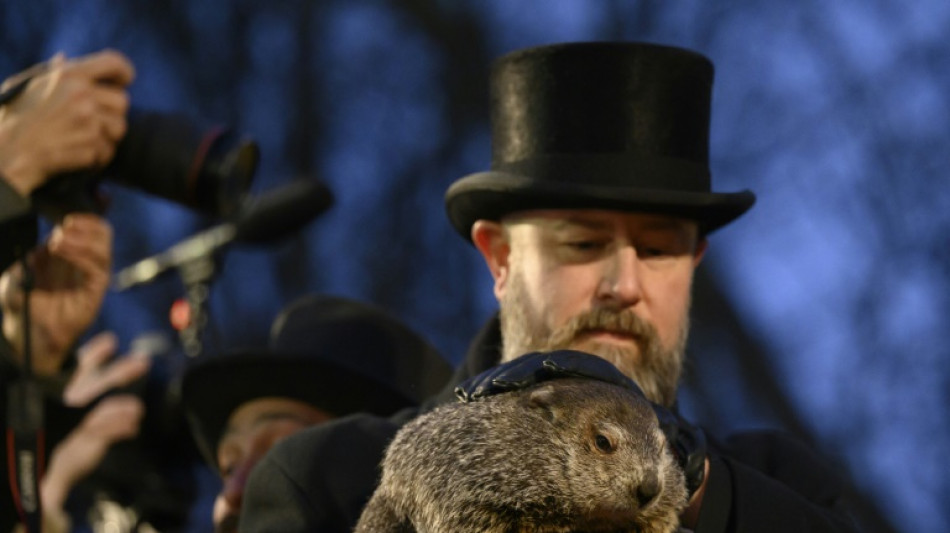
Scientists cast doubt on famous US groundhog's weather forecasts / Photo: JEFF SWENSEN - GETTY IMAGES NORTH AMERICA/AFP/File

 Kenya's economy faces climate change risks: World Bank

 Apple tops estimates in CEO Cook's final quarter, but shares fall

 Milei demands expulsion of foreigners expressing 'hate' against Argentina

 Italy's Po River valley on drought alert

 Prada profits pinched as growth hard to chase

 Stocks climb on earnings and rates, oil retreats

 US economic growth slows in second quarter, missing expectations

 Russia adds Telegram founder Durov to 'terrorist' blacklist

 Stocks diverge on earnings, as oil steadies

 Eurozone economy grows despite Middle East war

 Singapore group will develop 'most promising' Ebola vaccine

 Shell profit surges as Mideast war fuels oil prices

 Car maker Stellantis says back in profit in second quarter

 Samsung quarterly operating profit up 1,800% on AI boom

 South Korean stocks bounce after rout, oil holds gains on Mideast woes

 South Korea's women web sleuths fight AI deepfake porn

 Anything but programmable: New cost-efficient EC-power-supply-series for the DIN rail by CAMTEC PS

 Meta misses profit expectations, sticks to massive AI spending

 Campari - king of the spritz - hopes to conquer American heartland

 Air France-KLM and Lufthansa bid for Portugal's TAP airline

 Profits soar at Airbus as it delivers more planes

 Rheinmetall shares surge after armsmaker reports record profit

 FIFA hit by furious backlash over plans to sell stake in competitions

 MEXC Integrates World-Check to Fortify Institutional Grade Compliance Architecture
 Spain returns wildfire evacuees as France braces for worsening weather

Scientists have cast doubt on the reliability of America's most celebrated rodent forecaster -- whose apparent knack of predicting how long winter will last forms a hallowed tradition in the United States.
Punxsutawney Phil, made famous by the 1993 film "Groundhog Day," attracts thousands of onlookers every February 2 to the Pennsylvania town that he takes his name from.
The US state's tradition of using a large rodent to predict the seasons dates back to the Pennsylvania Dutch belief that if a groundhog left its burrow and saw its shadow, it would scurry back inside and winter would go on for six more weeks.
But professional forecasters have warned ahead of Phil's appearance this Sunday that his prediction is likely to be way off the mark.
The US National Oceanic and Atmospheric Administration (NOAA) has concluded that only 35 percent of Phil's forecasts have proved to be accurate -- placing him at a lowly 17th compared to other rodent forecasters.
Staten Island Chuck, a New York-based groundhog, tops the rankings with an impressive 85 percent accuracy rate on his forecasts.
Phil and his predecessors, also called Phil, have been forecasting since 1887.
L.K.Baumgartner--CPN