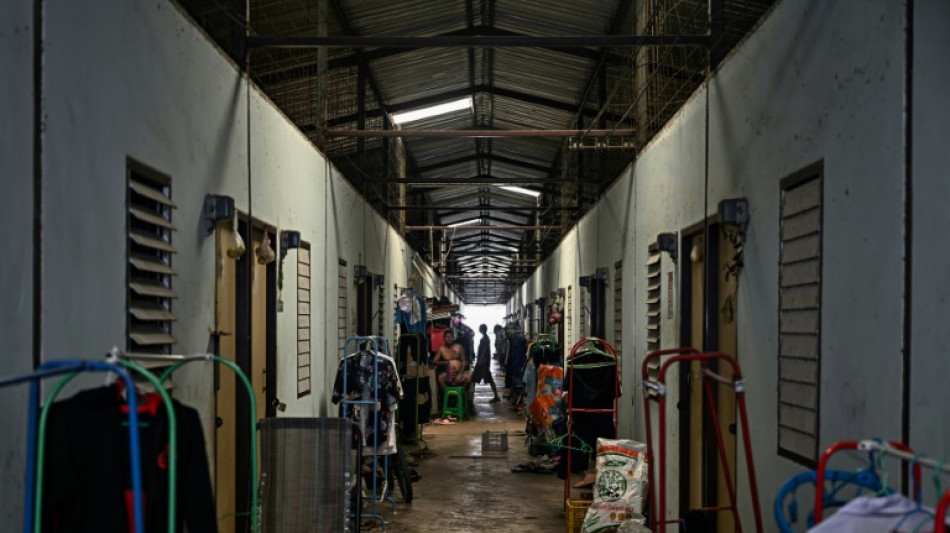
'No happiness': Misery for Myanmar exiles four years on from coup / Photo: Lillian SUWANRUMPHA - AFP

 Kenya's economy faces climate change risks: World Bank

 Apple tops estimates in CEO Cook's final quarter, but shares fall

 Milei demands expulsion of foreigners expressing 'hate' against Argentina

 Italy's Po River valley on drought alert

 Prada profits pinched as growth hard to chase

 Stocks climb on earnings and rates, oil retreats

 US economic growth slows in second quarter, missing expectations

 Russia adds Telegram founder Durov to 'terrorist' blacklist

 Stocks diverge on earnings, as oil steadies

 Eurozone economy grows despite Middle East war

 Singapore group will develop 'most promising' Ebola vaccine

 Shell profit surges as Mideast war fuels oil prices

 Car maker Stellantis says back in profit in second quarter

 Samsung quarterly operating profit up 1,800% on AI boom

 South Korean stocks bounce after rout, oil holds gains on Mideast woes

 South Korea's women web sleuths fight AI deepfake porn

 Anything but programmable: New cost-efficient EC-power-supply-series for the DIN rail by CAMTEC PS

 Meta misses profit expectations, sticks to massive AI spending

 Campari - king of the spritz - hopes to conquer American heartland

 Air France-KLM and Lufthansa bid for Portugal's TAP airline

 Profits soar at Airbus as it delivers more planes

 Rheinmetall shares surge after armsmaker reports record profit

 FIFA hit by furious backlash over plans to sell stake in competitions

 MEXC Integrates World-Check to Fortify Institutional Grade Compliance Architecture
 Spain returns wildfire evacuees as France braces for worsening weather

Four years after Myanmar's military seized power in a coup, the country is in the grip of a bloody civil war that has driven many of the country's young across the border to Thailand.
There they scrape by doing hard jobs for little pay -- often living in fear of being arrested and sent back to Myanmar.
AFP met three of them in Mahachai, a district of Samut Sakhon in Bangkok's western suburbs known as "Little Myanmar" for its population of migrant workers.
They told of their experiences and hopes and fears for the future -- speaking under pseudonyms for their own safety and that of their families back in Myanmar.
- Ma Phyu: 'I lost all my dreams' -
"After the coup, I lost all my dreams," Ma Phyu told AFP.
Before the military seized power, the 28-year-old was teaching young children while studying at university in Yangon with the aim of qualifying as a teacher.
After the February 1, 2021 coup, which ousted the elected civilian government of Aung San Suu Kyi, the generals launched a bloody campaign of violent repression against dissent.
Resistance has been fierce, led in large part by young people who grew up during Myanmar's 10-year dalliance with democracy.
Like thousands of others, Ma Phyu chose to flee Myanmar rather than live under the junta, and now cannot return for fear of retribution from the authorities.
Thailand is home to the world's largest Myanmar diaspora -- 2.3 million registered workers, plus another 1.8 million unofficial migrants, according to the UN migration agency IOM.
Lacking Thai language skills, Myanmar migrants in Thailand are forced into difficult and dirty jobs including construction, food and farm work -- often being paid below minimum wage.
Ma Phyu now works from 5:30 pm to 3:00 am in a fish processing plant, six days a week, regularly scolded by her supervisors for not understanding instructions in Thai.
Her husband arrived from Myanmar last year and the couple now live in a single-room apartment in Mahachai.
"I can't stand the smell of fish any more. I feel disgusted at work and it's the same at home. Nothing changes, I don't want to live any more," Ma Phyu said.
"My previous life was full of happiness. If there had been no coup, there would have been a good life for me."
- Lwin Lwin: 'There is no happiness' -
In a shabby room in a run-down building in Mahachai, Lwin Lwin practises Japanese grammar with five other Myanmar migrants.
The 21-year-old, who fled Myanmar without finishing high school, hopes learning the language will give her a way out of a tough existence in Thailand.
"The coup turned my life upside down. I thought I would finish school, go to university and work for the government," she told AFP.
"But then the coup happened and all my ambitions were swept away."
Like Ma Phyu, Lwin Lwin works in a fish processing factory in Samut Sakhon and lives in a crowded accommodation block.
"There is no happiness," she said.
"I never thought I would be working in canned fish factory, but no matter what I feel, sad or happy, I have to work."
- Thura: 'traumatised until we die' -
Thura, 25, fled Myanmar after the junta announced in February last year that it would enforce conscription into the military.
Like thousands of others, Thura chose to escape to Thailand rather than fight for a regime he did not believe in, abandoning his dream of running his own garage.
"At first I wanted to join a People's Defence Force and fight for the revolution," he said, referring to the civilian groups that have taken up arms across the country to oppose the junta's rule.
"But I have many siblings and I chose to come to Thailand."
Remittances from workers in Thailand are a vital lifeline for many families in Myanmar, where the civil war has wrecked the economy.
In 2022 nearly one billion dollars were sent from the kingdom, according to the IOM.
Thura is waiting for his "pink card" -- an official document allowing him to work in Thailand -- and until it arrives he rarely leaves the one-room apartment he shares with his sister.
"We will be traumatised by this military coup till we die," he said.
"If there were no coup, young people like us would be eating at home with our parents, brothers and sisters.
"Instead we are apart from our families for many years. It's not good and I feel sad for us."
Y.Tengku--CPN