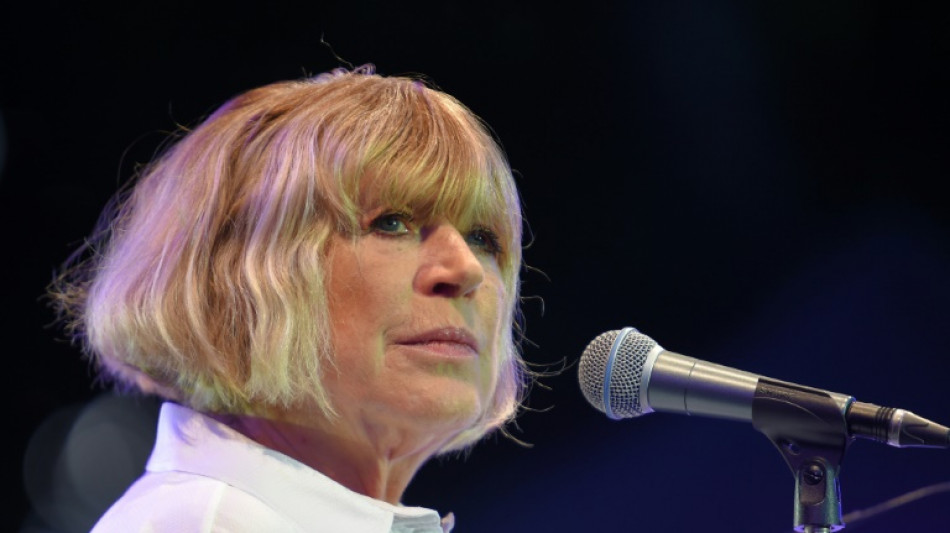
Marianne Faithfull: from muse to master / Photo: GUILLAUME SOUVANT - AFP/File

 Kenya's economy faces climate change risks: World Bank

 Apple tops estimates in CEO Cook's final quarter, but shares fall

 Milei demands expulsion of foreigners expressing 'hate' against Argentina

 Italy's Po River valley on drought alert

 Prada profits pinched as growth hard to chase

 Stocks climb on earnings and rates, oil retreats

 US economic growth slows in second quarter, missing expectations

 Russia adds Telegram founder Durov to 'terrorist' blacklist

 Stocks diverge on earnings, as oil steadies

 Eurozone economy grows despite Middle East war

 Singapore group will develop 'most promising' Ebola vaccine

 Shell profit surges as Mideast war fuels oil prices

 Car maker Stellantis says back in profit in second quarter

 Samsung quarterly operating profit up 1,800% on AI boom

 South Korean stocks bounce after rout, oil holds gains on Mideast woes

 South Korea's women web sleuths fight AI deepfake porn

 Anything but programmable: New cost-efficient EC-power-supply-series for the DIN rail by CAMTEC PS

 Meta misses profit expectations, sticks to massive AI spending

 Campari - king of the spritz - hopes to conquer American heartland

 Air France-KLM and Lufthansa bid for Portugal's TAP airline

 Profits soar at Airbus as it delivers more planes

 Rheinmetall shares surge after armsmaker reports record profit

 FIFA hit by furious backlash over plans to sell stake in competitions

 MEXC Integrates World-Check to Fortify Institutional Grade Compliance Architecture

 Spain returns wildfire evacuees as France braces for worsening weather

Marianne Faithfull, who died on Thursday aged 78, was one of the great survivors of the Swinging Sixties, bouncing back from drink and drug oblivion to become a celebrated and distinctive singer-songwriter.
Long known for her tempestuous relationship with the Rolling Stones' Mick Jagger -- who, with bandmate Keith Richards, penned her haunting hit "As Tears Go By" in 1964 -- she shook off the mantle of "muse" to carve out her own unique musical niche.
She was born on December 29, 1946 into a glamorous aristocrat family in London -- her mother was an Austro-Hungarian baroness and her father an erudite British spy.
Faithfull made her first tentative appearances on the folk scene before being drawn into the swirling orbit of the Stones.
She brought bohemian sophistication and an innate sense of style to the suburban Jagger after being introduced to him by the Stones' manager Andrew Loog Oldham, who famously dismissed her as "an angel with big tits".
"I was treated as somebody who not only can't even sing, but doesn't really write, just something you can make into something," she later said.
Yet her cut-glass delivery gave an eerie melancholy to such upbeat songs as "This Little Bird", "Go Away From My World", "Morning Sun" and "Broken English".
By the time she moved in with Jagger aged 19, Faithfull had already been briefly married and had a son.
As well as co-writing "Sister Morphine", she has been credited with inspiring the classic songs "You Can't Always Get What You Want" and "Sympathy for the Devil", after introducing Jagger to Russian writer Mikhail Bulgakov's classic novel "The Master and Margarita".
The pair were the king and queen of Swinging London, and Faithfull was also best friends with Anita Pallenberg, the artist and actress -- and sometime girlfriend of two other Stones members, Brian Jones and Keith Richards -- who would become another icon of the Sixties rebellion.
- Addict on the streets -
Everyone wanted a piece of her, with Faithfull appearing in Jean-Luc Godard's film "Made in USA", where she sang "As Tears Go By". She also starred opposite Glenda Jackson in Chekhov's "Three Sisters" at Britain's National Theatre.
But Faithfull was also becoming addicted to cocaine and she felt "destroyed... and judged as a bad mother" after the police gloried in revealing that they found her wearing nothing but a fur rug in a highly publicised drugs raid in 1967 that saw both Jagger and Richards convicted.
She left Jagger three years later as her life spiralled out of control and ended up living rough for nearly two years in London.
Addicted to heroin, she lost custody of her child and attempted suicide.
When she next appeared in public on a US television show in 1973 dressed as a nun to sing "I've Got You Babe" with David Bowie, her fine, faltering voice had gone, to be replaced by a deep whisky-soaked rasp that would later become her trademark.
Six years later her album "Broken English" was a revelation, not just because of the change in her voice and the way she unsparingly exposed the depths to which she had sunk, but because it was a musical tour de force.
It revived her career. But her drugs demons had not been tamed, and now living in the United States she hit the wall again in the mid-1980s.
- Living legend -
Having come out of rehab, she moved back to Ireland -- a refuge for her throughout her life -- and began reinventing herself as a jazz and blues singer.
It was there that she began to hone her musical talent, inspired by her interest in pre-war Weimar Germany, and revive her acting career, playing the mother in Pink Floyd's rock opera "The Wall" in 1990.
In the mountains south of Dublin, she also wrote the first volume of her autobiography, which was published alongside "A Collection of Her Best Recordings", featuring her old friends Richards and Stones drummer Charlie Watts and guitarist Ron Wood.
Her reputation continued to grow with a string of albums featuring collaborations with Daniel Lanois, Emmylou Harris, Pink Floyd's Roger Waters and PJ Harvey and Nick Cave.
She was now a living legend, playing herself as God in the British sitcom "Absolutely Fabulous" -- Pallenberg played the devil.
Faithfull herself then played the Devil in the Tom Waits and William S. Burroughs musical "The Black Rider".
Sofia Coppola cast her as the Empress Maria Theresa in her 2008 film "Marie Antoinette".
And she was a guest singer on a host of songs including "The Memory Remains" by the US heavy metal band Metallica.
Only in her later years, however, did her music finally fully escape the shadow of her personal life.
Her final album, "Negative Capability" (2018), which she wrote and produced in Paris, where she spent most of her last years, was a hugely acclaimed meditation on loss and loneliness.
Dogged by bad health for decades, she escaped several brushes with death, beating both breast cancer and hepatitis.
Only weeks before the end, she caused a stir when she appeared in her wheelchair in the front row of a Paris fashion show.
Y.Jeong--CPN