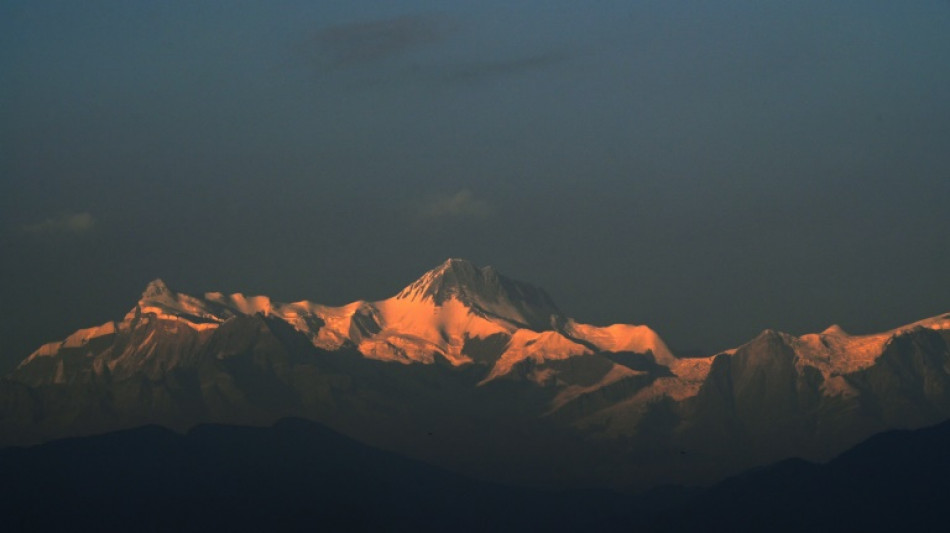
Nepal's top court bars infrastructure in protected areas / Photo: PRAKASH MATHEMA - AFP

 Kenya's economy faces climate change risks: World Bank

 Apple tops estimates in CEO Cook's final quarter, but shares fall

 Milei demands expulsion of foreigners expressing 'hate' against Argentina

 Italy's Po River valley on drought alert

 Prada profits pinched as growth hard to chase

 Stocks climb on earnings and rates, oil retreats

 US economic growth slows in second quarter, missing expectations

 Russia adds Telegram founder Durov to 'terrorist' blacklist

 Stocks diverge on earnings, as oil steadies

 Eurozone economy grows despite Middle East war

 Singapore group will develop 'most promising' Ebola vaccine

 Shell profit surges as Mideast war fuels oil prices

 Car maker Stellantis says back in profit in second quarter

 Samsung quarterly operating profit up 1,800% on AI boom

 South Korean stocks bounce after rout, oil holds gains on Mideast woes

 South Korea's women web sleuths fight AI deepfake porn

 Anything but programmable: New cost-efficient EC-power-supply-series for the DIN rail by CAMTEC PS

 Meta misses profit expectations, sticks to massive AI spending

 Campari - king of the spritz - hopes to conquer American heartland

 Air France-KLM and Lufthansa bid for Portugal's TAP airline

 Profits soar at Airbus as it delivers more planes

 Rheinmetall shares surge after armsmaker reports record profit

 FIFA hit by furious backlash over plans to sell stake in competitions

 MEXC Integrates World-Check to Fortify Institutional Grade Compliance Architecture

 Spain returns wildfire evacuees as France braces for worsening weather

Nepal's Supreme Court has scrapped controversial laws allowing hydropower and hotel projects in protected nature reserves, a lawyer said Thursday, calling it a win for the Himalayan republic's conservationists.
A fifth of Nepal's lands are designated as protected areas.
But both hydropower projects and tourism are major earners, and the government passed laws last year to allow infrastructure projects in national parks, forests and other conservation areas, except in highly sensitive zones.
"The controversial decision was made with deception," environmental advocate Padam Bahadur Shrestha, one of the petitioners challenging the changes to the law, told AFP.
"It clearly shows how our government is working just to appease investors because it lacks farsightedness."
Shrestha said that the verdict, which was issued on Wednesday, offers "justice to preserve ecology and biodiversity".
Kathmandu has been praised worldwide for its efforts to protect wildlife, allowing it to bring several species back from the brink of local extinction, including tigers and rhinos.
Nepal's protected habitat laws have helped to triple its tiger population to 355 since 2010 and to increase one-horned rhinoceros from around 100 in the 1960s to 752 in 2021.
After decades of rampant logging, Nepal also nearly doubled its forest cover between 1992 and 2016.
"The laws should have never been passed," said Rampreet Yadav, former chief conservation officer of Chitwan National Park, Nepal's most important conservation area.
"If development projects are allowed in protected areas, it will destroy our nature, it will destroy the habitats of animals."
Nepal is eager to develop its hydropower industry after a dam-building spree in the past two decades that has given it an installed capacity of more than 2,600 megawatts.
It signed deals with India and Bangladesh last year to export thousands of megawatts of hydroelectricity.
Tourism is also a major earner for Nepal, which saw a million foreign visitors last year after a post-pandemic bounceback, with the government pumping investments into infrastructure including airports.
Y.Ponomarenko--CPN