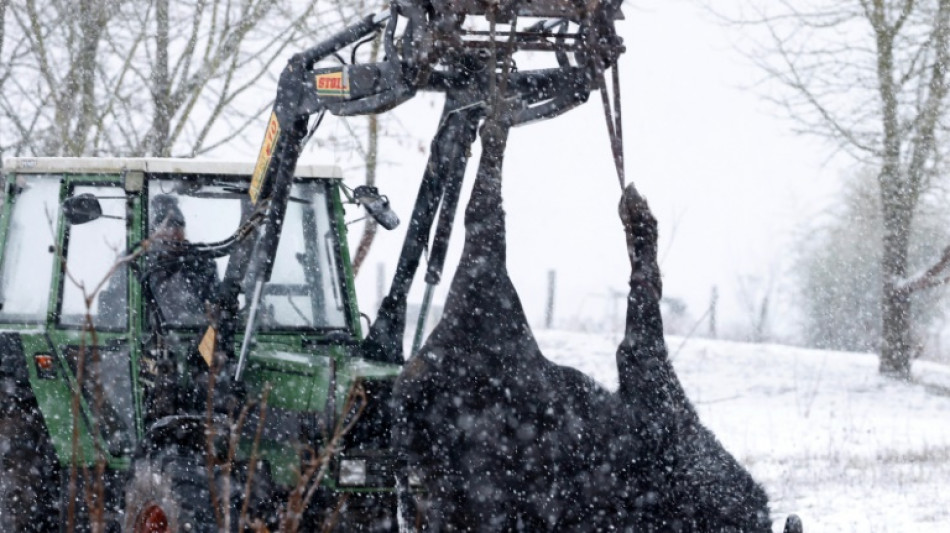
Germany reports foot-and-mouth disease in water buffalo / Photo: Odd ANDERSEN - AFP

 Kenya's economy faces climate change risks: World Bank

 Apple tops estimates in CEO Cook's final quarter, but shares fall

 Milei demands expulsion of foreigners expressing 'hate' against Argentina

 Italy's Po River valley on drought alert

 Prada profits pinched as growth hard to chase

 Stocks climb on earnings and rates, oil retreats

 US economic growth slows in second quarter, missing expectations

 Russia adds Telegram founder Durov to 'terrorist' blacklist

 Stocks diverge on earnings, as oil steadies

 Eurozone economy grows despite Middle East war

 Singapore group will develop 'most promising' Ebola vaccine

 Shell profit surges as Mideast war fuels oil prices

 Car maker Stellantis says back in profit in second quarter

 Samsung quarterly operating profit up 1,800% on AI boom

 South Korean stocks bounce after rout, oil holds gains on Mideast woes

 South Korea's women web sleuths fight AI deepfake porn

 Anything but programmable: New cost-efficient EC-power-supply-series for the DIN rail by CAMTEC PS

 Meta misses profit expectations, sticks to massive AI spending

 Campari - king of the spritz - hopes to conquer American heartland

 Air France-KLM and Lufthansa bid for Portugal's TAP airline

 Profits soar at Airbus as it delivers more planes

 Rheinmetall shares surge after armsmaker reports record profit
 FIFA hit by furious backlash over plans to sell stake in competitions

 MEXC Integrates World-Check to Fortify Institutional Grade Compliance Architecture
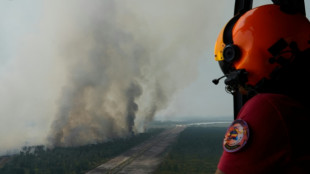 Spain returns wildfire evacuees as France braces for worsening weather

Germany on Friday registered three cases of foot-and-mouth disease in water buffalo on a farm near Berlin, the country's first reported cases of the livestock disease since 1988.
Foot-and-mouth disease is a highly contagious viral infection that is not dangerous to humans but which affects cattle and other cloven-hoofed animals, including sheep and pigs.
Symptoms include fever and blisters in the mouth and near the hoof.
The cases in the eastern state of Brandenburg, which surrounds Berlin, were confirmed by the federal government's Institute for Animal Health.
The outbreak affected a group of 14 animals, three of which had died, Brandenburg's environment ministry said.
The local district had ordered the rest of the herd to be culled to contain the potential spread of the virus, the ministry said.
Food and agriculture ministry spokesman Michael Hauck said it was Germany's first outbreak since 1988.
"Exclusion zones three kilometres (about two miles) wide and surveillance zones 10 kilometres wide have been set up," Hauck told a regular government press conference.
- Crisis meeting -
Following the confirmation of the outbreak, federal Agriculture Minister Cem Ozdemir convened a crisis committee meeting with state officials for Tuesday to discuss their response.
"Now it is a matter of finding out as quickly as possible which route the virus took" to reach Germany, Ozdemir said in a statement.
It was currently not possible to say whether other livestock had been infected with the virus, his ministry said.
The state of Brandenburg prohibited the movement of "transport of cattle, pigs, sheep, goats and camelids" for 72 hours while checks were carried out.
The transport ban would also apply to "carcasses or parts of these animals and manure", the ministry said, with the order coming into force on Saturday.
In previous outbreaks in Europe, more than 2,000 animals were culled to control the disease in the UK after an outbreak in 2007, according to the British government.
In 2011, hundreds were culled in Bulgaria after an outbreak there.
Water buffalo have been in Germany since the 1990s, according to the Berlin state government, farmed for their milk and meat and used to control grass growth on fields.
D.Avraham--CPN