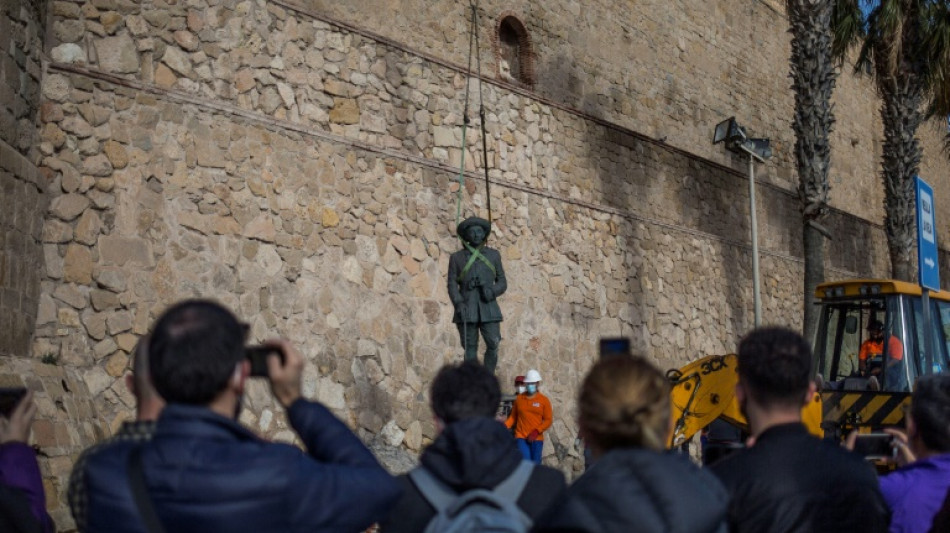
Franco dictatorship splits Spain 50 years after death / Photo: Javier BERNARDO - Regional Government of Melilla/AFP/File

 Kenya's economy faces climate change risks: World Bank

 Apple tops estimates in CEO Cook's final quarter, but shares fall

 Milei demands expulsion of foreigners expressing 'hate' against Argentina

 Italy's Po River valley on drought alert

 Prada profits pinched as growth hard to chase

 Stocks climb on earnings and rates, oil retreats

 US economic growth slows in second quarter, missing expectations

 Russia adds Telegram founder Durov to 'terrorist' blacklist

 Stocks diverge on earnings, as oil steadies

 Eurozone economy grows despite Middle East war

 Singapore group will develop 'most promising' Ebola vaccine

 Shell profit surges as Mideast war fuels oil prices

 Car maker Stellantis says back in profit in second quarter

 Samsung quarterly operating profit up 1,800% on AI boom

 South Korean stocks bounce after rout, oil holds gains on Mideast woes

 South Korea's women web sleuths fight AI deepfake porn

 Anything but programmable: New cost-efficient EC-power-supply-series for the DIN rail by CAMTEC PS

 Meta misses profit expectations, sticks to massive AI spending

 Campari - king of the spritz - hopes to conquer American heartland

 Air France-KLM and Lufthansa bid for Portugal's TAP airline

 Profits soar at Airbus as it delivers more planes

 Rheinmetall shares surge after armsmaker reports record profit
 FIFA hit by furious backlash over plans to sell stake in competitions

 MEXC Integrates World-Check to Fortify Institutional Grade Compliance Architecture
 Spain returns wildfire evacuees as France braces for worsening weather
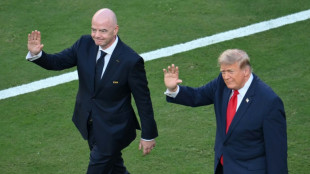
Spain's conservative opposition will boycott the start of official commemorations marking the 50th anniversary of right-wing dictator Francisco Franco's death, laying bare the enduring divisiveness of his legacy.
The general overthrew a democratic republic in a brutal civil war that killed hundreds of thousands and ruled with an iron fist from 1939 until his death in 1975.
Socialist Prime Minister Pedro Sanchez has announced around 100 events in 2025 to "showcase the great transformation achieved" in the half-century since the European country initiated its democratic transition.
Madrid's Reina Sofia art museum -- home to Pablo Picasso's "Guernica" painting, one of the most famous anti-Franco works -- will host the first ceremony on Wednesday.
Sanchez will lead it but neither King Felipe VI nor the leader of the main conservative Popular Party (PP), Alberto Nunez Feijoo, will attend.
Feijoo believes the initiative is an opportunistic ploy by the minority leftist government to distract attention from its political and legal woes.
Corruption investigations are ongoing against Sanchez's wife and political allies, while the Socialists have to negotiate painstakingly with an array of fringe and separatist parties to pass legislation.
The commemorations planned in schools, universities, museums and streets are the work of a government which "in its desperation constantly looks to the past", Feijoo said.
The Socialists have retorted by pointing to the origins of the PP, born in 1989 as the successor to the Popular Alliance, founded in 1976 by a former Franco minister.
- Victims disappointed -
Far-right Vox, the third-largest force in parliament, will also snub the programme.
One of its MPs recently said in parliament that Franco's rule "was not a period of darkness, as this government makes out, rather a stage of reconstruction, progress and reconciliation".
At the other end of the political spectrum, the hard-left Podemos has called the commemorations a "facade" to cover up the scant compensation for the dictatorship's victims.
Sanchez passed a "democratic memory" law in 2022 aiming to revive their memory, including the creation of a register of victims and the removal of Francoist symbols.
But the law has not tried or convicted any ex-Franco officials accused of crimes and who remain alive as they benefit from an amnesty approved during the transition, to the disappointment of survivors.
The polarising memory of the 1936-1939 civil war and Franco stems from the regime's tame demise, according to Joan Maria Thomas, professor of contemporary history at the University of Rovira i Virgili.
An ailing 82-year-old Franco passed away peacefully in hospital, in contrast with the spectacular collapse of Nazi Germany and fascist Italy during World War II or the Carnation Revolution that overthrew Portugal's right-wing dictatorship in 1974.
Democratic elections followed in 1977 and newly enfranchised Spaniards approved a new constitution in a referendum the following year, now celebrated with a public holiday on December 6.
- 'Positive' step -
In Spain, "there was a big agreement... to look forwards" without revisiting the injustices of the past, Thomas told AFP.
Remembering Franco's death was "positive" because today's Spain "does not keep in mind the importance of recovering a democratic system in 1977 and being able to consolidate it", he said.
But "we cannot avoid... a memory of the part of the country that was pro-Franco, which was a very considerable part," he added.
Fascist and conservative Catholic elements were among his supporters and loyalists once venerated Franco with masses and visits to the Valley of the Fallen, a gigantic mausoleum near Madrid that housed his tomb.
A previous Sanchez government took the historic step to remove Franco's remains in 2019 and renamed the valley, seen as a triumphalist monument to his cause.
In a 2018 survey by pollster Sigma Dos for the conservative El Mundo daily, the plan won only slightly more support than disapproval.
P.Gonzales--CPN