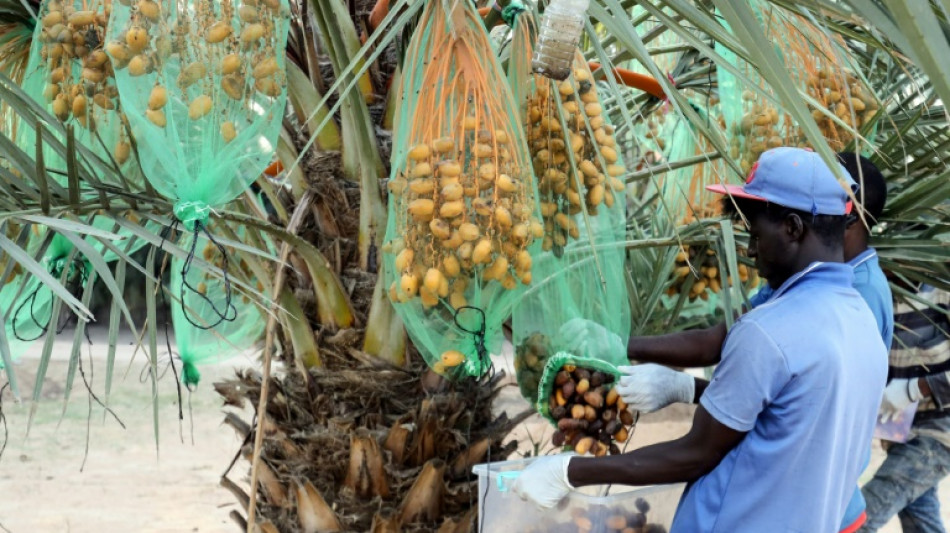
Libya farmer breaks new ground with outlier date variety / Photo: Mahmud Turkia - AFP

 Kenya's economy faces climate change risks: World Bank

 Amazon beats expectations with cloud and AI growth

 Blowout Microsoft results lift US stocks as oil retreats

 'Beginning of the end': Relief but no party as French wildfire winds down

 Southern Europe 'becoming more flammable' in hotter climate, experts say

 Mammoth bones found on parched bed of Danube in Bulgaria

 MEXC Lists Grvt (GRVT) with $60,000 Worth of GRVT and 10,000 USDT in Airdrop+ Rewards

 George and Amal Clooney flee French home due to wildfire

 MEXC Ventures Supports Alpha Arena's APAC Debut at Coinfest Bali

 AI data centre supplier Zhongji InnoLight slips on Hong Kong debut

 May, June heatwaves caused 2,877 extra deaths in England: govt

 BMW profit down a third as carmaker plans job cuts

 Seoul extends losses as most Asian markets drop, oil rises again

 Gambling.com Group Is Now Grandstand

 Meet the astronomer digging into the Milky Way's 'fossils'

 AI data centre supplier Zhongji InnoLight falls on Hong Kong debut

 Samsung operating profit up 1,800% in second quarter on AI boom

 Japanese population below 120 million for first time in decades

 US actor Jared Leto denies latest accusations of sexual assault
 Danube drops to 'historic lows' as fresh heatwave hits
 BTS pulls out of Grammys after Asian pop category introduction

 OpenAI says rogue AI agent attack hit other companies

 How an AFP beach snap became emblem of Europe's wildfire summer

 TRX Spot and Perpetuals Listing Launches on Backpack, Expanding Access to the TRON Ecosystem

 Nepal's tiger numbers climb 20 percent to estimated 429: survey

In the Libyan countryside, farmer Ismail Ben Saoud has launched an agricultural experiment, banking on Mejhoul dates -- a premium variety cherished across the Arab world but untested in such a humid coastal climate.
Ben Saoud's five-hectare (12-acre) farm in Misrata, western Libya, stands out in the landscape that is dotted by olive and citrus trees.
Eight years after taking the leap, he says his 700 palm trees now produce high-quality Mejhoul dates which he hopes will reach international markets soon.
"People have claimed that these palms couldn't survive here, especially near the sea," said Ben Saoud, 42.
"But with persistence and careful experimentation, we are proving them wrong."
Mejhoul dates, native to Morocco's semi-arid regions, are famed for their large size, tender texture and rich sweetness.
Traditionally thought unsuitable for Mediterranean climates, the variety has exceeded Ben Saoud's expectations.
Using organic fertilisers and refining techniques over time, Ben Saoud now anticipates reaching full production capacity in just two years.
"The harvest has been very satisfactory," he said about this year's output.
"Another year or two and it will be optimal. We improve from year to year."
For Libyans and others across the Arab world, dates are a treasured food.
A staple sweet during festivities, they hold cultural as well as religious value, traditionally eaten to break the daily fast during the Muslim month of Ramadan.
Mejhoul dates go for up to 80 Libyan dinars (around $16) per kilogramme in local markets, far more than the price tag attached to other varieties, as low as six and up to 20 dinar.
But for many customers, Mejhoul prices match their quality, with an unwavering demand among Libyans preferring locally produced goods.
- 'Growing interest' -
The country has faced a host of woes since a 2011 NATO-backed uprising overthrew and killed longtime dictator Moamer Kadhafi, plunging Libya into instability and conflict.
Even before that, decades of near-exclusive reliance on oil revenue left many of Libya's sectors underdeveloped.
But many have been striving to bring around Libyan agriculture.
In Misrata, a major port city and commercial hub about 200 kilometres (120 miles) from the capital Tripoli, supermarkets are stocked with a variety of date products.
They run the gamut from molasses and pastes used in traditional pastries like makroudhs, to novel concoctions such as stuffed dates smothered in chocolate.
"The quality of Libyan dates has improved noticeably since the 2011 war," said Najwa, an Egyptian nurse on vacation, shopping for her favourite varieties.
"There's more care put into growing and preparing them now."
Salah Shagan, a Libyan agriculture expert, said that "more Libyans are turning to farming in recent years", with a "growing interest" in olives, vegetables and dates.
"These efforts not only bring income, but also revive our connection to the land."
Libya now has over 10 million date palms, producing more than 50,000 tonnes of fruit annually, according to the agriculture ministry.
Much of this production satisfies local demand, but farmers also aim to make it to international markets.
For Ben Saoud, exporting Mejhoul is his next major bet.
"Our local demand is already strong, so we must ensure we can meet that before expanding further," he said, walking through his orchard with his two young daughters, their mouths full of fresh dates.
M.P.Jacobs--CPN