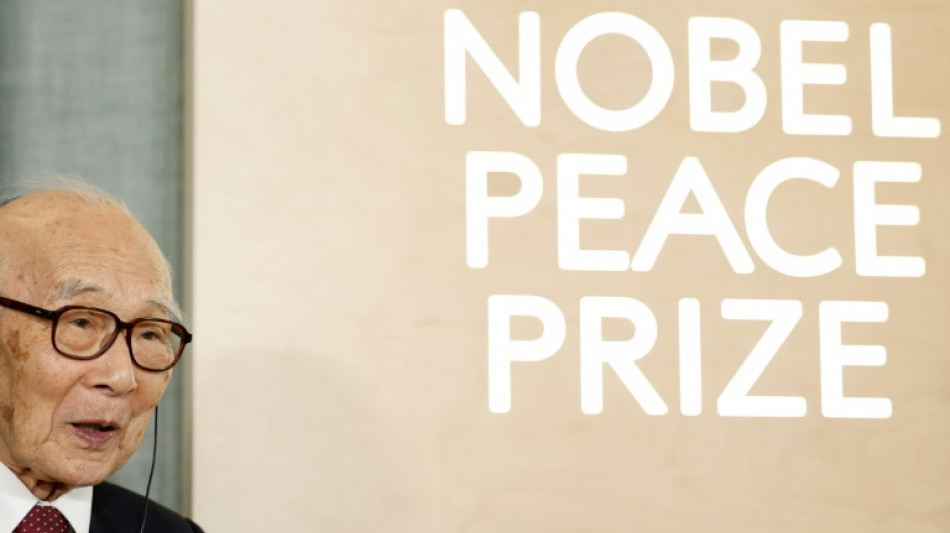
Nobel laureate warns Putin about danger of nuclear weapons / Photo: Odd ANDERSEN - AFP

 Kenya's economy faces climate change risks: World Bank
 Amazon beats expectations with cloud and AI growth

 Blowout Microsoft results lift US stocks as oil retreats

 'Beginning of the end': Relief but no party as French wildfire winds down

 Southern Europe 'becoming more flammable' in hotter climate, experts say

 Mammoth bones found on parched bed of Danube in Bulgaria

 MEXC Lists Grvt (GRVT) with $60,000 Worth of GRVT and 10,000 USDT in Airdrop+ Rewards
 George and Amal Clooney flee French home due to wildfire

 MEXC Ventures Supports Alpha Arena's APAC Debut at Coinfest Bali
 AI data centre supplier Zhongji InnoLight slips on Hong Kong debut

 May, June heatwaves caused 2,877 extra deaths in England: govt
 BMW profit down a third as carmaker plans job cuts

 Seoul extends losses as most Asian markets drop, oil rises again

 Gambling.com Group Is Now Grandstand
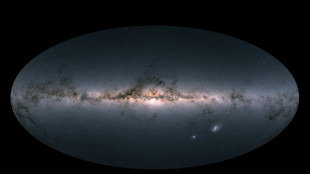 Meet the astronomer digging into the Milky Way's 'fossils'
 AI data centre supplier Zhongji InnoLight falls on Hong Kong debut

 Samsung operating profit up 1,800% in second quarter on AI boom

 Japanese population below 120 million for first time in decades

 US actor Jared Leto denies latest accusations of sexual assault

 Danube drops to 'historic lows' as fresh heatwave hits
 BTS pulls out of Grammys after Asian pop category introduction
 OpenAI says rogue AI agent attack hit other companies
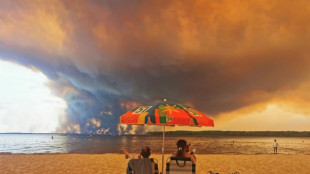 How an AFP beach snap became emblem of Europe's wildfire summer

 TRX Spot and Perpetuals Listing Launches on Backpack, Expanding Access to the TRON Ecosystem

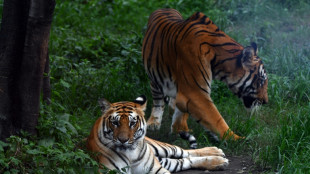 Nepal's tiger numbers climb 20 percent to estimated 429: survey
This year's Nobel Peace Prize laureate, Japan's atomic bomb survivors' group Nihon Hidankyo, on Monday urged Russia to stop issuing nuclear threats in a bid to prevail in its war in Ukraine.
"President Putin, I don't think he truly understands what nuclear weapons are for human beings," said Terumi Tanaka, the 92-year-old co-chair of Nihon Hidankyo and a survivor of the 1945 atomic bombing of Nagasaki.
"I don't think he has even thought about this," Tanaka told a press conference in Oslo a day before he was due to accept the 2024 Nobel Peace Prize, with two other co-chairs, at a formal ceremony in Oslo on behalf of Nihon Hidankyo.
Putin began making nuclear threats shortly after Russia's full-scale invasion of Ukraine in February 2022, and signed a decree in late November lowering the threshold for using atomic weapons.
Russian Foreign Minister Sergei Lavrov reiterated Thursday that Moscow was ready to use "any means" to defend itself.
On November 21, Moscow fired its new Oreshnik hypersonic missile on the Ukrainian city of Dnipro in an escalation of the almost three-year war.
The missile is designed to be equipped with a nuclear warhead, but was not in this case.
"Mr Putin... we would like to say that nuclear weapons are things which must never be used. The use of nuclear weapons is something which would be against humanity," Tanaka said.
Nihon Hidankyo, a grassroots anti-nuclear organisation, was established in 1956 and is the only nationwide organisation of atomic bomb survivors, who are known as hibakusha.
Around 140,000 people were killed in Hiroshima when the United States detonated an atomic bomb over the Japanese city on August 6, 1945.
A further 74,000 were killed by a US nuclear bomb in Nagasaki three days later.
Survivors suffered from radiation sickness and longer-term effects, including elevated risks of cancer.
The bombings were the only times nuclear weapons have been used in history.
Tanaka, who was 13 and living in Nagasaki when the bomb was dropped, said Nihon Hidankyo was not seeking "monetary compensation" from Washington.
"What we would like to see from the United States is for them to abolish their nuclear weapons," he said.
The organisation's ranks are dwindling with every passing year. The Japanese government lists around 106,800 "hibakusha" still alive today. Their average age is 85.
- Nuclear taboo -
The three co-chairs of Nihon Hidankyo formally receive their prestigious prize at Oslo's City Hall on Tuesday.
"Our message to Putin and also to other nuclear power states is, 'Listen to the testimonies of the hibakusha'," said the chairman of the Norwegian Nobel Committee, Jorgen Watne Frydnes.
"It is crucial for humanity to uphold the nuclear taboo, to stigmatise these weapons as morally unacceptable," he said.
"And to threaten with them is one way of reducing the significance of the taboo, and it should not be done," he added.
"And of course, to use them should never be done ever again by any nation on Earth."
Nine countries now have nuclear weapons: Britain, China, France, India, North Korea, Pakistan, Russia, the United States, and, unofficially, Israel.
As global geopolitical tensions rise, these nuclear powers have modernised their arsenals, the Stockholm International Peace Research Institute (SIPRI) said in a report in June.
In January, of the estimated 12,121 nuclear warheads around the world, about 9,585 were in stockpiles for potential use, according to SIPRI.
In 2017, 122 governments negotiated and adopted the historic UN Treaty on the Prohibition of Nuclear Weapons (TPNW), but the text is considered largely symbolic as no nuclear power has signed it.
"Of course, the nuclear weapon states will resist this," Tanaka said, urging citizens in these countries "to show them that their resistance is wrong".
"We want to create a world that is free from both nuclear weapons and from war."
M.Mendoza--CPN