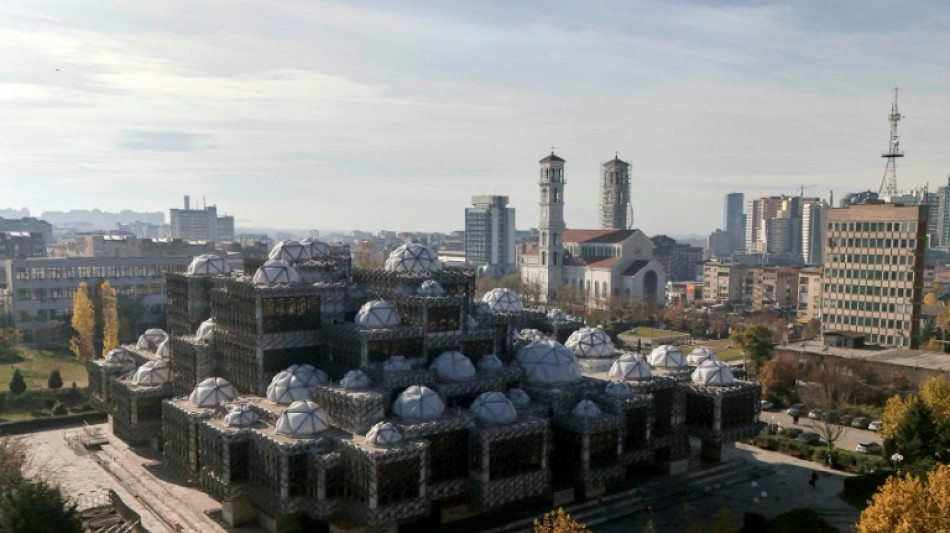
Ugly or awesome? Kosovo national library stirs never-ending debate / Photo: Kushtrim Kadriu - AFP

 Kenya's economy faces climate change risks: World Bank

 Amazon beats expectations with cloud and AI growth

 Blowout Microsoft results lift US stocks as oil retreats

 'Beginning of the end': Relief but no party as French wildfire winds down

 Southern Europe 'becoming more flammable' in hotter climate, experts say

 Mammoth bones found on parched bed of Danube in Bulgaria

 MEXC Lists Grvt (GRVT) with $60,000 Worth of GRVT and 10,000 USDT in Airdrop+ Rewards

 George and Amal Clooney flee French home due to wildfire

 MEXC Ventures Supports Alpha Arena's APAC Debut at Coinfest Bali

 AI data centre supplier Zhongji InnoLight slips on Hong Kong debut

 May, June heatwaves caused 2,877 extra deaths in England: govt

 BMW profit down a third as carmaker plans job cuts

 Seoul extends losses as most Asian markets drop, oil rises again

 Gambling.com Group Is Now Grandstand

 Meet the astronomer digging into the Milky Way's 'fossils'

 AI data centre supplier Zhongji InnoLight falls on Hong Kong debut

 Samsung operating profit up 1,800% in second quarter on AI boom

 Japanese population below 120 million for first time in decades

 US actor Jared Leto denies latest accusations of sexual assault

 Danube drops to 'historic lows' as fresh heatwave hits

 BTS pulls out of Grammys after Asian pop category introduction

 OpenAI says rogue AI agent attack hit other companies

 How an AFP beach snap became emblem of Europe's wildfire summer

 TRX Spot and Perpetuals Listing Launches on Backpack, Expanding Access to the TRON Ecosystem

 Nepal's tiger numbers climb 20 percent to estimated 429: survey

Smack in the middle of Kosovo's capital Pristina, the national library is all but impossible to miss.
To some it is an architectural wonder, with its bubble domes and shimmering steel lattice.
"It's the cherry on the cake of Pristina, and of Kosovo," declared local tourist guide Muamer Hasani.
Whenever you "search for something about Pristina, the first photo that comes up is of the national library," he added.
But for others, the building is an abomination.
"It's so ugly that it blinds you," said a middle-aged Pristina resident who asked not to be named.
"We've been living with it for decades and it hasn't been renovated yet. It's annoying, but what can we do?"
Opened in 1982, the library has witnessed Kosovo's occasional highs and bitter lows -- from the breakup of Yugoslavia to the bloody war with Serbia in the late 1990s, independence and all the turbulent history since.
- 'Iconic object' -
Its 74 translucent domes were designed to provide natural lighting for the reading rooms below. The grid of steel covering its brutalist exterior deflects sunlight, cooling the building and protecting the books inside.
Croatian architect Andrija Mutnjakovic, who oversaw the design, said he was trying to reflect Kosovo's diverse culture and history.
"Like any architect, I am in love with my building. I am glad to see that 40 years after its construction, it is as beautifully preserved as if it opened yesterday," Mutnjakovic told AFP.
He has little time for those who criticise it.
The library's director Blerina Rogova Gaxha agrees.
"It is an iconic object of Kosovar culture, giving Pristina itself identity because it is the main object in the capital that catches the eye," Rogova Gaxha told AFP.
Its design pays homage to the ancient cultures that had once ruled Kosovo, she said -- Romans, Byzantines, Ottomans and Illyrians.
- 'Gelatinous eggs' -
But for newcomers to the Kosovo capital, the cultural references and architectural brilliance are not always apparent at first, or even second, glance.
The Lonely Planet travel guide called the library "easily one of Pristina's most notable buildings".
"Think gelatinous eggs wearing armour," it added.
"The building looks quite strange. It is brutalist architecture but interesting," said Julie, a student from Warsaw, who was photographing the library from several angles.
"Maybe it is not the prettiest because it has a lot of concrete and is grey from the outside," said Paula Gers, a student visiting from Germany.
"I wouldn't rank it among the ugliest. I've seen much worse."
For the library's director, the ongoing debate over its aesthetics is a blessing in disguise.
"There are not as many readers as there used to be, but there are an extraordinary number of local and foreign visitors," Gaxha said.
Everyone wants to come and have a look for themselves, she said, trying to work out "why is it considered the ugliest", wanting to see it from the inside as well as from outside.
D.Avraham--CPN