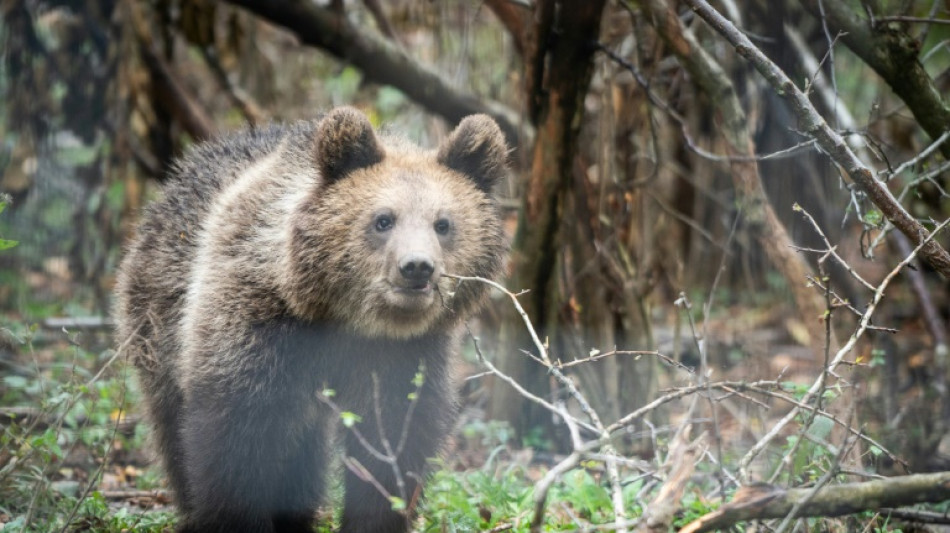
Romania sanctuary seeks to save bears as hunting resumes / Photo: Mihai Barbu - AFP

 Kenya's economy faces climate change risks: World Bank

 Amazon beats expectations with cloud and AI growth

 Blowout Microsoft results lift US stocks as oil retreats

 'Beginning of the end': Relief but no party as French wildfire winds down

 Southern Europe 'becoming more flammable' in hotter climate, experts say

 Mammoth bones found on parched bed of Danube in Bulgaria

 MEXC Lists Grvt (GRVT) with $60,000 Worth of GRVT and 10,000 USDT in Airdrop+ Rewards

 George and Amal Clooney flee French home due to wildfire

 MEXC Ventures Supports Alpha Arena's APAC Debut at Coinfest Bali

 AI data centre supplier Zhongji InnoLight slips on Hong Kong debut

 May, June heatwaves caused 2,877 extra deaths in England: govt

 BMW profit down a third as carmaker plans job cuts

 Seoul extends losses as most Asian markets drop, oil rises again

 Gambling.com Group Is Now Grandstand

 Meet the astronomer digging into the Milky Way's 'fossils'

 AI data centre supplier Zhongji InnoLight falls on Hong Kong debut

 Samsung operating profit up 1,800% in second quarter on AI boom

 Japanese population below 120 million for first time in decades

 US actor Jared Leto denies latest accusations of sexual assault

 Danube drops to 'historic lows' as fresh heatwave hits

 BTS pulls out of Grammys after Asian pop category introduction

 OpenAI says rogue AI agent attack hit other companies

 How an AFP beach snap became emblem of Europe's wildfire summer

 TRX Spot and Perpetuals Listing Launches on Backpack, Expanding Access to the TRON Ecosystem

 Nepal's tiger numbers climb 20 percent to estimated 429: survey
At a bear sanctuary in the heart of Romania's Carpathians, several cubs believed to have been orphaned have just arrived.
The centre fears more will need shelter now the country has authorised the hunting of this protected species, effectively overturning a ban in place since 2016.
"They come from the forest where their mother was killed," says Florin Ticusan of the Libearty bear sanctuary.
Ticusan and his team care for 128 brown bears at the sanctuary, which says it is the biggest such refuge in the world.
Bears are officially protected in Romania, which the government estimates has 8,000 of them -- the largest population in Europe outside Russia.
But now the European Union country is allowing 481 of the protected animals to be killed this year.
The government argues the bear population is too large and attacks have been increasing.
There was a hunting quota of 220 last year and 140 the year before, but in those instances, the permits came with tight restrictions.
- 'We take everything from them' -
Animal welfare and environment activists have voiced alarm about the soaring quotas.
They say conflicts between people and bears is fuelled by human behaviour but there is a lack of political will to tackle that touchy subject.
Bears are being pushed out of the forest, their natural habitat, because of deforestation and a shortage of their natural food, said sanctuary founder Cristina Lapis.
Romania is a major exporter of the forest berries and mushrooms the animals would usually eat.
"Everything is taken from them and then we wonder why they come down to the city," she said of the bears.
The 69-hectare (170-acre) Libearty centre -- a play on the words "liberty" and "bear" -- opened in Zarnesti in 2005.
With the help of former French film star-turned-animal-rights activist Brigitte Bardot, Lapis and her husband started out rescuing bears kept cooped up in cages, sometimes tiny, to attract customers to petrol stations, restaurants or circuses.
It was impossible to return them to the wild after being kept in captivity and many remain at the sanctuary, often still neurotically pacing in circles near the fences rather than roaming the forest stretching out behind them.
The refuge -- which welcomes 30,000 visitors a year, including school classes -- also takes in bears rescued from zoos in neighbouring war-torn Ukraine, from Albania and Armenia and even from as far afield as the United States.
The centre seeks to educate its visitors about bears' needs and natural behaviour.
They learn, for example, not to entice the animals out of the forests by offering them sandwiches in order to get a few souvenir photos.
This has become a frequent problem on the spectacular Transfagarasan mountain route, where it is not uncommon to come across bears that have become dependent on the unsuitable, easily accessible human food.
"Bears have fundamentally changed their behaviour over the last few years and begging on the road has become their main food source," Environment Minister Mircea Fechet said recently.
Fechet argued the bears posed "an imminent danger to tourists" who approach them and suggested they should be transferred to refuges like Libearty.
The sanctuary believes there are more appropriate solutions to managing the bear population than simply removing them from the wild.
These include putting rubbish bins out of the bears' reach, installing electric fences where required and educating people about how to live together with the animals.
- 8,000 euros per bear -
While it is too early to measure the impact that resuming hunting will have, Lapis is worried it will lead to even more orphaned bears being brought to her centre, which is already struggling to find funds to feed all its residents.
"We don't intend to take in all the bears" still in the wild, she explained.
She said the sanctuary won't place rehabilitated bears back in the forest because the recent culling law meant they just risked becoming "cannon fodder".
Spain's former king Juan Carlos used to come bear hunting in Romania before it was banned.
But recently, AFP found all-inclusive packages for two days' hunting advertised on the Internet.
Ioan Banucu, the head of a company which organises "hunting and shooting holidays in the Romanian wilderness", said he organised expeditions for foreign hunters.
Five bears had been shot dead since October, he said.
"People got excited" about bear hunting, he told AFP.
"But some customers have reservations," he acknowledged without elaborating, adding that interest for other species, like wild boars, was greater.
Bear hunting does not come cheap. It costs up to 8,000 euros ($8,500) per bear, depending on the size.
T.Morelli--CPN