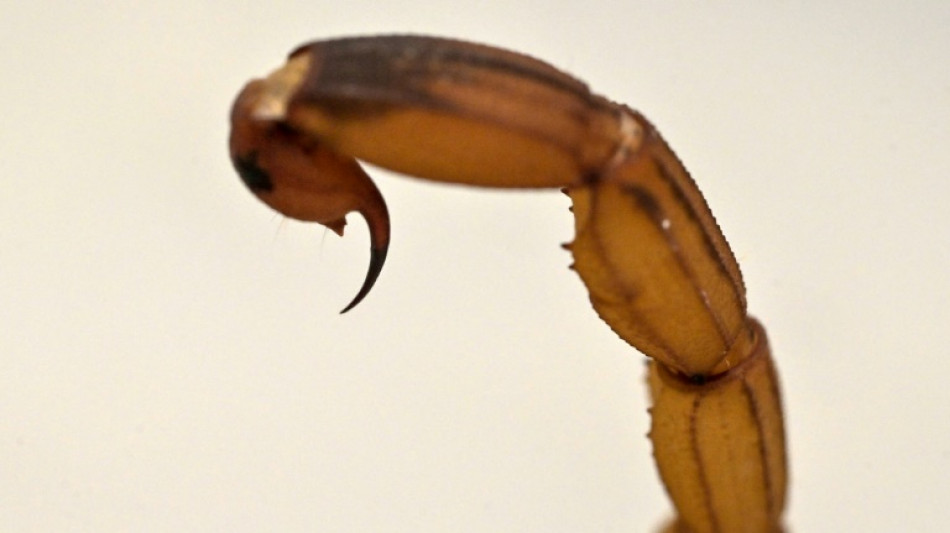
Thriving scorpion population is stinging problem for Brazil / Photo: Nelson ALMEIDA - AFP

 Kenya's economy faces climate change risks: World Bank

 Anthropic's models gained unauthorized 'real-world' access during testing

 Apple tops estimates in CEO Cook's final quarter, but shares fall

 Milei demands expulsion of foreigners expressing 'hate' against Argentina

 Italy's Po River valley on drought alert

 Prada profits pinched as growth hard to chase

 Stocks climb on earnings and rates, oil retreats

 US economic growth slows in second quarter, missing expectations

 Russia adds Telegram founder Durov to 'terrorist' blacklist

 Stocks diverge on earnings, as oil steadies

 Eurozone economy grows despite Middle East war

 Singapore group will develop 'most promising' Ebola vaccine

 Shell profit surges as Mideast war fuels oil prices

 Car maker Stellantis says back in profit in second quarter

 Samsung quarterly operating profit up 1,800% on AI boom

 South Korean stocks bounce after rout, oil holds gains on Mideast woes

 South Korea's women web sleuths fight AI deepfake porn

 Anything but programmable: New cost-efficient EC-power-supply-series for the DIN rail by CAMTEC PS

 Meta misses profit expectations, sticks to massive AI spending

 Campari - king of the spritz - hopes to conquer American heartland

 Air France-KLM and Lufthansa bid for Portugal's TAP airline

 Profits soar at Airbus as it delivers more planes

 Rheinmetall shares surge after armsmaker reports record profit

 FIFA hit by furious backlash over plans to sell stake in competitions

 MEXC Integrates World-Check to Fortify Institutional Grade Compliance Architecture

Forget snakes, it's scorpions Brazilians most need to worry about.
The arachnids -- feared for the toxic stinger poised atop their tails -- are proliferating thanks to urbanization and warming temperatures.
The result is that scorpions have become the most lethal poisonous animal in Brazil, posing a growing danger for people across the whole country -- and spurring demand for antivenom.
The most widely found species in the country, the Brazilian yellow scorpion, is the most dangerous scorpion in South America.
Unusually for scorpions, this all-female species also reproduces asexually, reducing population-control options.
"With a warming habitat, these animals' metabolisms are also warming, so they are more active, eating more and reproducing more," explained Thiago Chiariello, production coordinator of the scorpion antivenom lab at Brazil's Instituto Butantan in Sao Paulo.
Add to that rampant urbanization which both scares away scorpions' natural predators such as lizards and birds while boosting the number of available cockroaches -- tasty meals for the arachnids -- and the problem is evident.
"Cities are growing unchecked" and the spread of trash they bring means more food supply for scorpions, Chiariello said.
"This is leading to more contact with people, which means more accidents."
- Soaring sting numbers -
Last year -- the latest dataset available -- there were 152 deaths from scorpion stings in Brazil, compared with 140 from snakebites. That was an increase from 2019, when 95 deaths by scorpion sting were recorded.
According to Brazil's health ministry, there were more than 200,000 scorpion sting incidents registered last year -- 250 percent more than a decade earlier, and an average of nearly 550 stings per day.
Healthy adults might get mild to moderate symptoms from a Brazilian yellow scorpion sting, including pain, vomiting, profuse sweating and tremors.
But there are more severe symptoms -- including shock, fluid build-up in the lungs, cardiovascular collapse and heart failure -- that can prove deadly, especially for children and the elderly.
- Life-saving antivenom -
That makes the Butantan institute's antivenom very important.
Chiariello's team carry out their serum-making task in making that serum with extreme precision.
They first use tweezers to guide a live scorpion's stinger into a container.
The poison is then injected into horses, which are less vulnerable to the toxin's effects than humans, and which produce more antibodies.
"There is a whole purification process in the horses' blood," explained Paulo Goldoni, a biologist at the institute.
"The serum is the only way to save lives," he said.
Last year saw more than 11,000 people in Brazil receive scorpion antivenom, mostly in the country's heavily populated southeast, according to authorities.
With serum demand growing, but also the number of available scorpions, the Instituto Butantan has a steady supply of venom donors.
"If ever there was a lack of serum, we would certainly see a serious increase in the number of deaths," the biologist said.
A.Levy--CPN