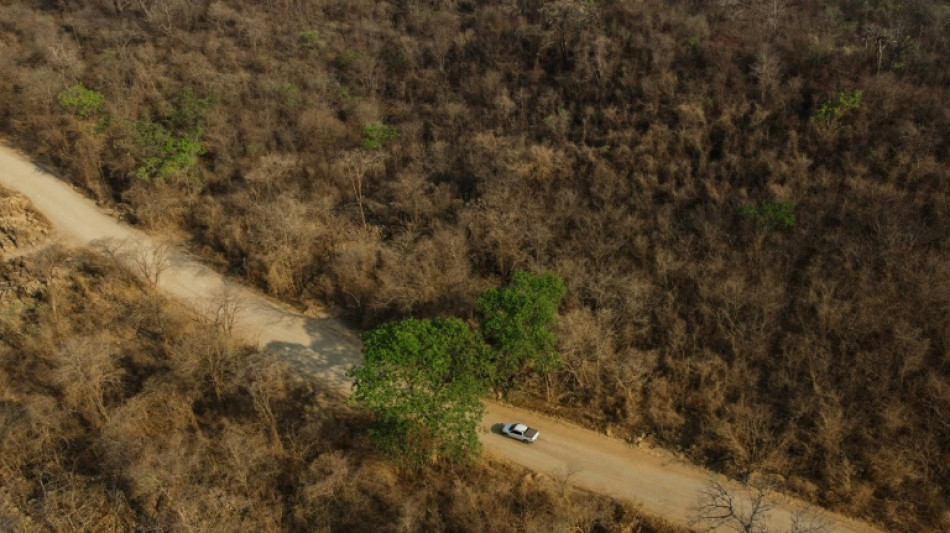
Green shoots spring from ashes in Brazil's fire-resistant savanna / Photo: Nelson ALMEIDA - AFP/File

 Kenya's economy faces climate change risks: World Bank
 Anthropic's models gained unauthorized 'real-world' access during testing

 Apple tops estimates in CEO Cook's final quarter, but shares fall

 Milei demands expulsion of foreigners expressing 'hate' against Argentina

 Italy's Po River valley on drought alert

 Prada profits pinched as growth hard to chase

 Stocks climb on earnings and rates, oil retreats

 US economic growth slows in second quarter, missing expectations

 Russia adds Telegram founder Durov to 'terrorist' blacklist

 Stocks diverge on earnings, as oil steadies

 Eurozone economy grows despite Middle East war

 Singapore group will develop 'most promising' Ebola vaccine

 Shell profit surges as Mideast war fuels oil prices

 Car maker Stellantis says back in profit in second quarter

 Samsung quarterly operating profit up 1,800% on AI boom

 South Korean stocks bounce after rout, oil holds gains on Mideast woes

 South Korea's women web sleuths fight AI deepfake porn

 Anything but programmable: New cost-efficient EC-power-supply-series for the DIN rail by CAMTEC PS

 Meta misses profit expectations, sticks to massive AI spending

 Campari - king of the spritz - hopes to conquer American heartland
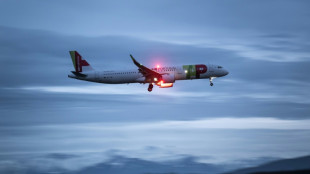 Air France-KLM and Lufthansa bid for Portugal's TAP airline

 Profits soar at Airbus as it delivers more planes

 Rheinmetall shares surge after armsmaker reports record profit
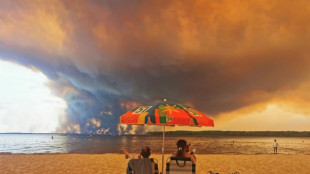
 FIFA hit by furious backlash over plans to sell stake in competitions

 MEXC Integrates World-Check to Fortify Institutional Grade Compliance Architecture
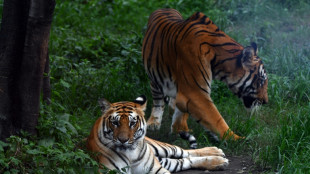
The huge wildfires that ripped through Brazil recently did not spare its vast tropical savanna, but green shoots are already emerging from the ashes there, proof of the vast grasslands' rare gift for fire resistance.
The Cerrado, the most species-rich savanna in the world, covers some two million square kilometers of land (770,000 square miles) in central Brazil -- nearly one-fifth of the country's entire surface area.
In Brasilia National Park, on the outskirts of the nation's capital, blackened soil and charred tree trunks stand testimony to the ferocity of a fire that ripped through 1,470 hectares (3,600 acres) of land in September.
Brazil was then in the throes of a record drought -- the city of Brasilia had gone 169 days without a drop of rain -- which lit the torch under the worst wildfire season in over a decade, blamed by experts at least partly on climate change.
But the Cerrado, which is less well-known than the neighboring Amazon and Pantanal wetlands, has a superpower: over millions of years, it has developed some resistance to flames and high temperatures.
- Upside-down forest -
"The Cerrado is an inverted forest. We see only a fraction of it because the forest is all under our feet," said Keiko Pellizzaro, an environmental analyst at the Chico Mendes Institute for Biodiversity Conservation, a government agency.
The Cerrado's deep root system acts like a "pump," sucking up groundwater "even during extreme drought," she said.
Meanwhile, above ground the trees' thick bark and the shells of the fruit act as "thermal insulators," said Isabel Schmidt, professor of ecology at the University of Brasilia.
Even if temperatures reach up to 800 centigrade (1,470 Fahrenheit), the vegetation can survive "as if it were just another hot day," she said.
A month after the recent fires, the first rains saw grass and small plants quickly beginning to grow, and new leaves sprouted on charred trees in Brasilia National Park.
"Even if it hadn't rained, we would have seen some resilience," Pellizzaro said.
"I'm amazed by its capacity for regeneration," said Priscila Erthal Risi, a 48-year-old volunteer who took part in an operation by the Chico Mendes Institute to replant the reserve with native species such as donkey's tail and Magonia pubescens trees.
- Tested to the limit -
Brazilian police are still investigating the cause of the fire in Brasilia National Park.
Most wildfires in Brazil are started by farmers or agribusiness workers to clear land for cattle grazing or crops.
Schmidt said the Cerrado's vegetation had always survived sporadic fires caused by lightning strikes during the rainy season.
But she warned that if extreme droughts become more frequent the biome's resilience could be tested.
"The resistance that plants and animals have to any type of fire was developed over millions of years, but climate change has taken place in a matter of decades. No organism can adapt that quickly," she said.
- 'Cradle of waters' at risk -
The Cerrado is crucial not only for the survival of the thousands of species that call it home but for the water supply of a large part of South America.
The so-called "cradle of waters" is home to the sources of some of the continent's biggest rivers and aquifers.
But its role as a continental spring is endangered.
With the rainy season starting later and later each year and the amount of rain declining by eight percent on average over the past three decades, the flow of the Cerrado's rivers has fallen by 15 percent.
If wildfires become more frequent, Schmidt warned, "many ecosystems that are more vulnerable to fire," including in the Cerrado, "will simply not survive."
S.F.Lacroix--CPN