Huge US lithium mine gets govt approval / Photo: Robyn Beck - AFP

 Kenya's economy faces climate change risks: World Bank
 Cables and cooling bring AI windfall to Indian suppliers

 Anthropic's models gained unauthorized 'real-world' access during testing

 Apple tops estimates in CEO Cook's final quarter, but shares fall

 Milei demands expulsion of foreigners expressing 'hate' against Argentina

 Italy's Po River valley on drought alert

 Prada profits pinched as growth hard to chase

 Stocks climb on earnings and rates, oil retreats

 US economic growth slows in second quarter, missing expectations

 Russia adds Telegram founder Durov to 'terrorist' blacklist

 Stocks diverge on earnings, as oil steadies

 Eurozone economy grows despite Middle East war

 Singapore group will develop 'most promising' Ebola vaccine

 Shell profit surges as Mideast war fuels oil prices

 Car maker Stellantis says back in profit in second quarter

 Samsung quarterly operating profit up 1,800% on AI boom

 South Korean stocks bounce after rout, oil holds gains on Mideast woes

 South Korea's women web sleuths fight AI deepfake porn

 Anything but programmable: New cost-efficient EC-power-supply-series for the DIN rail by CAMTEC PS

 Meta misses profit expectations, sticks to massive AI spending

 Campari - king of the spritz - hopes to conquer American heartland

 Air France-KLM and Lufthansa bid for Portugal's TAP airline

 Profits soar at Airbus as it delivers more planes

 Rheinmetall shares surge after armsmaker reports record profit

 FIFA hit by furious backlash over plans to sell stake in competitions

An enormous lithium mine in the Nevada desert was granted final government approval Thursday in a project the miner predicts will quadruple US production of a mineral critical to the renewable energy revolution.
Operations at Rhyolite Ridge will produce enough lithium to supply the batteries for more than 370,000 electric vehicles every year, Australian operator Ioneer said.
The plant will create 500 construction jobs over the next few years and 350 jobs during its decades of extraction, the company said.
"There are few deposits in the world as impactful as Rhyolite Ridge," said Ioneer Executive Chairman James Calaway, heralding the permit issued Thursday by the Bureau of Land Management.
The company's managing director, Bernard Rowe, said construction would begin next year.
"This permit gives us a license to commence construction in 2025 and begin our work in creating hundreds of good-paying rural jobs, generating millions in tax revenue for Esmeralda County, and bolstering the domestic production of critical minerals," he said.
The news comes less than two weeks before Americans go to the polls to elect a new president, and will be welcomed in Nevada, where unemployment is well above the national average.
The administration of President Joe Biden has made the green transition a key plank of its economic policy, investing heavily in technologies aimed at slashing the pollution that is causing the climate to change.
Scientists say electric vehicles are a vital link in that chain, and their widespread adoption in the car-dependent US will be vital if the country is to meet its carbon reduction targets.
Biden has tried to nudge the US auto industry to re-tool and shift production away from gas-guzzlers and into electric cars, in a move he says will help create jobs at home.
Subsidies for consumers have rewarded automakers who produce EVs in the United States, even while they struggle to source lithium batteries -- a sector dominated by strategic rival China.
But the project at Rhyolite Ridge has highlighted the trade-off between the need to adapt energy sources and the desire to protect the planet's biodiversity.
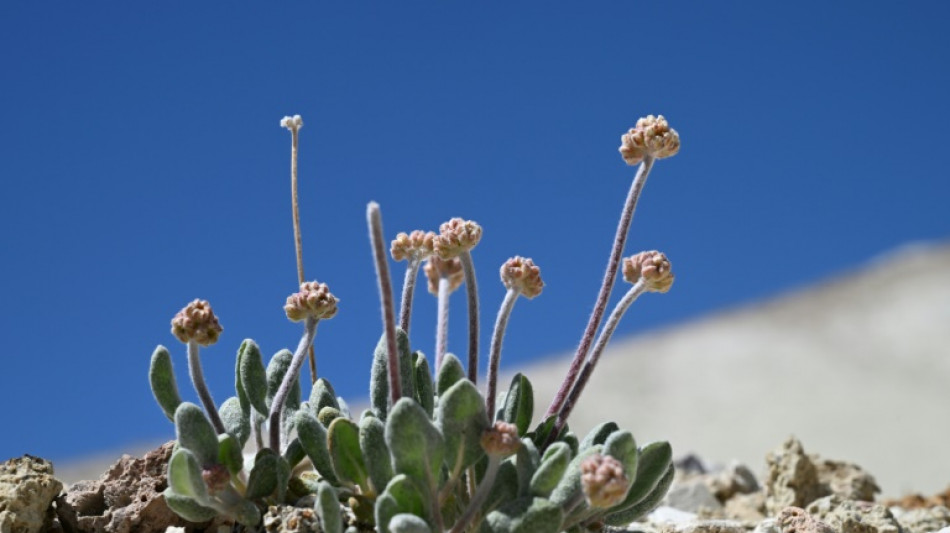
Campaigners say the mine will threaten the unique habitat of the endangered Tiehm's Buckwheat -- a rare wildflower with delicate cream-colored blossoms that grows only in this corner of Nevada.
"By greenlighting this mine the Bureau of Land Management is abandoning its duty to protect endangered species like Tiehm's Buckwheat and it's making a mockery of the Endangered Species Act," said Patrick Donnelly of the Center for Biological Diversity, a nonprofit conservation group.
"We need lithium for the energy transition, but it can't come with a price tag of extinction."
Ioneer admits that over the years the mine is in operation around a fifth of the flower's habitat will be directly affected.
But the company, which has spent $2.5 million researching the plant, says mining will not affect its survival, insisting their experiments show it is already growing well in greenhouses.
A.Agostinelli--CPN