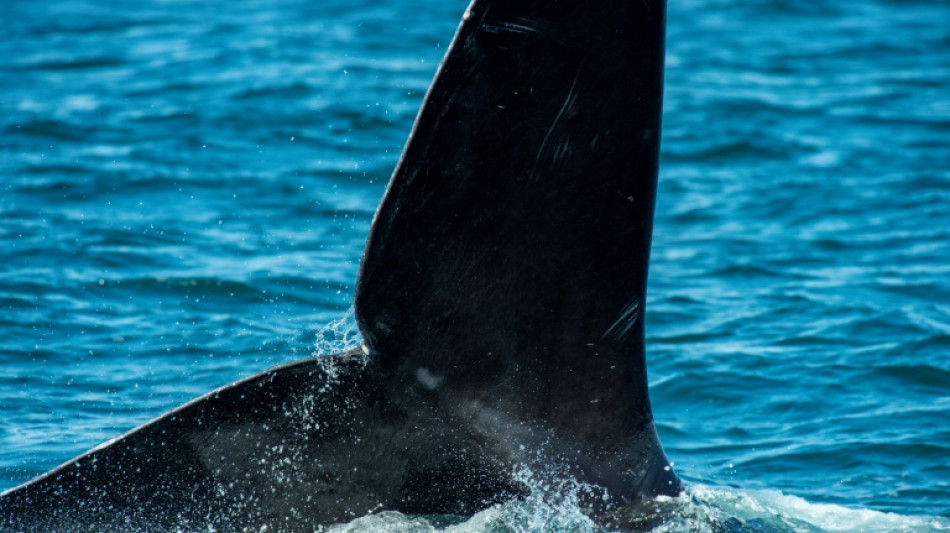
Critically endangered whale species rebounds slightly / Photo: Joseph Prezioso - AFP/File

 Kenya's economy faces climate change risks: World Bank

 Cables and cooling bring AI windfall to Indian suppliers

 Anthropic's models gained unauthorized 'real-world' access during testing

 Apple tops estimates in CEO Cook's final quarter, but shares fall

 Milei demands expulsion of foreigners expressing 'hate' against Argentina

 Italy's Po River valley on drought alert

 Prada profits pinched as growth hard to chase

 Stocks climb on earnings and rates, oil retreats

 US economic growth slows in second quarter, missing expectations

 Russia adds Telegram founder Durov to 'terrorist' blacklist

 Stocks diverge on earnings, as oil steadies

 Eurozone economy grows despite Middle East war

 Singapore group will develop 'most promising' Ebola vaccine

 Shell profit surges as Mideast war fuels oil prices

 Car maker Stellantis says back in profit in second quarter

 Samsung quarterly operating profit up 1,800% on AI boom

 South Korean stocks bounce after rout, oil holds gains on Mideast woes

 South Korea's women web sleuths fight AI deepfake porn

 Anything but programmable: New cost-efficient EC-power-supply-series for the DIN rail by CAMTEC PS

 Meta misses profit expectations, sticks to massive AI spending

 Campari - king of the spritz - hopes to conquer American heartland

 Air France-KLM and Lufthansa bid for Portugal's TAP airline

 Profits soar at Airbus as it delivers more planes

 Rheinmetall shares surge after armsmaker reports record profit

 FIFA hit by furious backlash over plans to sell stake in competitions

One of the world's rarest whale species has seen a slight population rebound, according to data released Tuesday, though experts warn it remains at serious risk of extinction.
The number of North Atlantic right whales rose to 373 in 2023, up four percent from a recent low of 358 individuals in 2020, according to the latest estimates by scientists at the New England Aquarium and the National Oceanic and Atmospheric Administration (NOAA).
But the stabilization in numbers shouldn't be mistaken for a turning point, said conservationists, because the most serious threats to the marine giants, strikes by speeding vessels and entanglements in fishing gear, remain largely unaddressed.
Climate change is further exacerbating the situation by altering the distribution of zooplankton, the whales' primary food source.
"While we are happy to see that the population estimate has not decreased, we remain gravely concerned," said Kathleen Collins, senior marine campaign manager with the International Fund for Animal Welfare.
Approaching 60 feet (18 meters) in length and with lifespans similar to humans, North Atlantic right whales are thought to have once numbered up to 20,000 before commercial whaling decimated their population.
They were considered the "right whale" to hunt by whalers who sought their blubber for oil and their baleen plates (which the whales use to filter their food) for making a strong, flexible material in the pre-plastic era.
Whaling was eventually banned in 1935, leading to a recovery and a peak of 483 individuals by 2010, before a decade-long decline began.
In the fall of 2022, NOAA proposed rule changes to broaden the boundaries and timing of seasonal speed restrictions along the East Coast, and expand mandatory speed restrictions of 10 knots or less for vessels over 65 feet to those over 35 feet.
But two years on, these changes, strongly opposed by the boating and fishing industries, are still under review.
"The US government is too busy dealing in partisan politics rather than saving this species while we still have a fighting chance," said Collins.
The other main threat to the whales comes from entanglements with fishing gear -- which weigh whales down and prevent them from moving freely, feeding and breeding, or cut into their blubber and bones, killing them slowly from infection.
Recent years have seen progress in "on demand" fishing gear -- traps that catch lobster and crab on the seafloor without long buoy lines. Some use coiled ropes that rise to the surface only when triggered by fishermen, while others rely on inflatable bags.
These technologies however remain in their infancy and aren't yet widely deployed.
Despite the slight rise, scientists said too many right whales are still dying from human activity, including so far this year five documented mortalities and four lost calves that scientists presume are dead.
C.Smith--CPN