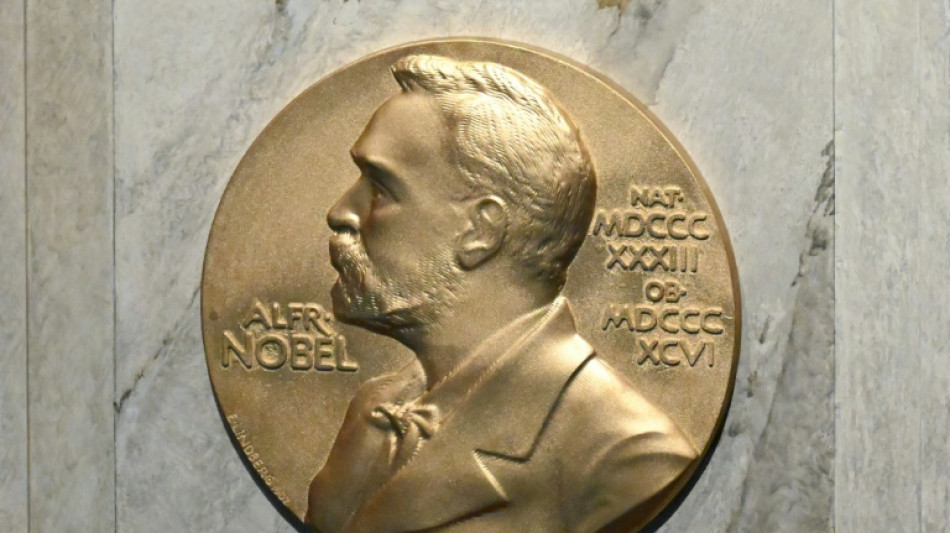
Role of government, poverty research tipped for economics Nobel / Photo: Jonathan NACKSTRAND - AFP

 Kenya's economy faces climate change risks: World Bank
 Cables and cooling bring AI windfall to Indian suppliers
 Anthropic's models gained unauthorized 'real-world' access during testing

 Apple tops estimates in CEO Cook's final quarter, but shares fall

 Milei demands expulsion of foreigners expressing 'hate' against Argentina

 Italy's Po River valley on drought alert

 Prada profits pinched as growth hard to chase

 Stocks climb on earnings and rates, oil retreats

 US economic growth slows in second quarter, missing expectations

 Russia adds Telegram founder Durov to 'terrorist' blacklist

 Stocks diverge on earnings, as oil steadies

 Eurozone economy grows despite Middle East war

 Singapore group will develop 'most promising' Ebola vaccine

 Shell profit surges as Mideast war fuels oil prices

 Car maker Stellantis says back in profit in second quarter

 Samsung quarterly operating profit up 1,800% on AI boom

 South Korean stocks bounce after rout, oil holds gains on Mideast woes

 South Korea's women web sleuths fight AI deepfake porn

 Anything but programmable: New cost-efficient EC-power-supply-series for the DIN rail by CAMTEC PS

 Meta misses profit expectations, sticks to massive AI spending

 Campari - king of the spritz - hopes to conquer American heartland
 Air France-KLM and Lufthansa bid for Portugal's TAP airline

 Profits soar at Airbus as it delivers more planes

 Rheinmetall shares surge after armsmaker reports record profit

 FIFA hit by furious backlash over plans to sell stake in competitions

Closing the season, the Norwegian Nobel Committee will announce the Nobel economics prize on Monday, with specialists on credit, the role of government, and wealth inequality seen as possible contenders.
The winner of the prestigious prize, which last year went to American economist Claudia Goldin, will be announced at 11:45 am (0945 GMT).
Goldin was recognised "for having advanced our understanding of women's labour market outcomes" and was ironically one of very few women ever handed the prize.
Of the 93 laureates honoured since 1969, only three have been women -- Goldin in 2023, her compatriot Elinor Ostrom in 2009 and French-American Esther Duflo in 2019.
"The general trend in society to attach greater importance to parity and diversity has broadened the research process," Mikael Carlsson, professor of economics at Uppsala University in Sweden, told AFP.
"However, this is not the criteria taken into account when assessing whether a scientific contribution is worthy of a Nobel Prize," he insisted.
His bet is that Japan's Nobuhiro Kiyotaki and Britain's John H. Moore will win for their work on how small shocks can affect economic cycles, or American Susan Athey for her work on market design.
But what criteria should be used to predict a Nobel winner?
For Magnus Henrekson of the Research Institute of Industrial Economics in Stockholm, the most obvious place to start is to look at the research interests of the committee that decides which candidates are worthy.
Its chairman specialises in development economics, though Henrekson said it was doubtful the field would be honoured as it was recently awarded a prize.
"I don't think it's likely that the same field will win the prize two years running," Henrekson said.
- Poverty or wealth inequality? -
Frenchman Philippe Aghion, as well as Americans George Loewenstein, Kenneth Rogoff and Carmen Reinhart are academics often mentioned as worthy of the prize.
Turkish-American Daron Acemoglu, a professor at MIT in the United States and the author of several best-sellers including "Why Nations Fail: The Origins of Power, Prosperity, and Poverty," is considered a top name this year.
Acemoglu could potentially be paired with Russian-American Andrei Shleifer.
Predicting the winner is always tricky, but online statistics platform Statista noted that by looking at past recipients and the state of current research in economics, "we have a decent idea of candidates who are likely to win a Nobel in their career, if not in 2024".
It believes Acemoglu could get the nod for his "work on the long-run development of institutions which facilitate or hinder economic growth".
Other possible candidates include macroeconomists such as Frenchman Olivier Blanchard, and Americans Larry Summers and Gregory Mankiw.
Economists who work on wealth inequality, such as France's Thomas Piketty and Gabriel Zucman as well as French-American Emmanuel Saez have also often been mentioned in recent years.
Canadian-American Janet Currie, a specialist in anti-poverty policies, is a favourite for analytics group Clarivate, which keeps an eye on potential Nobel science laureates based on citations.
It also spotlighted British-Indian Partha Dasgupta as a potential winner for "integrating nature and its resources in the human economy".
- 'False Nobel' -
Paolo Mauro, a former member of the International Monetary Fund, was also put forward for "empirical studies of the effects of corruption on investment and economic growth".
The economics prize is the only Nobel not among the original five created in the will of Swedish scientist Alfred Nobel, who died in 1896.
It was instead created through a donation from the Swedish central bank in 1968, leading detractors to dub it "a false Nobel".
However, like for the other Nobel science prizes, the Royal Swedish Academy of Sciences decides the winner and follows the same selection process.
The economics prize wraps up this year's Nobel season, which honoured achievements in artificial intelligence for the physics and chemistry prizes, while the Peace Prize went to Japanese group Nihon Hidankyo, committed to fighting nuclear weapons.
South Korea's Han Kan won the literature prize -- the only woman laureate so far this year -- while the medicine prize lauded discoveries in understanding gene regulation.
The Nobel Prizes consist of a diploma, a gold medal and a one-million-dollar lump sum.
They will be presented at ceremonies in Stockholm and Oslo on December 10, the anniversary of the 1896 death of scientist and prize creator Alfred Nobel.
A.Samuel--CPN