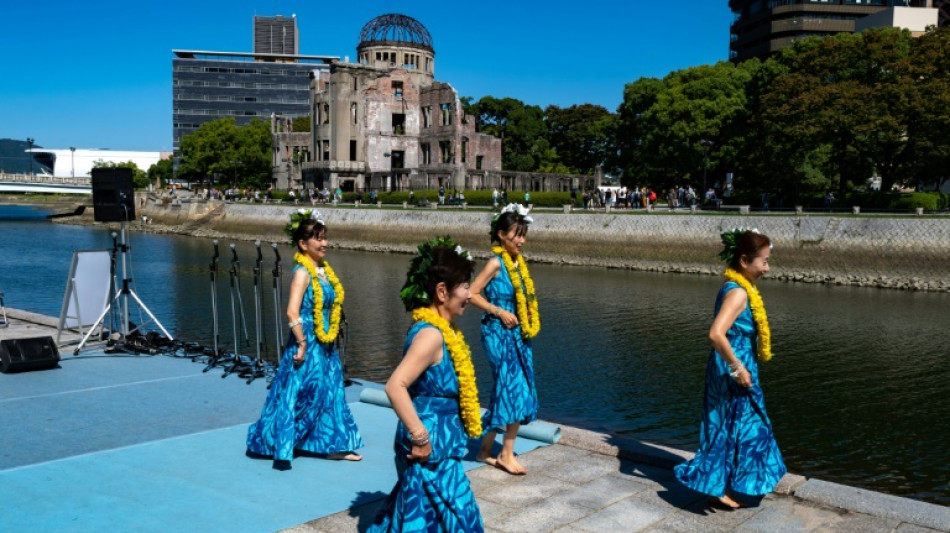
Nobel prize a timely reminder, Hiroshima locals say / Photo: Philip FONG - AFP

 Kenya's economy faces climate change risks: World Bank
 Tech rebound fuels record-breaking rally in South Korean stocks
 Cables and cooling bring AI windfall to Indian suppliers

 Anthropic's models gained unauthorized 'real-world' access during testing

 Apple tops estimates in CEO Cook's final quarter, but shares fall

 Milei demands expulsion of foreigners expressing 'hate' against Argentina

 Italy's Po River valley on drought alert

 Prada profits pinched as growth hard to chase

 Stocks climb on earnings and rates, oil retreats

 US economic growth slows in second quarter, missing expectations

 Russia adds Telegram founder Durov to 'terrorist' blacklist

 Stocks diverge on earnings, as oil steadies

 Eurozone economy grows despite Middle East war

 Singapore group will develop 'most promising' Ebola vaccine

 Shell profit surges as Mideast war fuels oil prices

 Car maker Stellantis says back in profit in second quarter

 Samsung quarterly operating profit up 1,800% on AI boom

 South Korean stocks bounce after rout, oil holds gains on Mideast woes

 South Korea's women web sleuths fight AI deepfake porn
 Anything but programmable: New cost-efficient EC-power-supply-series for the DIN rail by CAMTEC PS
 Meta misses profit expectations, sticks to massive AI spending

 Campari - king of the spritz - hopes to conquer American heartland
 Air France-KLM and Lufthansa bid for Portugal's TAP airline
 Profits soar at Airbus as it delivers more planes

 Rheinmetall shares surge after armsmaker reports record profit
Just like the dwindling group of survivors now recognised with a Nobel prize, the residents of Hiroshima hope that the world never forgets the atomic bombing of 1945 -- now more than ever.
Susumu Ogawa, 84, was five when the bomb dropped by the United States all but obliterated the Japanese city 79 years ago, and many of his family were among the 140,000 people killed.
"My mother, my aunt, my grandfather,and my grandfather all died in the atomic bombing," Ogawa told AFP a day after the survivors' group Nihon Hidankyo was awarded the Nobel Peace Prize.
Ogawa himself recalls very little but the snippets he garnered later from his surviving relatives and others painted a hellish picture.
"All they could do was to evacuate and save their own lives, while they saw other people (perish) inside the inferno," he said.
"All nuclear weapons in the world have to be abandoned," he said. "We know the horror of nuclear weapons, because we know what happened in Hiroshima."
What is happening now in the Middle East saddens him greatly.
"Why do people fight each other? ...hurting each other won't bring anything good," he said.
- 'Great thing' -
On a sunny Saturday, many tourists and some residents were strolling around the Hiroshima Peace Memorial Park to the bomb's 140,000 victims.
A preserved skeleton of a building close to ground zero of the "Little Boy" bomb and a statue of a girl with outstretched arms are poignant reminders of the devastation.
Jung Jaesuk, 43, a South Korean primary school teacher visiting the site, said the Nobel was a "a victory for (grassroots) people."
"Tension in East Asia is intensifying so we have to boost anti-nuclear movement," he told AFP.
Kiyoharu Bajo, 69, a retired business consultant, decided to take in the atmosphere of the site after the "great thing" that was the Nobel award.
With Ukraine and the Middle East, the world "faces crises that we've not experienced since the Second World War in terms of nuclear weapons," he told AFP.
The stories told by the Nihon Hidankyo group of "hibakusha", as the survivors of the bombings of Hiroshima and Nagasaki are known, "have to be known to the world," he said.
He said he hopes that the Nobel prize will help "the experiences of atomic bomb survivors spread further spread around the world” including by persuading people to visit Hiroshima.
- Future generations -
Kiwako Miyamoto, 65, said the Nobel prize was a "great thing, because even some locals here are indifferent" to what happened.
"In Hiroshima, you pray on August 6, and children go to school", even though the date is during summer vacation, she told AFP.
"But I was surprised to see that outside Hiroshima, some people don't know (so much about it)" she said.
She said that like many people in Hiroshima, she personally knows people whose relatives died in the bombing or who witnessed it.
With the average age among members of the Nihon Hidankyo over 85, it is vital that young people continue to be taught about what happened, added Bajo.
"I was born 10 years after the atom bomb was dropped, so there were many atom bomb survivors around me. I felt the incident as something familiar to me," he said.
"But for the future, it will be an issue."
L.K.Baumgartner--CPN