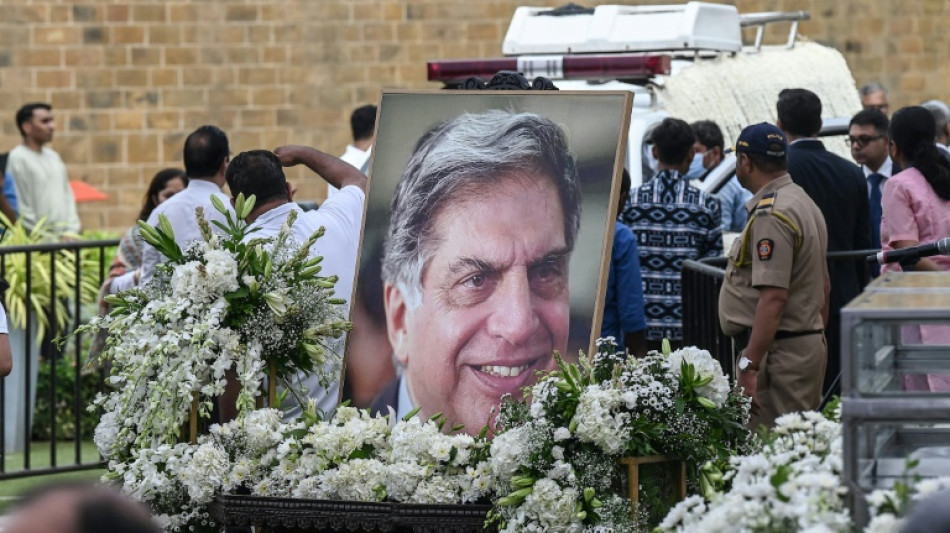
Mumbai declares day of mourning for Indian industrialist Ratan Tata / Photo: SUJIT JAISWAL - AFP

 Kenya's economy faces climate change risks: World Bank

 Tech rebound fuels record-breaking rally in South Korean stocks

 Cables and cooling bring AI windfall to Indian suppliers

 Anthropic's models gained unauthorized 'real-world' access during testing

 Apple tops estimates in CEO Cook's final quarter, but shares fall

 Milei demands expulsion of foreigners expressing 'hate' against Argentina

 Italy's Po River valley on drought alert

 Prada profits pinched as growth hard to chase

 Stocks climb on earnings and rates, oil retreats

 US economic growth slows in second quarter, missing expectations

 Russia adds Telegram founder Durov to 'terrorist' blacklist

 Stocks diverge on earnings, as oil steadies

 Eurozone economy grows despite Middle East war

 Singapore group will develop 'most promising' Ebola vaccine

 Shell profit surges as Mideast war fuels oil prices

 Car maker Stellantis says back in profit in second quarter

 Samsung quarterly operating profit up 1,800% on AI boom

 South Korean stocks bounce after rout, oil holds gains on Mideast woes

 South Korea's women web sleuths fight AI deepfake porn

 Anything but programmable: New cost-efficient EC-power-supply-series for the DIN rail by CAMTEC PS

 Meta misses profit expectations, sticks to massive AI spending

 Campari - king of the spritz - hopes to conquer American heartland

 Air France-KLM and Lufthansa bid for Portugal's TAP airline

 Profits soar at Airbus as it delivers more planes

 Rheinmetall shares surge after armsmaker reports record profit

Crowds of mourners gathered in India's financial capital Mumbai on Thursday for the funeral of industrialist Ratan Tata, hailed as a "titan" who led one of the country's biggest conglomerates.
Tata, who died aged 86 on Wednesday, transformed the Tata Group into a sprawling international enterprise, with a portfolio ranging from software to sports cars.
His coffin, draped in an Indian flag, was flanked by a guard of honour, with a marching band of trumpets and drums accompanying the procession.
Mumbai has declared a day of mourning, with the funeral rites to take place on Thursday afternoon.
"A titan of Indian industry", The Hindu newspaper called him on its front-page. "India loses its crown jewel", the Hindustan Times wrote.
The hundreds who queued to pay tribute on Thursday included a mix of ordinary mourners, high-profile business leaders, politicians and Tata employees.
Abdul Khan, 52, described Tata's passing as both a "personal loss" and a "loss for the country", praising him for his philanthropy.
"He made so many lives better, not just the people who worked for him, but everybody," he said.
Tributes also poured in from fellow industrialists, with Asia's richest man Mukesh Ambani saying it was a "big loss, not just to the Tata group, but to every Indian".
Tata was born in Mumbai in 1937 into a family of Parsis -- a proud but dwindling community which played an outsized role in the city's business affairs under British rule.
He had intended to chart his own course in life as an architect after graduating from Cornell University in New York.
- 'Visionary' -
But an appeal from his grandmother saw him return to India in 1962 and join the sprawling family business, beginning work as a factory floor labourer and sleeping in a hostel for trainees.
He took over the family empire in 1991, riding the wave of the radical free-market reforms India had just unleashed that year.
Tata's 21 years at its helm saw the salt-to-steel conglomerate expand its global footprint.
His 2008 decision to purchase Britain's loss-making Jaguar and Land Rover carmakers for $2.3 billion burnished his reputation when Tata Group was able to restructure both brands and return them to profit the following year.
The Tata Group said his philanthropy work "touched the lives of millions."
"From education to healthcare, his initiatives have left a deep-rooted mark that will benefit generations to come," the company added.
Indian Prime Minister Narendra Modi called Tata "a visionary business leader, a compassionate soul and an extraordinary human being."
Modi praised Tata for providing "stable leadership to one of India's oldest and most prestigious business houses".
P.Schmidt--CPN