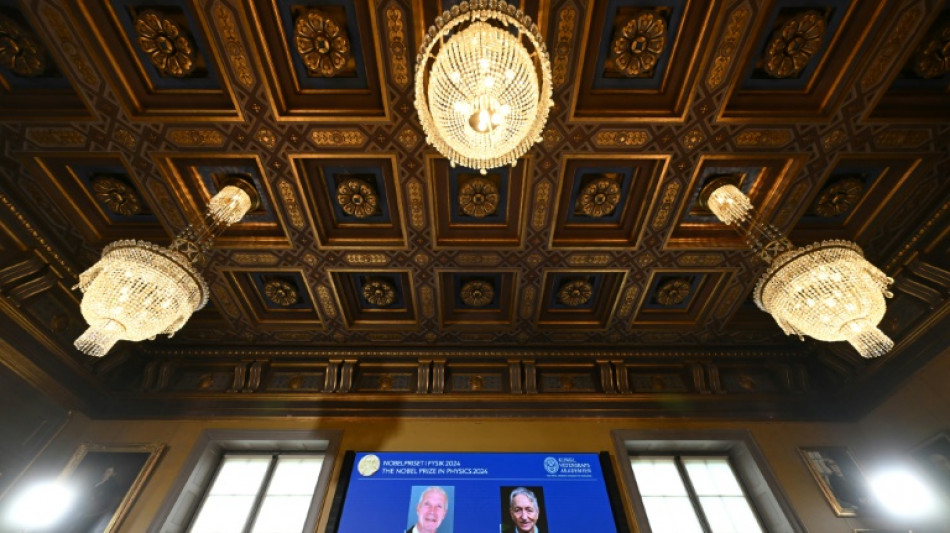
AI steps into science limelight with Nobel wins / Photo: Jonathan NACKSTRAND - AFP

 Kenya's economy faces climate change risks: World Bank
 Tech rebound fuels record-breaking rally in South Korean stocks
 Cables and cooling bring AI windfall to Indian suppliers
 Anthropic's models gained unauthorized 'real-world' access during testing
 Apple tops estimates in CEO Cook's final quarter, but shares fall

 Milei demands expulsion of foreigners expressing 'hate' against Argentina

 Italy's Po River valley on drought alert

 Prada profits pinched as growth hard to chase

 Stocks climb on earnings and rates, oil retreats

 US economic growth slows in second quarter, missing expectations

 Russia adds Telegram founder Durov to 'terrorist' blacklist

 Stocks diverge on earnings, as oil steadies

 Eurozone economy grows despite Middle East war

 Singapore group will develop 'most promising' Ebola vaccine

 Shell profit surges as Mideast war fuels oil prices

 Car maker Stellantis says back in profit in second quarter

 Samsung quarterly operating profit up 1,800% on AI boom

 South Korean stocks bounce after rout, oil holds gains on Mideast woes

 South Korea's women web sleuths fight AI deepfake porn

 Anything but programmable: New cost-efficient EC-power-supply-series for the DIN rail by CAMTEC PS

 Meta misses profit expectations, sticks to massive AI spending

 Campari - king of the spritz - hopes to conquer American heartland

 Air France-KLM and Lufthansa bid for Portugal's TAP airline

 Profits soar at Airbus as it delivers more planes
 Rheinmetall shares surge after armsmaker reports record profit

For long periods of its history, artificial intelligence has lurked in the hinterland of science, often unloved and unfunded -- but two Nobel prizes in one week suggest its time in the sunshine has finally arrived.
First on Tuesday, Geoffrey Hinton and John Hopfield won the physics prize for their pioneering work in creating the foundations of modern AI.
Then on Wednesday, David Baker, John Jumper and Demis Hassabis shared the chemistry prize for work revealing the secrets of proteins through AI.
While the trio had been among the favourites for the chemistry prize, the physics one was unexpected.
"I'm flabbergasted," said Hinton when he was told of the prize. "I had no idea this would happen. I'm very surprised."
He wasn't the only one.
Online commentators wondered why a computer scientist was getting a physics prize.
And with programs such as OpenAI's ChatGPT dominating the cultural conversation around AI, for many the idea that such a technology could be worthy of such an award seemed bizarre.
- 'AI winter' -
But for scientists the news was not so surprising.
"AI's role in transforming how we do science cannot be underestimated," Elena Simperl, a professor at King's College London's informatics department, told AFP.
"The Nobel prize news recognises this, while also acknowledging the role interdisciplinary methods play in advancing computing."
The science now bundled together as artificial intelligence has a long history, emerging in the 1950s and 60s with rudimentary chatbots, translation machines and simple algorithms.
But many of the early experiments failed to take off and researchers struggled to get funding, particularly during the 1970s and the 1990s, periods known as "AI winters".
Before the latest explosion of interest prompted by ChatGPT in 2022, AI had only had a handful of moments when it pierced the public imagination.
In 2016, a program called AlphaGo created by Hassabis's DeepMind beat South Korean grandmaster Lee Se-Dol at the game Go.
It came almost a decade after the IBM-developed supercomputer Deep Blue beat world chess champion Garry Kasparov.
In his acceptance speech, Hassabis flagged that there was a direct line between AlphaGo and AlphaFold, the program that won them the Nobel for predicting protein structures.
"We used games in the early part of DeepMind to train as a proving ground for our early algorithms that then led to some of the techniques we eventually use in our modern programs," he said.
And he encouraged children to play games, saying it was "just a really fun way to get into the guts of how computers work".
- New Nobels needed? -
Simperl said that, far from it being problematic to see AI pioneers being rewarded by the Nobels, it should be encouraged.
"Maybe it's time for this to be recognised with a new Nobel prize category," she said.
She added that disciplines like software engineering and cybersecurity also deserved recognition for their contributions to society.
"There is no issue in my mind with an AI scientist being recognised in a Nobel prize scientific category," she said.
"This is merely an acknowledgement of how modern science works today."
Outside the science community, the conversation continues to be dominated by the astronomical valuations of AI companies and the outsize cultural influence of some of their leaders.
After Wednesday's prize was announced, online memes quickly emerged suggesting Sam Altman, boss of ChatGPT-maker OpenAI, could be next in line.
"It's not done yet," Sean O'Heigeartaigh, director of the AI: Futures and Responsibility Programme at the University of Cambridge, wrote on the social media platform X.
"Hearing reports that the Nobel prize for literature will be going to the authors of 'OpenAI's nonprofit governance structure' for outstanding contributions to creative fiction."
Y.Ibrahim--CPN