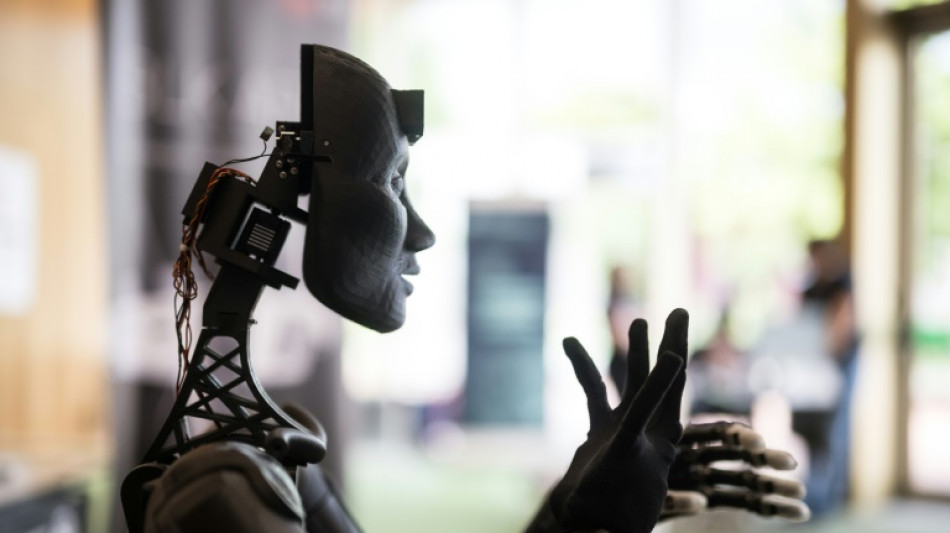
Will AI one day win a Nobel Prize? / Photo: Fabrice COFFRINI - AFP

 Kenya's economy faces climate change risks: World Bank

 Tech rebound fuels record-breaking rally in South Korean stocks
 Cables and cooling bring AI windfall to Indian suppliers
 Anthropic's models gained unauthorized 'real-world' access during testing

 Apple tops estimates in CEO Cook's final quarter, but shares fall

 Milei demands expulsion of foreigners expressing 'hate' against Argentina

 Italy's Po River valley on drought alert

 Prada profits pinched as growth hard to chase

 Stocks climb on earnings and rates, oil retreats

 US economic growth slows in second quarter, missing expectations
 Russia adds Telegram founder Durov to 'terrorist' blacklist

 Stocks diverge on earnings, as oil steadies

 Eurozone economy grows despite Middle East war

 Singapore group will develop 'most promising' Ebola vaccine
 Shell profit surges as Mideast war fuels oil prices
 Car maker Stellantis says back in profit in second quarter

 Samsung quarterly operating profit up 1,800% on AI boom
 South Korean stocks bounce after rout, oil holds gains on Mideast woes

 South Korea's women web sleuths fight AI deepfake porn
 Anything but programmable: New cost-efficient EC-power-supply-series for the DIN rail by CAMTEC PS

 Meta misses profit expectations, sticks to massive AI spending
 Campari - king of the spritz - hopes to conquer American heartland

 Air France-KLM and Lufthansa bid for Portugal's TAP airline

 Profits soar at Airbus as it delivers more planes
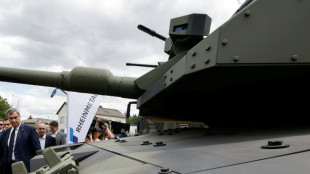 Rheinmetall shares surge after armsmaker reports record profit

Artificial intelligence is already disrupting industries from banking and finance to film and journalism, and scientists are investigating how AI might revolutionise their field -- or even win a Nobel Prize.
In 2021, Japanese scientist Hiroaki Kitano proposed what he dubbed the "Nobel Turing Challenge", inviting researchers to create an "AI scientist" capable of autonomously carrying out research worthy of a Nobel Prize by 2050.
Some scientists are already hard at work seeking to create an AI colleague worthy of a Nobel, with this year's laureates to be announced between October 7 and 14.
And in fact, there are around 100 "robot scientists" already, according to Ross King, a professor of machine intelligence at Chalmers University in Sweden.
In 2009, King published a paper in which he and a group of colleagues presented "Robot Scientist Adam" -- the first machine to make scientific discoveries independently.
"We built a robot which discovered new science on its own, generated novel scientific ideas and tested them and confirmed that they were correct," King told AFP.
The robot was set up to form hypotheses autonomously, and then design experiments to test these out.
It would even program laboratory robots to carry out those experiments, before learning from the process and repeating.
- 'Not trivial' -
"Adam" was tasked with exploring the inner workings of yeast and discovered "functions of genes" that were previously unknown in the organism.
In the paper, the robot scientist's creators noted that while the discoveries were "modest" they were "not trivial" either.
Later, a second robot scientist -- named "Eve" -- was set up to study drug candidates for malaria and other tropical diseases.
According to King, robot scientists already have several advantages over your average human scientist.
"It costs less money to do the science, they work 24/7," he explained, adding that they are also more diligent at recording every detail of the process.
At the same time, King conceded that AI is far from being anywhere close to a Nobel-worthy scientist.
For that, they would need to be "much more intelligent" and able to "understand the bigger picture".
- 'Nowhere near' -
Inga Strumke, an associate professor at the Norwegian University of Science and Technology, said that for the time being the scientific profession is safe.
"The scientific tradition is nowhere near being taken over by machines anytime soon," she told AFP.
However, Strumke added that "doesn't mean that it's impossible", adding that it's "definitely" clear that AI is having and will have an impact on how science is conducted.
One example of how it is already in use is AlphaFold -- an AI model developed by Google DeepMind -- which is used to predict the three-dimensional structure of proteins based on their amino acid.
"We knew that there was some relation between the amino acids and the final three-dimensional shape of the proteins... and then we could use machine learning to find it," Strumke said.
She explained that the complexity of such calculations was too daunting for humans.
"We kind of have a machine that did something that no humans could do," she said.
At the same time, for Strumke, the case of AlphaFold also demonstrates one of the weaknesses of current AI models such as so-called neural networks.
They are very adept at crunching massive amounts of information and coming up with an answer, but not very good at explaining why that answer is correct.
So while the over 200 million protein structures predicted by AlphaFold are "extremely useful", they "don't teach us anything about microbiology", Strumke said.
- Aided by AI -
For her, science seeks to understand the universe and is not merely about "making the correct guess".
Still, the groundbreaking work done by AlphaFold has led to pundits putting the minds behind it as front-runners for a Nobel Prize.
Google DeepMind's director John Jumper and CEO and co-founder Demis Hassabis were already honoured with the prestigious Lasker Award in 2023.
Analytics group Clarivate, which keeps an eye on potential Nobel science laureates, places the pair among the top picks for the 2024 candidates for the Prize in Chemistry, announced on October 9.
David Pendlebury, head of the research group, admits that while a 2021 paper by Jumper and Hassabis has been cited thousands of times, it would be out of character for the Nobel jury to award work so quickly after publication -- as most discoveries that are honoured date back decades.
At the same time, he feels confident that it won't be too long before research aided by AI will win the most coveted of science prizes.
"I'm sure that within the next decade there will be Nobel Prizes that are somehow assisted by computation and computation these days is more and more AI," Pendlebury told AFP.
X.Cheung--CPN