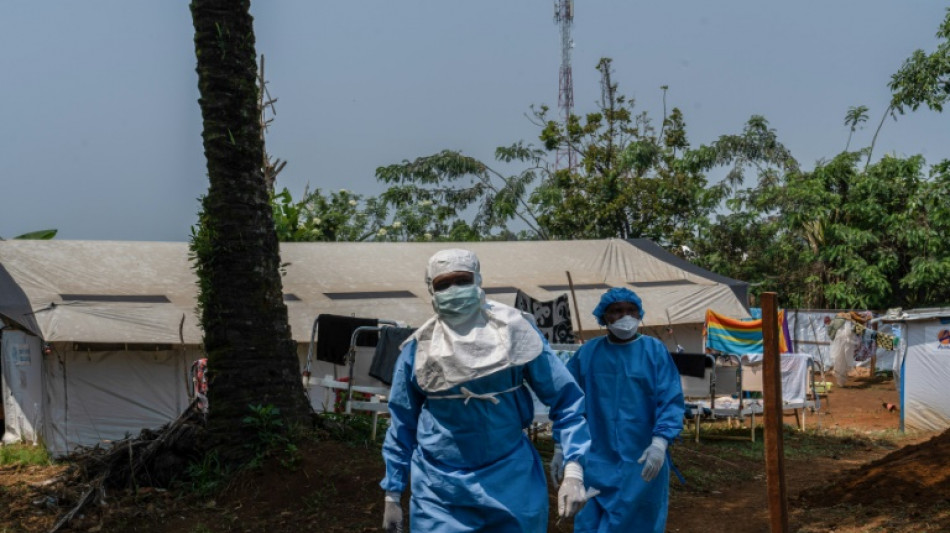
Mpox vaccine rollout faces challenges in east DR Congo / Photo: Glody MURHABAZI - AFP

 Kenya's economy faces climate change risks: World Bank

 Tech rebound fuels record-breaking rally in South Korean stocks
 Cables and cooling bring AI windfall to Indian suppliers
 Anthropic's models gained unauthorized 'real-world' access during testing

 Apple tops estimates in CEO Cook's final quarter, but shares fall

 Milei demands expulsion of foreigners expressing 'hate' against Argentina

 Italy's Po River valley on drought alert

 Prada profits pinched as growth hard to chase

 Stocks climb on earnings and rates, oil retreats

 US economic growth slows in second quarter, missing expectations

 Russia adds Telegram founder Durov to 'terrorist' blacklist

 Stocks diverge on earnings, as oil steadies

 Eurozone economy grows despite Middle East war

 Singapore group will develop 'most promising' Ebola vaccine

 Shell profit surges as Mideast war fuels oil prices

 Car maker Stellantis says back in profit in second quarter

 Samsung quarterly operating profit up 1,800% on AI boom

 South Korean stocks bounce after rout, oil holds gains on Mideast woes

 South Korea's women web sleuths fight AI deepfake porn

 Anything but programmable: New cost-efficient EC-power-supply-series for the DIN rail by CAMTEC PS
 Meta misses profit expectations, sticks to massive AI spending

 Campari - king of the spritz - hopes to conquer American heartland
 Air France-KLM and Lufthansa bid for Portugal's TAP airline

 Profits soar at Airbus as it delivers more planes

 Rheinmetall shares surge after armsmaker reports record profit
Mpox epicentre DR Congo is less than a week away from the start of a vaccination campaign, but the rollout faces challenges in a vast country with limited roads, often in poor condition.
Residents of Kamituga, a bustling mining town in eastern Democratic Republic of Congo's South Kivu province, will be among the first to be vaccinated when the campaign begins on October 2.
But authorities still face logistical challenges -- only one road leads to Kamituga and most of the communities surrounding it are isolated.
Taxis crammed with passengers sit beside large trucks, moving slowly through the winding, bumpy mountain pass.
For the most part, the road is a dirt track, interspersed with bridges made from metal beams and wooden planks that allow drivers to cross overflowing rivers.
The town, where the latest mpox epidemic began in September 2023, lies around 180 kilometres (112 miles) from the provincial capital, Bukavu.
- 'We are afraid' -
Lack of passable roads to villages and suburbs of Kamituga means that motorcyclists often provide rides to people going to the town's hospital.
"We are the first in danger because we carry customers and we do not know if they are infected," motorbike driver Salumu Hassan told AFP.
The only protection Hassan and his colleagues have are long-sleeved jackets and making sure they limit physical contact with passengers.
"We are afraid," Daniel Ngama, another driver, told AFP.
Kamituga has around 280,000 inhabitants, according to official statistics.
But locals estimate the number to be closer to half a million.
Gold mining attracts many to the town and it can often be difficult to monitor the population flow.
"This transient population poses a lot of problems," said Evariste Mbayu, who supervises workers responsible for detecting mpox cases in villages and neighbourhoods.
People come from the eastern city of Bukavu, neighbouring North Kivu province and even Burundi, he said.
With people coming and going "we fear that vaccination will be difficult", doctor James Wakilonga Zanguilwa at Kamituga hospital told AFP.
-'We have been cautious'-
At night, Kamituga's clubs are full of miners and sex workers.
"We don't have time to educate them" on the risk of mpox infection, doctor Dally Muamba Kambaji told AFP.
Sex workers were among the first to spread the virus in the town, according to local doctors.
"We don't have the means to protect ourselves. If you sleep with someone who is going to kiss you and take off their clothes, it's difficult to respect distancing measures," prostitute Nicole Mubukwa told AFP.
"Since we were hit by the epidemic, we have been cautious," the 30-year-old, who hopes to be vaccinated quickly, said.
"We require our customers to take off their clothes, and if they show signs of mpox, we tell them to leave," she added.
The peak of the epidemic has now passed the town and spread to the shores of Lake Kivu to the north and Lake Tanganyika to the east.
But authorities are confident they are managing the outbreak.
"We are in a very encouraging phase where the disease has stabilised," South Kivu governor Jean-Jacques Purusi told AFP.
Claude Bahizire, a doctor and communications officer at South Kivu's provincial health division, told AFP that authorities have a "cold room for the storage and transport of vaccines".
The doses must be kept at a temperature of minus 20 degrees Celsius (minus 4 degrees Fahrenheit).
Public confidence in vaccines has plummeted in South Kivu since the Covid-19 pandemic, according to a study published in the journal Human Vaccines and Immunotherapeutics last year.
But people interviewed by AFP in Kamituga all said they were ready to get vaccinated.
A.Levy--CPN