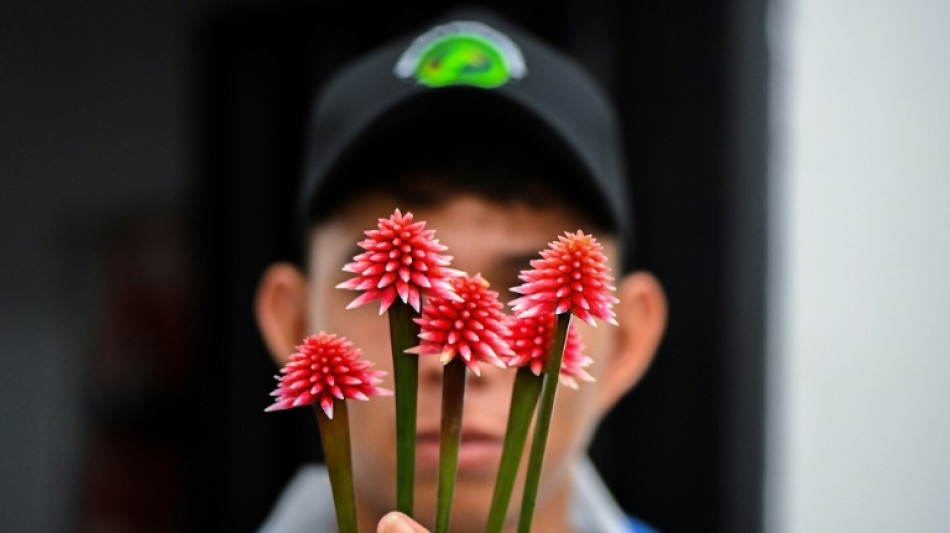
Colombia's Inirida flower: from 'weed' to emblem for UN meeting / Photo: Luis ACOSTA - AFP

 Kenya's economy faces climate change risks: World Bank

 Far right and far left battle for power in polarised Berlin

 The last trio: S.Africa's zoo elephants await their fate

 Oil industry sees war windfall but girds for political blowback

 Amazon beats expectations with cloud and AI growth

 Blowout Microsoft results lift US stocks as oil retreats

 'Beginning of the end': Relief but no party as French wildfire winds down

 Southern Europe 'becoming more flammable' in hotter climate, experts say

 Mammoth bones found on parched bed of Danube in Bulgaria

 MEXC Lists Grvt (GRVT) with $60,000 Worth of GRVT and 10,000 USDT in Airdrop+ Rewards

 George and Amal Clooney flee French home due to wildfire

 MEXC Ventures Supports Alpha Arena's APAC Debut at Coinfest Bali

 AI data centre supplier Zhongji InnoLight slips on Hong Kong debut

 May, June heatwaves caused 2,877 extra deaths in England: govt

 BMW profit down a third as carmaker plans job cuts

 Seoul extends losses as most Asian markets drop, oil rises again

 Gambling.com Group Is Now Grandstand

 Meet the astronomer digging into the Milky Way's 'fossils'

 AI data centre supplier Zhongji InnoLight falls on Hong Kong debut

 Samsung operating profit up 1,800% in second quarter on AI boom

 Japanese population below 120 million for first time in decades

 US actor Jared Leto denies latest accusations of sexual assault
 Danube drops to 'historic lows' as fresh heatwave hits

 BTS pulls out of Grammys after Asian pop category introduction

 OpenAI says rogue AI agent attack hit other companies

When Ruben Dario Carianil began cultivating the unusual, pointy Inirida flower in the Colombian Amazon ten years ago, his relatives made fun of him for growing "weeds."
Today, the 63-year-old Carianil, of the Curripako tribe, grows tons of the curious blooms on a plot outside Inirida -- the jungle city of 30,000 people from which the flower took its name.
Carianil exports Inirida cuttings to the United States, Europe and Asia, and soon even more foreigners will be introduced to the rare blossom as the emblem of a UN biodiversity conference to be held in Cali from October 21 to November 1.
"I'm very happy," Carianil told AFP of his success, which he sees as helping, not harming, the environment.
"For us, Nature, the forest, is life. We Indigenous people respect it and we live in harmony with Nature without damaging it."
Inirida flowers once grew abundantly in the wild in the region. Over-picking led to a dramatic reduction and the government in 1989 prohibited harvesting.
The ban remained in place until 2005, when the door was opened for Inirida's commercial cultivation as long as wild populations remained untouched.
So far, only Carianil's farm has managed to grow, and get a licence to market, the red flowers with their hard, spikey, finger-like petals.
He was helped in the domestication process by biologist Mateo Fernandez.
At first, Carianil's blooms sold at the local airport, then in the Colombian capital Bogota some 700 kilometers (about 430 miles) away, then further afield.
In 2022, the first box of Inirida blooms was delivered to China from Colombia, one of the world's top flower growers and exporters.
- 'Eternal flowers' -
Carianil runs the business with his wife Martha Toledo and their children.
On a plot of some 20 hectares (49 acres), the Inirida crops share space with a variety of native shrubs and even a patch of undisturbed forest.
From the air, the farm looks very different from the flower plantations abundant in Colombia's Andean regions with their rows upon rows of monoculture, often in plastic greenhouses.
Fertilizers and pesticides are banned on Carianil's farm, and only Indigenous farming methods used.
"When you buy a flower from Inirida, you take a piece of the jungle home with you," said Toledo.
They call the enterprise "Liwi: Eternal flowers" as the buds retain their shape years after being cut, even when dried.
It is this longevity that inspired the choice of the Inirida as the logo for the 16th meeting of the Conference of Parties (COP16) of the Convention on Biological Diversity.
"This is a flower that never dies, its petals never fall apart. We hope that the COP16 in Colombia can help the world to make peace with Nature, so that we can sustain and maintain life on the planet forever," says Environment Minister Susana Muhamad.
The flower is native to Colombia's eastern Guainia department, of which Inirida is the capital, and a part of the neighboring Venezuelan Amazon.
M.Davis--CPN