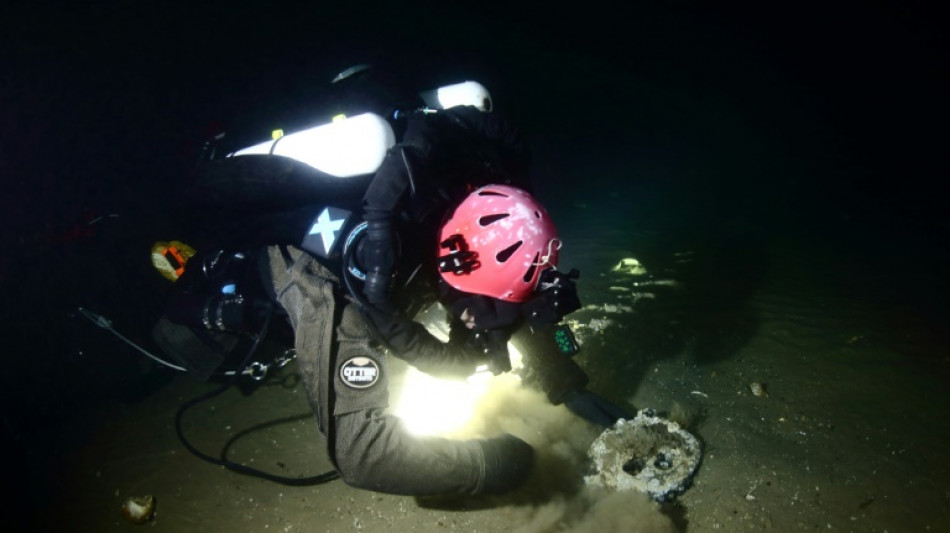
Wreck discovered of French steamship that sank in Atlantic in 1856 / Photo: Andrew Donn - Atlantic Wreck Salvage/AFP

 Kenya's economy faces climate change risks: World Bank

 Far right and far left battle for power in polarised Berlin

 The last trio: S.Africa's zoo elephants await their fate

 Oil industry sees war windfall but girds for political blowback

 Amazon beats expectations with cloud and AI growth

 Blowout Microsoft results lift US stocks as oil retreats

 'Beginning of the end': Relief but no party as French wildfire winds down

 Southern Europe 'becoming more flammable' in hotter climate, experts say

 Mammoth bones found on parched bed of Danube in Bulgaria

 MEXC Lists Grvt (GRVT) with $60,000 Worth of GRVT and 10,000 USDT in Airdrop+ Rewards
 George and Amal Clooney flee French home due to wildfire

 MEXC Ventures Supports Alpha Arena's APAC Debut at Coinfest Bali

 AI data centre supplier Zhongji InnoLight slips on Hong Kong debut

 May, June heatwaves caused 2,877 extra deaths in England: govt

 BMW profit down a third as carmaker plans job cuts

 Seoul extends losses as most Asian markets drop, oil rises again

 Gambling.com Group Is Now Grandstand

 Meet the astronomer digging into the Milky Way's 'fossils'

 AI data centre supplier Zhongji InnoLight falls on Hong Kong debut

 Samsung operating profit up 1,800% in second quarter on AI boom

 Japanese population below 120 million for first time in decades

 US actor Jared Leto denies latest accusations of sexual assault

 Danube drops to 'historic lows' as fresh heatwave hits

 BTS pulls out of Grammys after Asian pop category introduction

 OpenAI says rogue AI agent attack hit other companies

A US dive team has discovered the wreck of a French steamship, Le Lyonnais, that sank in the Atlantic Ocean in 1856 after a "hit-and-run" collision with an American sailing vessel, claiming 114 lives.
Le Lyonnais, which was built in 1855 and was considered state-of-the-art at the time, was returning to France after completing its maiden voyage from Le Havre to New York when the disaster occurred.
Jennifer Sellitti of Atlantic Wreck Salvage, a New Jersey-based company, said a team on the dive boat D/V Tenacious discovered the wreckage of Le Lyonnais last month after a two-decade search.
Sellitti said divers positively identified the ship in waters 200 miles (320 kilometers) off of New Bedford, Massachusetts, in an area known as the Georges Bank. They are not revealing the exact location for now.
"She certainly doesn't look as good as she used to," Sellitti told AFP. "She was really broken apart.
"The North Atlantic is a brutal place to be a shipwreck -- storms, tides," she said. "The Nantucket shoals are known for shifting sands that just completely bury wrecks."
Sellitti said measurements of an engine cylinder were key to identifying the vessel.
The iron-hulled Le Lyonnais, which had both sails and a steam engine, was built by a British shipmaker, Laird & Sons, for Compagnie Franco-Americaine to provide passenger and mail service across the Atlantic.
"The 1850s was the beginning of the transition from sail to steam," Sellitti said. "This was an early attempt by France to have its first successful passenger line."
Le Lyonnais had sailed to New York carrying cargo and mail, she said, and was returning to Le Havre with its first passengers, most of whom were French.
- Hit-and-run -
On the night of November 2, 1856, Le Lyonnais, carrying 132 passengers and crew, collided with the Adriatic, an American barque which was sailing from Maine to Georgia.
Jonathan Durham, the Adriatic's captain, in a statement published in the November 19, 1856 edition of The New York Times, said it was around 11:00 pm on a starlit but "hazy" night when Le Lyonnais "suddenly changed her course, which rendered a collision inevitable."
Durham said the Adriatic suffered significant damage but managed to make it to Gloucester, Massachusetts two days later while Le Lyonnais continued on its way.
The French ship had, in fact, suffered extensive damage -- a hole at the water line and another one lower, probably near its coal bunkers, Sellitti said.
It sank several days later. The handful of survivors were picked up by another ship.
Sellitti, whose book about the incident, "The Adriatic Affair: A Maritime Hit-and-Run Off the Coast of Nantucket," comes out in February 2025, said the sinking of Le Lyonnais was "a really big deal at the time."
The American captain was arrested and put on trial in France, she said, and the collision raised a number of novel maritime liability questions such as what happens when a sailing vessel meets a steamship at sea.
The disaster, which is mentioned in Jules Verne's novel "Twenty Thousand Leagues Under the Sea," was the focus of much international attention, she said, but when the US Civil War broke out in 1861 "everybody stopped talking about this and went on to the Civil War."
U.Ndiaye--CPN