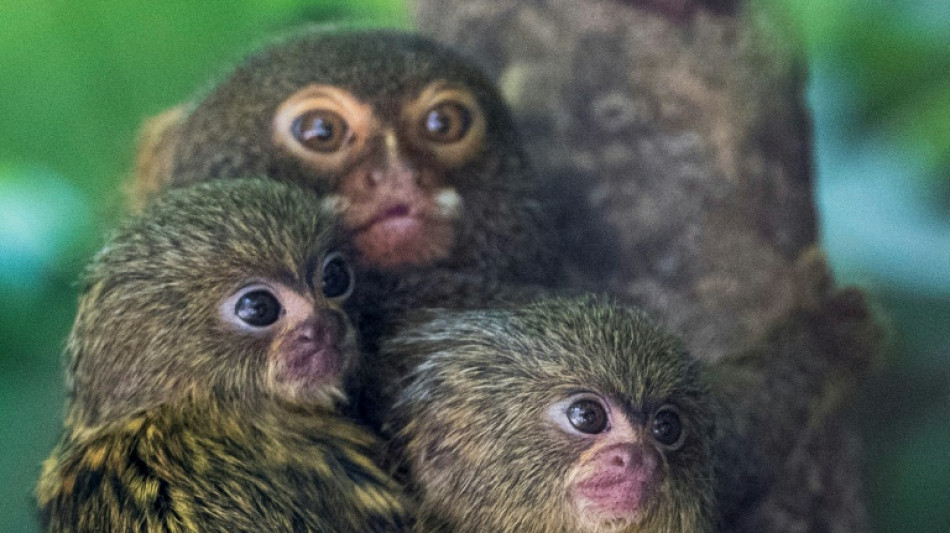
Monkey monikers: Like humans, marmosets give each other names / Photo: SEBASTIEN BOZON - AFP/File

 Kenya's economy faces climate change risks: World Bank

 Far right and far left battle for power in polarised Berlin

 The last trio: S.Africa's zoo elephants await their fate

 Oil industry sees war windfall but girds for political blowback

 Amazon beats expectations with cloud and AI growth

 Blowout Microsoft results lift US stocks as oil retreats

 'Beginning of the end': Relief but no party as French wildfire winds down

 Southern Europe 'becoming more flammable' in hotter climate, experts say

 Mammoth bones found on parched bed of Danube in Bulgaria

 MEXC Lists Grvt (GRVT) with $60,000 Worth of GRVT and 10,000 USDT in Airdrop+ Rewards

 George and Amal Clooney flee French home due to wildfire

 MEXC Ventures Supports Alpha Arena's APAC Debut at Coinfest Bali

 AI data centre supplier Zhongji InnoLight slips on Hong Kong debut

 May, June heatwaves caused 2,877 extra deaths in England: govt

 BMW profit down a third as carmaker plans job cuts

 Seoul extends losses as most Asian markets drop, oil rises again

 Gambling.com Group Is Now Grandstand

 Meet the astronomer digging into the Milky Way's 'fossils'

 AI data centre supplier Zhongji InnoLight falls on Hong Kong debut

 Samsung operating profit up 1,800% in second quarter on AI boom

 Japanese population below 120 million for first time in decades

 US actor Jared Leto denies latest accusations of sexual assault

 Danube drops to 'historic lows' as fresh heatwave hits

 BTS pulls out of Grammys after Asian pop category introduction

 OpenAI says rogue AI agent attack hit other companies

Naming others is considered a marker of highly advanced cognition in social animals, previously observed only in humans, bottlenose dolphins and African elephants.
Marmoset monkeys have now joined this exclusive club, according to a new study published in Science on Thursday.
The diminutive primates use loud, high-pitched calls to assign each other "vocal labels," as shown in research conducted by a team at the Hebrew University of Jerusalem.
"We are very interested in social behavior because we think that social behavior is essentially what drove us humans to be so special compared to other animals," senior author David Omer told AFP.
"We don't run fast, we don't fly, we don't excel in anything else besides being social and all our achievements as a society are our societal achievements."
Marmosets are ideal subjects to study the evolution of social behavior and language in humans, he explained, because they exhibit similar traits, living in small monogamous family groups of six to eight individuals that cooperatively rear their young.
Led by graduate student Guy Oren, the researchers recorded natural conversations between pairs of marmosets separated by a visual barrier, as well as interactions between the monkeys and a computer system that played back pre-recorded calls.
They discovered that marmosets use "phee calls" -- very high-pitched vocalizations, as loud as power tools -- to address one another. Notably, the monkeys could recognize when such calls were directed at them and were more likely to respond when addressed by their name.
- Machine learning advances -
The ten marmosets they tested came from three separate families, and the research also revealed that members within a family group used similar sound features to code different names, akin to dialects or accents in humans. This held true even for adult marmosets that weren't related by blood, suggesting they learned from others within the family group.
Marmosets are relatively distant relatives of humans. We last shared a common ancestor around 35 million years ago, while the split between ourselves and chimpanzees could have happened 5-7 million years ago.
Rather than genetic proximity, Omer attributes the acquisition of vocal labels by marmosets to "convergent evolution," or the idea that they evolved similar traits in response to comparable environmental challenges.
For marmosets, vocal labeling may have been crucial for maintaining social bonds and group cohesion in the dense rainforests of South America, where visibility is often limited.
How and when humans first began talking is a matter of debate, but until recently many scientists had dismissed the idea we could look to other primates for clues. Omer stressed the latest research was yet another blow to that long-standing opinion.
"We can still learn a lot from non-human primates about the evolution of language in humans," he said.
The team's statistical analysis of the marmosets' calls was made possible by recent advancements in computational power and machine learning, he added. Looking ahead, one exciting avenue for future research could be leveraging AI to further decipher the content of marmoset conversations.
L.K.Baumgartner--CPN