
Uruguay's Fede Alvarez returns 'Alien' saga to roots with 'Romulus' / Photo: Sofia TORRES - AFP

 Kenya's economy faces climate change risks: World Bank

 Far right and far left battle for power in polarised Berlin

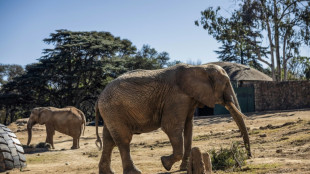 The last trio: S.Africa's zoo elephants await their fate

 Oil industry sees war windfall but girds for political blowback

 Amazon beats expectations with cloud and AI growth

 Blowout Microsoft results lift US stocks as oil retreats

 'Beginning of the end': Relief but no party as French wildfire winds down

 Southern Europe 'becoming more flammable' in hotter climate, experts say

 Mammoth bones found on parched bed of Danube in Bulgaria

 MEXC Lists Grvt (GRVT) with $60,000 Worth of GRVT and 10,000 USDT in Airdrop+ Rewards

 George and Amal Clooney flee French home due to wildfire

 MEXC Ventures Supports Alpha Arena's APAC Debut at Coinfest Bali

 AI data centre supplier Zhongji InnoLight slips on Hong Kong debut

 May, June heatwaves caused 2,877 extra deaths in England: govt

 BMW profit down a third as carmaker plans job cuts

 Seoul extends losses as most Asian markets drop, oil rises again

 Gambling.com Group Is Now Grandstand

 Meet the astronomer digging into the Milky Way's 'fossils'

 AI data centre supplier Zhongji InnoLight falls on Hong Kong debut

 Samsung operating profit up 1,800% in second quarter on AI boom

 Japanese population below 120 million for first time in decades

 US actor Jared Leto denies latest accusations of sexual assault

 Danube drops to 'historic lows' as fresh heatwave hits

 BTS pulls out of Grammys after Asian pop category introduction

 OpenAI says rogue AI agent attack hit other companies

It's back to basics for the "Alien" film franchise: "Alien: Romulus" hits theaters worldwide this week and director Fede Alvarez is hoping to follow in the footsteps of Ridley Scott, who launched the saga in 1979.
In an interview with AFP, Alvarez explained how he was forever marked by the series' early chapters as a kid growing up in Uruguay.
After Scott, James Cameron ("Aliens," 1986), David Fincher ("Alien 3," 1992) and Jean-Pierre Jeunet ("Alien Resurrection," 1997), Disney has entrusted this installment to Alvarez, who is far less known.
Scott rebooted the franchise in the 2010s with "Prometheus" and "Alien: Covenant," and is still one of the producers.
Alvarez, whose previous films include "Evil Dead" and "Don't Breathe" -- deems the first two "Alien" installments as "fundamental" to his work and for cinema in general.
"Romulus"-- which takes place almost entirely within the confines of a drifting spaceship -- is set at the time of the first films, when teams of space travelers discover, in deadly fashion, the existence of xenomorphs, formidable extraterrestrials.
"There's a scene in the 1986 film where we see a bunch of children and young people running around a space station. I thought, 'What is it going to be like for these kids when they grow up?" wonders the director, who is now based in Hollywood.
The film is also meant to bring back the gore and horror of the first film.
Alvarez faithfully reproduces the familiar motifs and scenes, including the emblematic hatching of the parasitic alien in the body of its human host.
The 46-year-old filmmaker also revisits the visual style of Scott, whom he calls "one of the great masters of the genre."
- 'Ambitious film' -
"It's not so much a desire to go back, but simply the fact that as a filmmaker, I want to practice as I learned to do," he explains, particularly his decision to film without "too many green screens" -- a technique allowing visual effects to be added in post-production.
Alvarez immersed himself in the "futurism of the 1980s," with mythical specimens of "Alien" controlled by teams of puppeteers.
"Technically, it's a very ambitious film," he says. "Generating real emotion in people is the most difficult thing there is."
And "when you decide to see this film, you know more or less what you want to expose yourself to. It's like when you go on a roller coaster," he explains, adding: "I like having that effect on people."
In the tradition of "Alien," which starred a young Sigourney Weaver as the hero Ellen Ripley, this film features Cailee Spaeny, who earned a Golden Globe nomination for her portrayal of Elvis Presley's wife in the 2023 biopic "Priscilla."
In "Romulus," she plays an orphan, reduced to the state of quasi-slave on a sunless corner of the planet managed in a "Blade Runner"-style atmosphere by the private conglomerate Weyland-Yutani, which mines a toxic mineral there.
She doesn't hesitate when a group of young rebels suggest that she try to escape to more hospitable skies.
The plan? Seize a spaceship that they think is abandoned, but really is inhabited by xenomorphs who have brutally murdered the crew.
Y.Ibrahim--CPN