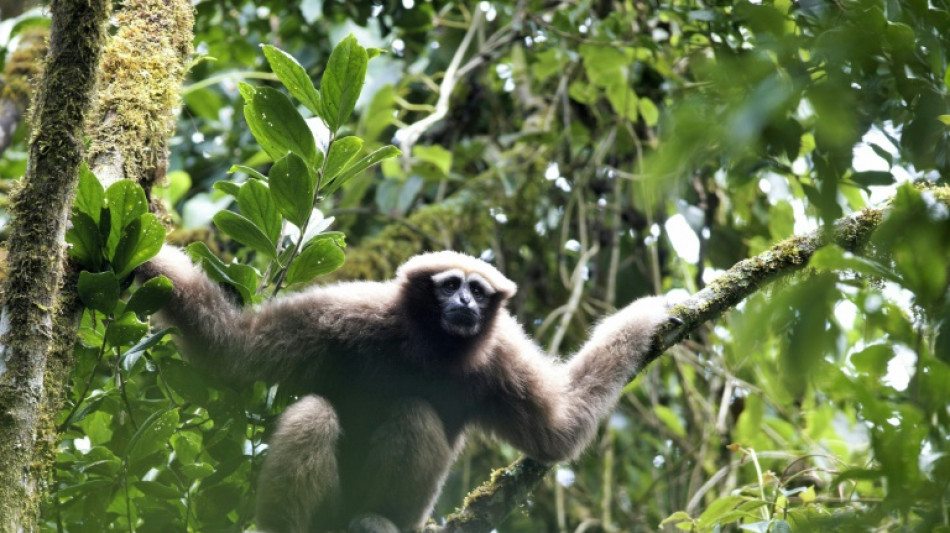
Finding Skywalker gibbons with love songs: study / Photo: Pengfei Fan - Sun Yat-Sen University/AFP

 Kenya's economy faces climate change risks: World Bank

 Commerzbank agrees to talks with UniCredit after two-year standoff

 Fornaro Legal Releases Guidance to Help Businesses Maintain Clear Ownership Records During Growth

 Japan probe made closest-ever asteroid flyby: space agency

 British oil giant BP aims to sell North Sea business

 China factory activity slides as leaders seek spending boost

 Tech rebound fuels record-breaking rally in South Korean stocks
 Cables and cooling bring AI windfall to Indian suppliers

 Anthropic's models gained unauthorized 'real-world' access during testing

 Apple tops estimates in CEO Cook's final quarter, but shares fall

 Milei demands expulsion of foreigners expressing 'hate' against Argentina

 Italy's Po River valley on drought alert

 Prada profits pinched as growth hard to chase

 Stocks climb on earnings and rates, oil retreats

 US economic growth slows in second quarter, missing expectations

 Russia adds Telegram founder Durov to 'terrorist' blacklist

 Stocks diverge on earnings, as oil steadies

 Eurozone economy grows despite Middle East war

 Singapore group will develop 'most promising' Ebola vaccine

 Shell profit surges as Mideast war fuels oil prices

 Car maker Stellantis says back in profit in second quarter

 Samsung quarterly operating profit up 1,800% on AI boom

 South Korean stocks bounce after rout, oil holds gains on Mideast woes

 South Korea's women web sleuths fight AI deepfake porn

 Anything but programmable: New cost-efficient EC-power-supply-series for the DIN rail by CAMTEC PS

Valentine's day is over but love's call lingers: the Skywalker gibbons' mating song, scientists reported this week, has revealed a previously unknown population -- the largest in the world -- of the endangered primate in the jungles of Myanmar.
When the Skywalker hoolock gibbon was first discovered in 2017 by a group of Star Wars-loving scientists, its only confirmed population -- less than 200 individuals -- was in neighbouring China's Yunnan Province.
But in a new study published in the International Journal of Primatology, researchers confirmed Myanmar has the largest known population of Skywalker gibbons in a single location.
"This is a significant discovery for the future of primate conservation in Myanmar," Ngwe Lwin, expedition leader and Fauna & Flora country director in Myanmar, said in a statement.
Gibbons do not swim, restricting them to the forest canopy's towering treetops.
This means broad rivers cutting through the jungle can dictate where the species settles.
Though no live Skywalker gibbons have been confirmed in Myanmar over the past century, a team of researchers from Myanmar, the United States, Britain and Germany followed a hunch based on geography that the primates might be found between two rivers in the southeast Asian nation.
Between December 2021 and March 2023, researchers set up acoustic monitoring systems in the hopes of detecting and recording the Skywalker's morning love songs to figure out their location.
Then, the team collected half-eaten plants and fruits favoured by the primates for genetic analysis.
When spotted, the researchers took photographs of Skywalker hoolock gibbons and compared them to other hoolock species, noting that Skywalkers have distinctively thinner eyebrows, a black or brown beard rather than a white one, and females have incomplete white face rings.
After determining viable habitat, analysing recordings and photographs, sequencing DNA and interviewing local wildlife and conservation organisations, the team had no doubts: Myanmar is home to 44 groups of Skywalker gibbons.
While the exact number of Skywalker gibbons in the new location is still unknown, a 2013 population estimate suggested that there could have been up to 65,000 gibbons in the area where Skywalkers were identified.
However, the current number of individuals could be lower due to the threats the primates face.
- Urgent need for protection -
Only four percent of habitat in Myanmar suitable for Skywalker gibbons is found in established protected areas.
Besides habitat loss, other threats the primates face include land fragmentation and degradation, accelerating deforestation, "bush meat" hunting, and the live trade in exotic animals.
More than 95 percent of the skywalker gibbon population in Myanmar exists outside of protected areas, and population decline is projected to continue, and possibly accelerate, according to the study.
Given these threats, the researchers recommended to the International Union for the Conservation of Nature (IUCN) that the species keep its "endangered" status despite the discovery of a new population.
"Now more than ever, it is recognised that the collective efforts of stakeholders, including governments, communities and Indigenous Peoples groups, are the only effective way to protect and save our closest living relatives," Ngwe Lwin said.
M.P.Jacobs--CPN