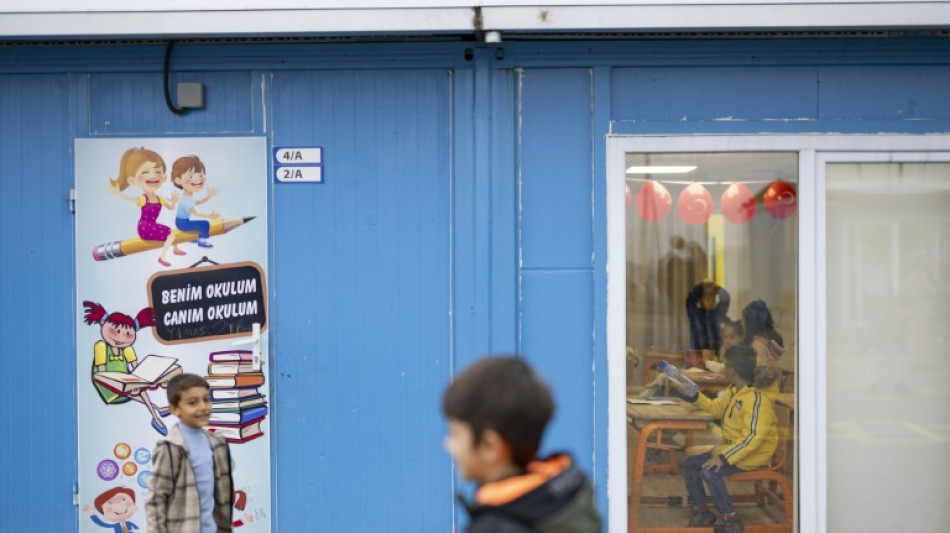
Quake trauma haunts children in Turkey's container city / Photo: YASIN AKGUL - AFP

 Kenya's economy faces climate change risks: World Bank
 New York sues online prediction markets giant Kalshi

 Profits surge at US oil giant amid Iran war supply shock
 Stock markets rally on tech rebound
 France, Spain assess scorched terrain as new wildfires threaten other regions

 Chipmaker Kioxia reports AI-driven 45-fold surge in quarterly net profit
 Far right and far left battle for power in polarised Berlin

 The last trio: S.Africa's zoo elephants await their fate
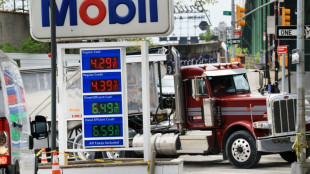 Oil industry sees war windfall but girds for political blowback

 Amazon beats expectations with cloud and AI growth

 Blowout Microsoft results lift US stocks as oil retreats

 'Beginning of the end': Relief but no party as French wildfire winds down

 Southern Europe 'becoming more flammable' in hotter climate, experts say

 Mammoth bones found on parched bed of Danube in Bulgaria

 MEXC Lists Grvt (GRVT) with $60,000 Worth of GRVT and 10,000 USDT in Airdrop+ Rewards

 George and Amal Clooney flee French home due to wildfire

 MEXC Ventures Supports Alpha Arena's APAC Debut at Coinfest Bali

 AI data centre supplier Zhongji InnoLight slips on Hong Kong debut

 May, June heatwaves caused 2,877 extra deaths in England: govt

 BMW profit down a third as carmaker plans job cuts

 Seoul extends losses as most Asian markets drop, oil rises again

 Gambling.com Group Is Now Grandstand

 Meet the astronomer digging into the Milky Way's 'fossils'

 AI data centre supplier Zhongji InnoLight falls on Hong Kong debut

 Samsung operating profit up 1,800% in second quarter on AI boom

Cansu Gol lost her baby in the rubble of Turkey's massive earthquake a year ago. Now she spends her time trying to heal the mental scars of her two surviving children.
One suffers from trauma-related attention deficit disorder and the other from speech problems which emerged after last year's February 6 disaster in which 50,000 died across Turkey's southeast.
For the 33-year-old mother, the improvised schools in a container city near the quake's epicentre in the province of Kahramanmaras offer a glimmer of hope.
"My seven-year-old daughter was pulled out alive from the rubble hours after the earthquake. Now she is suffering from attention deficit disorder," Gol told AFP.
"She didn't cry or scream at all, instead storing all the stress inside," she said.
Her four-and-a-half-year-old son began to speak after joining a nursery set up in one of the containers housing hundreds of thousands of survivors of Turkey's deadliest disaster of modern times.
"He keeps asking about his brother (who died). He says he flew away like a bird," the mother said.
- Bouts of violence -
Teachers try to create an atmosphere of normality for the kids, each one of whom has lost homes, family and friends. All have varied levels of understanding what actually occurred.
A bust of post-Ottoman Turkey's founder, Mustafa Kemal Ataturk, stands in the courtyard, just as it would at any other school.
The 20-student classrooms are decorated with balloons, adding colour to a camp comprised of hundreds of identical white metal containers arranged in even rows.
Just a 10-minute walk away, empty spaces recall the apartment towers that stood in this Mediterranean city, once most famous for its ice cream.
"It is just as painful for the students as it is for the teachers," said the school's principal, who spoke to AFP on condition of anonymity because civil servants are barred from speaking to the media without authorisation.
"Many things evoke the quake: aftershocks, the month of February or simply the snowfall," which was heavy that fatal night, he said.
His school takes care of 850 children from diverse backgrounds.
They live in a container city housing 10,000 survivors, creating a tense atmosphere that breeds occasional bouts of violence.
"Cursing, offensive gestures, kicking -- things won't go well until these families are settled in apartments," he said.
- 'Ghost city' -
The principal said the state was doing its best, even housing teachers in the container cities so they can be near the kids.
"In which disaster is everything perfect?" he asked. "Life goes on."
But that life, said Sara Resitoglu, 24, is a constant struggle.
"There's no space. All our lives are in one room," the young mother sighed.
Elif Yavuz and her husband tried to rebuild their lives in the nearby city of Mersin, following the path taken by more than three million people who left immediately after the quake.
But like many others, the couple eventually moved back because their seven-year-old, who has heart problems, struggled to adapt.
"I resigned myself to returning and living in a container just so that she would not be upset," the mother said.
Her daughter was now doing well in school. Yavuz plans to buy her a new pair of shoes as a reward for another excellent report card.
Away from the container camp, Fatih Yilanci joined the multitudes who spend days scouring city ruins for scrap metal they can sell to feed their families.
His apartment was only lightly damaged, meaning that his family did not automatically qualify for a container home.
But his neighbourhood is gone, as are most of his friends, who died in the ruins.
"Kahramanmaras has turned into a ghost city," Yilanci said.
P.Kolisnyk--CPN