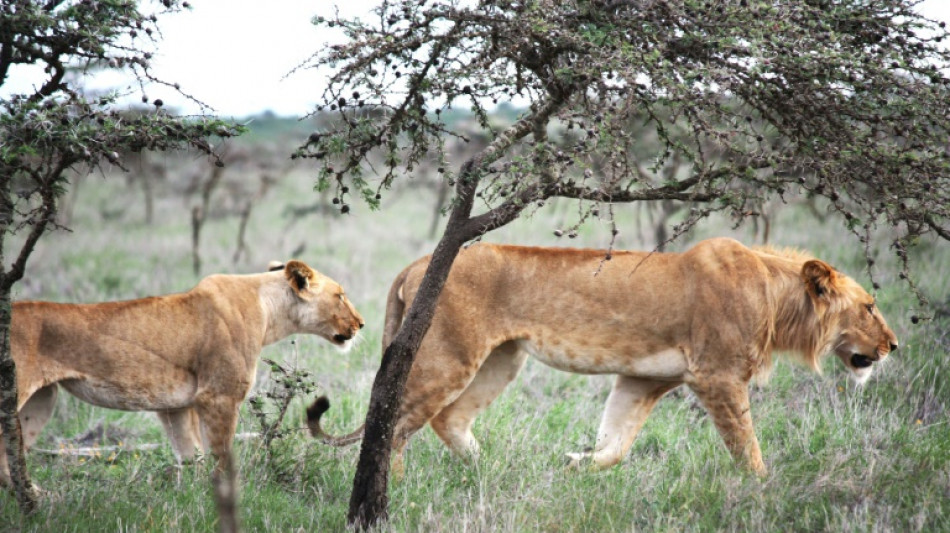
How an invasive ant caused lions to change their diet / Photo: Todd Palmer - AFP

 Kenya's economy faces climate change risks: World Bank

 New York sues online prediction markets giant Kalshi

 Profits surge at US oil giant amid Iran war supply shock

 Stock markets rally on tech rebound
 France, Spain assess scorched terrain as new wildfires threaten other regions

 Chipmaker Kioxia reports AI-driven 45-fold surge in quarterly net profit

 Far right and far left battle for power in polarised Berlin

 The last trio: S.Africa's zoo elephants await their fate

 Oil industry sees war windfall but girds for political blowback

 Amazon beats expectations with cloud and AI growth

 Blowout Microsoft results lift US stocks as oil retreats

 'Beginning of the end': Relief but no party as French wildfire winds down

 Southern Europe 'becoming more flammable' in hotter climate, experts say

 Mammoth bones found on parched bed of Danube in Bulgaria

 MEXC Lists Grvt (GRVT) with $60,000 Worth of GRVT and 10,000 USDT in Airdrop+ Rewards

 George and Amal Clooney flee French home due to wildfire

 MEXC Ventures Supports Alpha Arena's APAC Debut at Coinfest Bali

 AI data centre supplier Zhongji InnoLight slips on Hong Kong debut

 May, June heatwaves caused 2,877 extra deaths in England: govt

 BMW profit down a third as carmaker plans job cuts

 Seoul extends losses as most Asian markets drop, oil rises again

 Gambling.com Group Is Now Grandstand

 Meet the astronomer digging into the Milky Way's 'fossils'

 AI data centre supplier Zhongji InnoLight falls on Hong Kong debut

 Samsung operating profit up 1,800% in second quarter on AI boom

You may have heard of the "butterfly effect", but how about the "ant effect"?
Research published Thursday has shown how an ant muscled into a Kenyan savannah and sparked such a dramatic transformation in the landscape that even the local lions changed the way they hunt.
The study highlights the potentially profound impacts of invasive species, which are spreading at an increasing rate as human activities give animals, insects and plants opportunities to hitchhike into new territories.
"Oftentimes, we find it's the little things that rule the world," said Todd Palmer, an ecologist from the University of Florida, who was part of the research team that traced the implications of the big-headed ant on the hunting habits of lions in central Kenya.
"These tiny invasive ants showed up maybe 15 years ago, and none of us noticed because they aren't aggressive toward big critters, including people. We now see they are transforming landscapes in very subtle ways but with devastating effects," Palmer said.
It all starts with the whistling-thorn acacia trees in the plains of Laikipia, Kenya.
These thorny trees had developed a mutually beneficial relationship with the local acacia ant: The trees provide shelter and food for the ants and in return they use their stinging bite to discourage hungry elephants from devouring the trees.
But the big-headed ant changed all that.
Thought to have originated on an island in the Indian Ocean and brought to the area by the movement of people and goods, these invasive marauders arrived around two decades ago and started killing the acacia ants, leaving the whistling-thorn trees vulnerable to herbivores.
Diminished tree cover poses a problem for lions because they rely on the element of surprise to ambush their prey, notably zebras.
Researchers spent three years in Kenya's Ol Pejeta Conservancy tracking the lions' movements with GPS collars to see how they responded in the areas colonised by the invasive ants.
Their study, published in the journal Science, found that the big-headed ants had led to a threefold decline in zebra killings.
But the researchers were surprised to find that this did not cause the lion population to decline -- good news because lion populations in the region have already shrunk to around 2,000 individuals from an estimated 100,000.
Instead, the big cats switched dining preference and strategy -- ganging up in larger groups to go after buffalo, said Douglas Kamaru of the University of Wyoming, lead author of the study.
- 'Profound switch' -
While the lions have adapted thus far, the big-headed ants could spell trouble for other species that rely on the whistling-thorn tree, like giraffes or the critically endangered black rhino.
"The question is what happens going forward," Kamaru told AFP.
And the lions' changing diet may provoke its own cascade of impacts.
"We don't yet know what could result from this profound switch in the lions' hunting strategy," Palmer said.
Last year the intergovernmental science advisory panel for the UN Convention on Biodiversity (IPBES) catalogued more than 37,000 so-called alien species that have taken root -- often literally -- far from their places of origin.
That number is trending sharply upward, along with the bill for the damage, estimated at well over $400 billion a year.
X.Wong--CPN