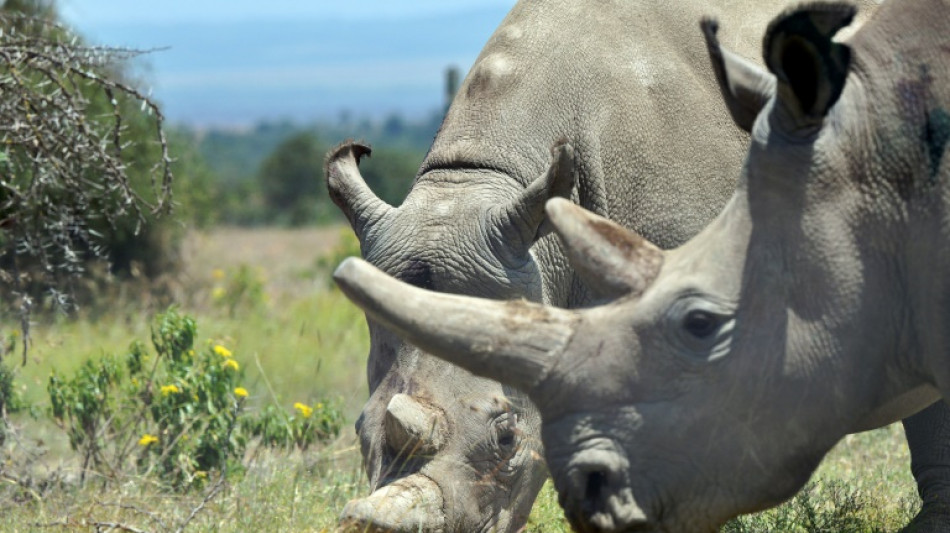
IVF breakthrough could revive nearly extinct rhino species / Photo: TONY KARUMBA - AFP/File

 Kenya's economy faces climate change risks: World Bank
 New York sues online prediction markets giant Kalshi

 Profits surge at US oil giant amid Iran war supply shock

 Stock markets rally on tech rebound

 France, Spain assess scorched terrain as new wildfires threaten other regions

 Chipmaker Kioxia reports AI-driven 45-fold surge in quarterly net profit

 Far right and far left battle for power in polarised Berlin

 The last trio: S.Africa's zoo elephants await their fate

 Oil industry sees war windfall but girds for political blowback

 Amazon beats expectations with cloud and AI growth

 Blowout Microsoft results lift US stocks as oil retreats

 'Beginning of the end': Relief but no party as French wildfire winds down

 Southern Europe 'becoming more flammable' in hotter climate, experts say

 Mammoth bones found on parched bed of Danube in Bulgaria

 MEXC Lists Grvt (GRVT) with $60,000 Worth of GRVT and 10,000 USDT in Airdrop+ Rewards

 George and Amal Clooney flee French home due to wildfire

 MEXC Ventures Supports Alpha Arena's APAC Debut at Coinfest Bali

 AI data centre supplier Zhongji InnoLight slips on Hong Kong debut

 May, June heatwaves caused 2,877 extra deaths in England: govt

 BMW profit down a third as carmaker plans job cuts

 Seoul extends losses as most Asian markets drop, oil rises again

 Gambling.com Group Is Now Grandstand

 Meet the astronomer digging into the Milky Way's 'fossils'

 AI data centre supplier Zhongji InnoLight falls on Hong Kong debut

 Samsung operating profit up 1,800% in second quarter on AI boom

Scientists have carried out the first successful in vitro fertilisation of a southern white rhino, a major breakthrough that could pave the way to saving its highly endangered northern cousin.
Only two female northern white rhinos remain in existence but neither is capable of carrying a pregnancy to term.
To save the functionally extinct species, researchers from the scientific consortium Biorescue are attempting to implant a lab-grown northern white rhino embryo in a southern surrogate.
The ambitious reproduction programme is the last chance at survival for the northern white rhino species, whose last two members live at the Ol Pejeta Conservancy in Kenya under 24-hour guard to protect them from poachers.
The successful impregnation of a southern white rhino with an embryo of the same species was a "milestone", project leader Thomas Hildebrandt said at a press conference in Berlin.
"We achieved something that was not believed to be possible," Hildebrandt said.
The successful recent trial ended in tragedy when the bull and the surrogate, along with the foetus, were killed by an unrelated infection the scientists believe was caused by bacteria released by a mudslide in their enclosure.
The foetus was only 70 days old at the time but the team said they were confident it could have survived the 16-month pregnancy period.
The next step will see scientists try to repeat the feat with other embryos made with eggs harvested from the surviving females and sperm preserved from two long-dead males.
The team aims to "produce northern white rhino calves in the next two to two-and-a-half years", Hildebrandt said.
- Delicate operation -
To place the embryo in the surrogate, the team of conservationists use a sterile "teaser" bull rhino, whose approaches to the female indicate she is ready to conceive.
The team subsequently carry out the delicate operation in just under an hour with the surrogate under anaesthetic.
The size and delicate anatomy of the white rhinos means the embryo is implanted via the rectum into the uterus.
The trials were carried out using southern white rhino embryos to preserve what scarce genetic material is left from the northern species.
Biorescue has collected eggs from the surviving females, Najin and Fatu, since 2019 but had to retire the elder of the two from the programme in 2021.
The last male, whose name was Sudan, died at the sanctuary in Kenya in 2018.
What northern white rhino sperm has been preserved from now-dead male donors is of "very poor quality", said Cesare Galli from the Italian lab Avantea where the new northern white rhino eggs are fertilised in vitro.
- 'Big day' -
The Biorescue team have 30 fertilised eggs in freezers "waiting for their big day", said Susanne Holtze from the Leibniz Institute for Zoo and Wildlife Research.
The IVF method could potentially provide a model for other endangered species of rhino, such as the endangered Sumatran rhino in South East Asia, according to project leader Hildebrandt.
Rhinos, which have roamed the planet for 26 million years, have very few natural predators but their numbers have been decimated by poaching since the 1970s.
A.Zimmermann--CPN