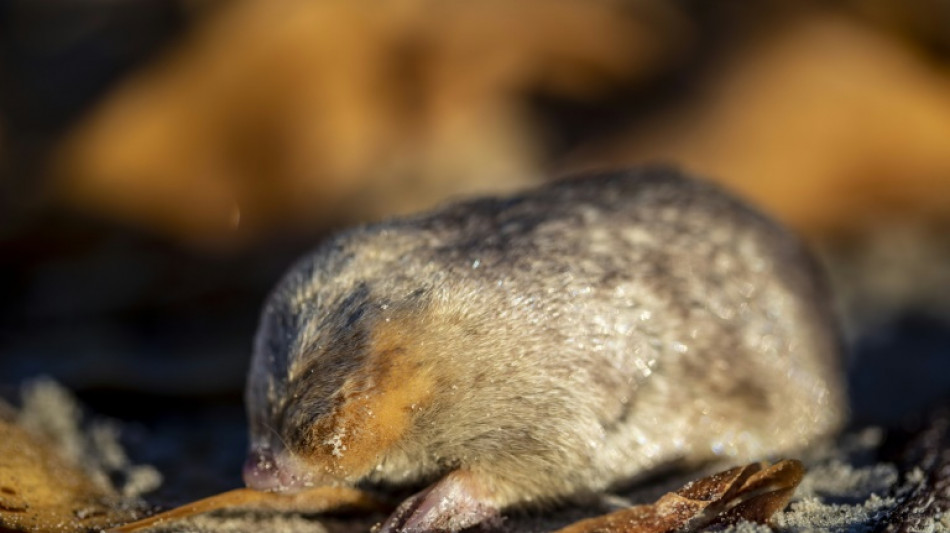
Bashful golden mole detected in South Africa after 87 years / Photo: Nicky Souness - Endangered Wildlife Trust/AFP

 Nintendo producer 'all nervous' as Zelda classic remake hits shelves

 Three killed by storm in southern India

 Two hundred 'Cruise for life' passengers stranded in Cambodia

 Billionaire Ambani's Jio jumps 21% in market debut after record India IPO

 Sri Lanka's Tamil farmers fight to reclaim land after civil war

 'They don't care about us': Trump food aid cuts leave Americans struggling and angry

 Palestinian activist Khalil returns to Columbia after US detention

 Youths testify about 'despair' in unprecedented Canadian climate trial

 Storied Paris department store seeks bankruptcy protection

 Boeing shares tumble after it releases cautious growth forecast

A golden mole that "swims" in sand has resurfaced in South Africa after 87 years in the wilderness when many specialists feared it had become extinct, researchers have said.
Traces of two De Winton's golden moles have been found under the sands of a beach after a "detective novel search", said Endangered Wildlife Trust (EWT) senior field officer Esther Matthew on Tuesday.
EWT and University of Pretoria researchers covered up to 18 kilometres (11.2 miles) of dune habitat a day as they spent months hunting for signs, said Matthew.
The blind moles are cute but excessively timid.
They pick inaccessible areas to burrow homes and have extremely sensitive hearing to detect ground vibrations made by anyone who could be looking for them. The last scientific trace dates back to 1936.
The team used a scent-detecting Border Collie dog, Jessie, to find traces of the moles' tunnels.
There are 21 species of golden moles and the De Winton's were detected using environmental DNA samples -- skin, hair and bodily excretions -- taken from soil at Port Nolloth beach on the northwest coast.
More than 100 samples were collected from the dunes.
Even now the researchers have not physically seen the blind mole that has an iridescent coat sheen that allows it to "swim" through sand.
To finally make a connection, they have made videos and taken photos.
The De Winton's golden mole was one of the top 25 animals on a list of long-lost species drawn up by the Re:wild non-government group in 2017.
Eleven have now been discovered again.
Christina Biggs, a lost species specialist for Re:wild, praised the persistence of the team that found the moles.
"They left no sandhill unturned and now it’s possible to protect the areas where these threatened and rare moles live," said Biggs.
The use of environmental DNA was a "case study on how such forward-thinking technologies can be utilised to find other lost species."
The team found traces of four other golden moles in the same region. Matthew said the De Winton's are still threatened by mining and residential developments near the beaches that are their home.
P.Schmidt--CPN