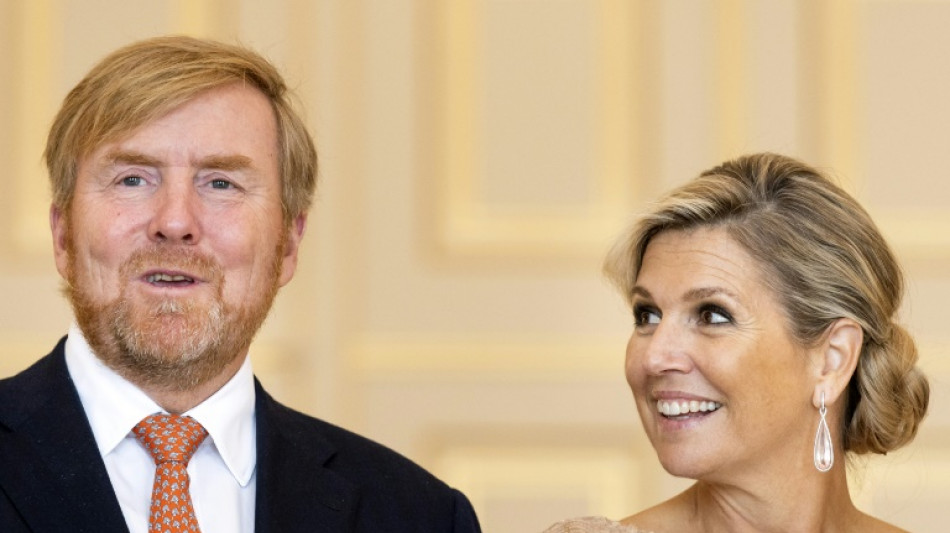
Nazi past shakes Dutch royals as popularity wanes / Photo: Koen van Weel - ANP/AFP

 Kenya's economy faces climate change risks: World Bank

 Commerzbank agrees to talks with UniCredit after two-year standoff

 Fornaro Legal Releases Guidance to Help Businesses Maintain Clear Ownership Records During Growth

 Japan probe made closest-ever asteroid flyby: space agency
 British oil giant BP aims to sell North Sea business

 China factory activity slides as leaders seek spending boost
 Tech rebound fuels record-breaking rally in South Korean stocks
 Cables and cooling bring AI windfall to Indian suppliers

 Anthropic's models gained unauthorized 'real-world' access during testing

 Apple tops estimates in CEO Cook's final quarter, but shares fall

 Milei demands expulsion of foreigners expressing 'hate' against Argentina

 Italy's Po River valley on drought alert

 Prada profits pinched as growth hard to chase

 Stocks climb on earnings and rates, oil retreats

 US economic growth slows in second quarter, missing expectations
 Russia adds Telegram founder Durov to 'terrorist' blacklist

 Stocks diverge on earnings, as oil steadies

 Eurozone economy grows despite Middle East war
 Singapore group will develop 'most promising' Ebola vaccine

 Shell profit surges as Mideast war fuels oil prices
 Car maker Stellantis says back in profit in second quarter

 Samsung quarterly operating profit up 1,800% on AI boom

 South Korean stocks bounce after rout, oil holds gains on Mideast woes

 South Korea's women web sleuths fight AI deepfake porn

 Anything but programmable: New cost-efficient EC-power-supply-series for the DIN rail by CAMTEC PS

Revelations that the Dutch king's grandfather was a card-carrying member of Adolf Hitler's Nazi party have stunned the Netherlands and its royal family, whose popularity was already in free-fall.
Prince Bernhard, husband of the former queen Juliana, had insisted until his death in 2004 that he had never signed up to the Nazi party.
"I can swear with my hand on the Bible: I have never been a Nazi," Bernhard told daily De Volkskrant in an interview just before his death aged 93.
He added he had "never paid a subscription fee and never had a membership card".
But the card, dated 1933 and confirmed to AFP to be genuine by the royal household, shattered these claims.
Historian Flip Maarschalkerweerd, former head of the royal archives, unearthed the membership card in the prince's personal files stored at his sumptuous Soestdijk Palace residence.
Born in 1911 in Jena, Bernhard von Biesterfeld was living in Berlin at the time he signed up to the Nazi party.
He married crown princess Juliana in 1937 after meeting her at the Berlin Olympic Games a year earlier and introduced her to the good life with fast cars, luxury holidays and designer clothes.
During the war, he headed the Dutch resistance from London, where the government and his mother-in-law, Queen Wilhelmina, resided in exile.
After Juliana became queen in 1948, he was made inspector general of the armed forces and conducted official and unofficial economic missions for the government.
Internationally, he was best known as founder of the World Wildlife Fund (WWF) in 1961. He was its president until 1977.
Two weeks after his death came revelations that he had fathered two illegitimate daughters and had a string of affairs, in the bombshell interview in De Volkskrant, where his part in a 1970s corruption scandal also came to light.
"I was surprised that Prince Bernhard kept the document and that it is still in the archives of the royal family," Rick Evers, a Dutch royal specialist, told AFP.
He said that the emergence of the card would not have happened without the consent of the current King Willem-Alexander.
"These are private archives, not national ones. He decides what to do with them."
The country's main Jewish group, CIDI, and a parliamentary party have demanded an enquiry into Bernhard's Nazi past but Prime Minister Mark Rutte has so far rejected the appeals.
The CIDI said the revelations "add another black page to a painful part of the recent history of the Netherlands".
For his part, Willem-Alexander told reporters: "I imagine that the news has a major impact and that it prompts a lot of emotion, especially in the Jewish community."
- 'Too little openness' -
For Jolijn Oliemans, a 41-year-old personal trainer passing by the splendid Noordeinde Palace, where Willem-Alexander has his office, the news came as a sort of betrayal.
"It is also that he has always denied it, which is difficult for many people and that there has been too little openness about it," she told AFP.
There were some calls on Dutch social media to abolish the royal family in the wake of the revelations and polls show their popularity is waning.
According to a September Ipsos survey, only 38 percent of the Dutch said they still had "real confidence" in the king.
This was down from nearly 80 percent in 2020.
More than a quarter of those surveyed called for the Netherlands to become a republic.
Several dozen protesters booed the royal family during the traditional Prince's Day celebrations in The Hague last month.
The family is still recovering from gaffes during Covid.
In October 2020, the king and queen flew to Greece for a holiday, as the country declared a partial Covid lockdown.
The couple returned a day later, following an outcry in the Netherlands after news of the trip became public.
Two months earlier, the king faced accusations that he was out of touch with the Covid struggles of the ordinary Dutch, when he was pictured on a Greek island without a facemask and not keeping social distancing.
A.Samuel--CPN