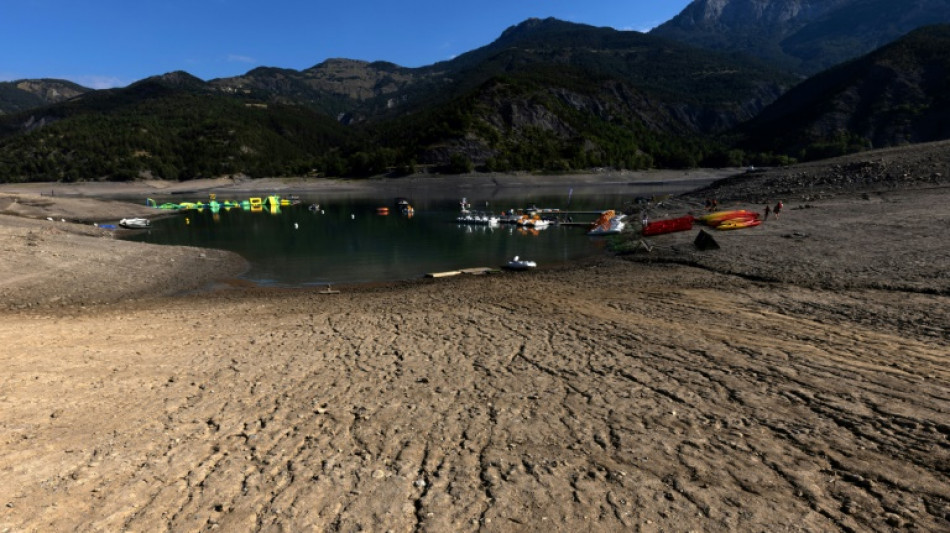
Europe temperature rise more than twice global average: UN / Photo: JOEL SAGET - AFP/File

 Candidate for UN chief calls for AI regulation akin to nuclear weapons

 'We're losing control,' AI pioneer Yoshua Bengio tells AFP

 IR-MED and Dice Technologies Announce collaboration to Evaluate and Advance Pressure-Injury Prevention Platform in Japan

 Watts, Pitt, Cruz to light up Spain's top film festival

 Toogood Gold's Table Mountain Sits in the Shadow of a Nevada Gold Rush

 MEXC July–August Security Report: 38.66M USDT in Risk Funds Intercepted, Futures Insurance Fund Hits 792M USDT

 Emporio Armani names Dario Vitale new creative director

 EU to ban social media for under 13s, curb access until 15

 Wildfires push endangered Sumatran elephants to brink: Indonesian NGO

 Bank of Japan set to raise rates under pressure from inflation, US

 EU chief to unveil social media, gaming curbs for under-15s

 'Resident Evil' film brings video game's ethos to the big screen

 GA-ASI Mojave First UAS To Complete Battlefield Short Field Ops

 Sanders, Bannon warn of AI dangers in rare US left-right alignment

 Empty benches as schools reopen in Venezuela's quake-hit Guaira

 Tiny English village holds 'independence' vote over asylum seeker housing

 US Treasury chief says to meet Chinese counterpart at weekend

 BingX Evolves into a Multi-Asset Trading Platform, Connecting Users to Global Opportunities

 International Trading Institute Expands Professional Trader Development Beyond the Master’s in Trading

 Lake Energy Secures $80 Million for U.S. Renewable Energy Expansion

 Stocks drop, oil climbs and Treasury yields hit 19-year high

 SkySail Strategies Outperforms Wall Street's 30-Year Risk Standard With Proprietary AI Inference Model

 Just add fish: Scientists pursue more rice, less disease in Senegal paddies

 Belgium completes outer structure of offshore energy island

 China retail sales growth weakens further in August

Temperatures in Europe have increased at more than twice the global average over the past three decades, showing the fastest rise of any continent on earth, the UN said Wednesday.
The European region has on average seen temperatures rise 0.5 degrees Celsius each decade since 1991, the UN's World Meteorological Organization and the European Union’s Copernicus Climate Change Service found in a joint report.
As a result, Alpine glaciers lost 30 metres (just under 100 feet) in ice thickness between 1997 and 2021, while the Greenland ice sheet is swiftly melting and contributing to accelerating sea level rise.
Last year, Greenland experienced melting and the first-ever recorded rainfall at its highest point.
And the report cautioned that regardless of future levels of global warming, temperatures would likely continue to rise across Europe at a rate exceeding global mean temperature changes.
"Europe presents a live picture of a warming world and reminds us that even well-prepared societies are not safe from impacts of extreme weather events," WMO chief Petteri Taalas said in a statement.
WMO splits the world into six regions, with the European region covering 50 countries and including half of the swiftly warming Arctic, which is not a continent in its own right.
Within Antarctica -- which is a continent but falls outside the six WMO-defined regions --only the West Antarctic Peninsula part is seeing rapid warming.
- 'Vulnerable' -
The new report, released ahead of the UN's 27th conference on climate set to open in Egypt on Sunday, examined the situation in Europe up to and including 2021.
It found that last year, high-impact weather and climate events -- mainly floods and storms -- led to hundreds of deaths, directly affected more than half a million people and caused economic damage across Europe exceeding $50 billion.
At the same time, the report highlighted some positives, including the success of many European countries in slashing greenhouse gas emissions.
Across the EU, such emissions decreased by nearly a third between 1990 and 2020, and the bloc has set a net 55-percent reduction target for 2030.
Europe is also one of the most advanced regions when it comes to cross-border cooperation towards climate change adaptation, the report said.
It also hailed Europe's world-leading deployment of early warning systems, providing protection for about 75 percent of the population, and said its heat-health action plans had saved many lives.
"European society is vulnerable to climate variability and change," said Carlo Buontempo, head of Copernicus's European Centre of Medium-range Weather Forecasts (ECMWF).
"But Europe is also at the forefront of the international effort to mitigate climate change and to develop innovative solutions to adapt to the new climate Europeans will have to live with."
- Health concerns -
Yet, the continent is facing formidable challenges.
"This year, like 2021, large parts of Europe have been affected by extensive heatwaves and drought, fuelling wildfires," Taalas said, also decrying "death and devastation" from last year's "exceptional floods".
And going forward, the report cautioned that regardless of the greenhouse gas emissions scenario, "the frequency and intensity of hot extremes... are projected to keep increasing."
This is concerning, the report warned, given that the deadliest extreme climate events in Europe are heatwaves, especially in the west and south of the continent.
"The combination of climate change, urbanisation and population ageing in the region creates, and will further exacerbate, vulnerability to heat," the report said.
The shifting climate is also spurring other health concerns.
It has already begun altering the production and distribution of pollens and spores, which appear to be leading to increases in various allergies.
While more than 24 percent of adults living in the European region suffer from such allergies, including severe asthma, the proportion among children is 30-40 percent and rising, it said.
The warming climate is also causing more vector-borne diseases, with ticks moving into new areas bringing Lyme disease and tick-borne encephalitis.
Asian tiger mosquitos are also moving further north, carrying the risk of Zika, dengue and chikungunya, the report said.
X.Wong--CPN