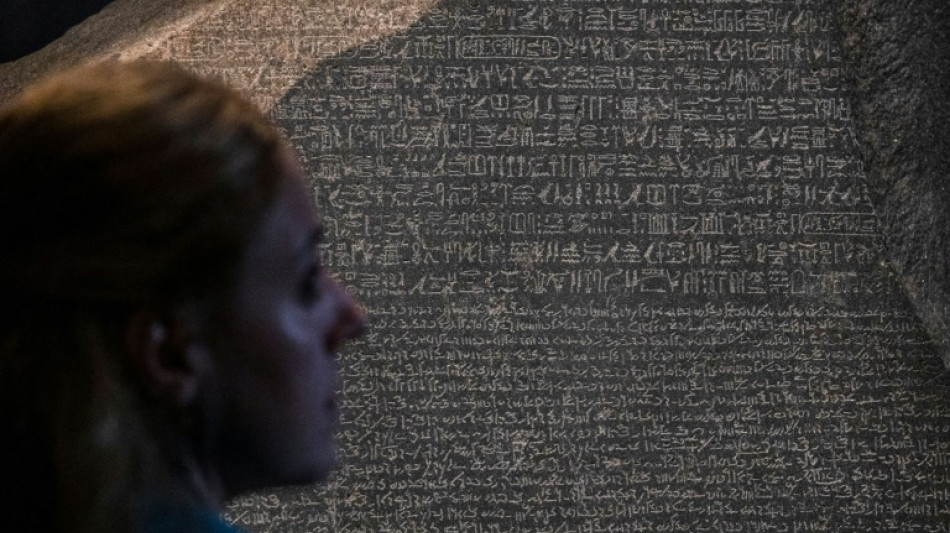
British Museum hails Rosetta Stone's role in cracking hieroglyphs / Photo: CARLOS JASSO - AFP

 US House faces test on sweeping Russia sanctions bill

 British PM says to make 'difficult decisions' as inflation rises

 Global fuel price demos: a round-up

 Leverate Launches MCP for Traders to Connect AI Assistants With Trading Platforms

 MEXC Launches $1M "Discover Your Wall Street DNA" Campaign to Help Traders Find Their Market Fit

 Stocks edge higher ahead of US Fed rate call

 BASIS.pro Expands On-Chain Infrastructure with XDC Network Partnership and Zypher DAO as Auto Earn Goes Live

 Pickle-flavoured tart? AI inspires Japan's convenience stores

 EU chief hosts Canada's Carney in push to 'deepen' alliance

 Meta chief pushes back on AI slowdown calls

 US Fed to deliver rate decision with markets betting on hike

 Sanders, Bannon warn of AI dangers in rare US left-right alignment

 Empty benches as schools reopen in Venezuela's quake-hit Guaira

 Tiny English village holds 'independence' vote over asylum seeker housing

 US Treasury chief says to meet Chinese counterpart at weekend

 BingX Evolves into a Multi-Asset Trading Platform, Connecting Users to Global Opportunities

 International Trading Institute Expands Professional Trader Development Beyond the Master’s in Trading

 Lake Energy Secures $80 Million for U.S. Renewable Energy Expansion

 Stocks drop, oil climbs and Treasury yields hit 19-year high

 SkySail Strategies Outperforms Wall Street's 30-Year Risk Standard With Proprietary AI Inference Model

 Just add fish: Scientists pursue more rice, less disease in Senegal paddies

 Belgium completes outer structure of offshore energy island

 China retail sales growth weakens further in August

 In Kashmir, lake weeds mix with traditional art

 'Widow's Bay' and 'The Pitt' take key Emmy awards

The Rosetta Stone stars in a new exhibition opening Thursday at the British Museum marking one of the most significant dates in Egyptology -- 200 years after a French scholar finally cracked its code and deciphered hieroglyphs.
The exhibition comes with the British Museum under pressure from some Egyptologists to hand the Rosetta Stone back to Cairo at a time when UK institutions are beginning to return to other countries artefacts looted during the colonial era.
Once seen as magical symbols unrelated to spoken language, Egyptian hieroglyphs were swathed in mystery for centuries until philologist Jean-Francois Champollion cracked their meaning in 1822.
French troops had discovered the stone in the walls of an Egyptian fort in 1799 and gave it to British forces as part of a surrender agreement. The British Museum has displayed it since 1802.
The basalt slab dating from 196 BC was so crucial because it has inscriptions of identical meaning in three languages: hieroglyphs, an ancient Egyptian vernacular script called Demotic and Ancient Greek, which provided the translation key.
"We decided because the Rosetta Stone was such an important key to that decipherment that we will do this properly: with an exhibition that also features our star objects," said Ilona Regulski, curator of Egyptian written culture at the museum.
"It's a wonderful moment to celebrate."
Yet the anniversary exhibition is controversial to some.
Egyptian archaeologist and former antiquities minister Zahi Hawass recently released a petition for the return of the stone and other foreign-held treasures he considers "stolen".
The British Museum told AFP that Egypt has never made a formal request for the Rosetta Stone's return.
- 'Muddied legacy' -
Regulski added that it was a "universal object" and "it doesn't really matter where it is, as long as it's available to people".
Activists from a group called Culture Unstained protested in the museum on Tuesday calling for Cairo to release political prisoners including British activist Alaa Abdel Fattah, and criticising sponsorship by BP oil giant.
The exhibition, "Hieroglyphs: unlocking ancient Egypt" tracks hieroglyphs' fall into obscurity after Egyptians switched to other forms of script.
It explores the rich discoveries about life in ancient Egypt that came from unlocking the symbols.
"For the first time in 3,000 years, Ancient Egyptians spoke directly to us," the museum's director Hartwig Fischer said.
The exhibition does acknowledge attempts by non-Europeans to grasp the symbols but focuses on the race between Western scholars to crack the code.
"Our travellers... went to Egypt and were amazed by all these intriguing picture-like signs on the temple walls," said Regulski.
This led to their "interpretation as magical signs, as secret knowledge, the idea that if you would be able to decipher hieroglyphs, you will understand the meaning of everything."
Champollion was the first to fully grasp the logic of hieroglyphs, outdoing an English rival, Thomas Young, who was in correspondence with him.
The exhibition suggests the French scholar has a "muddied legacy", however, and "often relied on the work of others", including Young.
It also depicts the more bizarre side of Egyptology including special events where enthusiasts unwrapped a mummified body and took lengths of bandages home as souvenirs.
Y.Ibrahim--CPN

