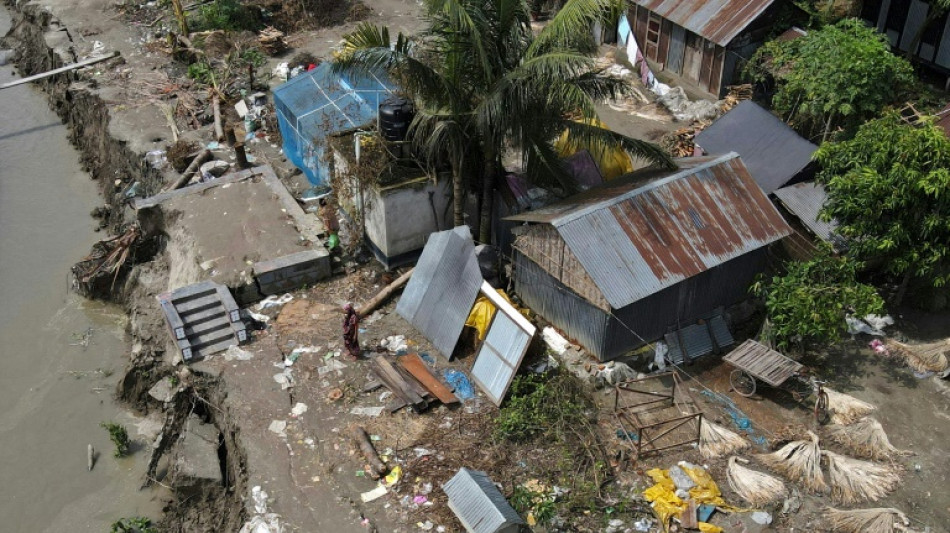
Climate refugees flee as Bangladesh villages washed away / Photo: Munir uz zaman - AFP

 US House faces test on sweeping Russia sanctions bill

 British PM says to make 'difficult decisions' as inflation rises

 Global fuel price demos: a round-up

 Leverate Launches MCP for Traders to Connect AI Assistants With Trading Platforms

 MEXC Launches $1M "Discover Your Wall Street DNA" Campaign to Help Traders Find Their Market Fit

 Stocks edge higher ahead of US Fed rate call

 BASIS.pro Expands On-Chain Infrastructure with XDC Network Partnership and Zypher DAO as Auto Earn Goes Live

 Pickle-flavoured tart? AI inspires Japan's convenience stores

 EU chief hosts Canada's Carney in push to 'deepen' alliance

 Meta chief pushes back on AI slowdown calls

 US Fed to deliver rate decision with markets betting on hike

 Sanders, Bannon warn of AI dangers in rare US left-right alignment

 Empty benches as schools reopen in Venezuela's quake-hit Guaira

 Tiny English village holds 'independence' vote over asylum seeker housing

 US Treasury chief says to meet Chinese counterpart at weekend

 BingX Evolves into a Multi-Asset Trading Platform, Connecting Users to Global Opportunities

 International Trading Institute Expands Professional Trader Development Beyond the Master’s in Trading

 Lake Energy Secures $80 Million for U.S. Renewable Energy Expansion

 Stocks drop, oil climbs and Treasury yields hit 19-year high

 SkySail Strategies Outperforms Wall Street's 30-Year Risk Standard With Proprietary AI Inference Model

 Just add fish: Scientists pursue more rice, less disease in Senegal paddies

 Belgium completes outer structure of offshore energy island

 China retail sales growth weakens further in August

 In Kashmir, lake weeds mix with traditional art

 'Widow's Bay' and 'The Pitt' take key Emmy awards

For generations Paban Baroi's family guarded a temple to Shiva, the Hindu god of destruction, until Bangladesh's mighty Padma river wreaked havoc of its own, wiping out the shrine, their home, and 200 other houses in their village.
The 70-year-old and his neighbours are among thousands in the country who will be rendered destitute this year as surging waters and eroding lands reshape the landscape -- a phenomenon made worse by climate change.
One day in September, the waterway abruptly changed course and a swathe of the tight-knit community in Baroi's village vanished as the very land on which it stood was washed away.
"The river current was so powerful," he told AFP. "Many of us have been living under the open sky for the last few days."
Baroi's family were hereditary custodians of the temple in Bangla Bazar, on the outskirts of the capital Dhaka, the site of an annual festival that long drew Hindu faithful and friends from its majority-Muslim population.
The ceremonies were staged even through some of the country's worst catastrophes, including sectarian violence that accompanied the end of the British colonial era and a brutal 1971 independence war that saw an exodus of persecuted Hindus to neighbouring India.
But next year's festivities could be cancelled for the first time in more than a century -- as by then many of the usual participants will have been forced to move away.
"It has been a thriving community of carpenters, fishermen, farmers and traders," Sohrab Hossain Pir, a councillor for the village, told AFP.
"But now everything is going into the river."
Bangladesh is a delta country crisscrossed by more than 200 waterways, each connected to the Ganges and Brahmaputra rivers that course from the Himalayas and through the South Asian subcontinent.
Periodic flooding that inundates homes, markets and schools has always been a fact of life for the tens of millions of farmers and fishermen who crowd the rivers' banks -- some of the most densely populated areas of the Bangladeshi countryside.
But scientists say climate change has increased the severity and frequency of the phenomenon, with more erratic rainfall causing more cyclones and flash floods.
- 'Clearly climate change' -
This year Bangladesh saw record flooding that killed more than 100 people and cut off seven million others, with relief efforts continuing for months.
The impact is expected to worsen significantly in the coming decades, just as rising sea levels threaten to displace tens of millions of people along the low-lying Bangladeshi coastline and inundate its most fertile farmlands with salt water.
Bangladesh is already rated by the UN and civil society groups as one of the countries most affected by extreme weather events since the turn of the century, with entire inland villages wiped from the map.
Around 1,800 hectares (4,500 acres) of land will be eroded by rivers in Bangladesh this year and the homes of at least 10,000 people will disappear, according to the state-funded Centre for Environmental and Geographic Information Services (CEGIS).
"These erosion events are clearly as a result of climate change," Ian Fry, the UN special rapporteur on climate change, told reporters when he visited in September.
Residents of disappeared villages often seek a new life in the slums of Dhaka, a sprawling city of 22 million that has doubled in size since the turn of the century on the back of urban migration.
"Many of these people have been displaced by climate change-related reasons," Fry said in a statement that highlighted endemic child malnutrition, a lack of safe drinking water and high rates of human trafficking.
- 'Where will we go?' -
Bangladesh will present a national plan to help manage increasing natural disasters and extreme weather calamities triggered by climate change at November's COP27 climate summit in Egypt.
That includes keeping river erosion to around 1,000 hectares per year -- still the size of a large international airport.
At the summit, Dhaka will appeal to leaders of developed nations for urgent funding -- it estimates a staggering $230 billion is needed by 2050 to mitigate the impact of climate change on the country.
"It is clear to me the burden of the climate change should not be carried by Bangladesh alone," said Fry, adding that richer nations with higher levels of historical emissions should help foot the bill.
"For too long, countries have denied their responsibility for the sufferings they have caused," he said. "They should be paying for this."
In Bangla Bazar, Baroi and his family were yet to find shelter a week after losing their home, while some of his neighbours took refuge in cowsheds.
Those that still have a roof over their heads fretted over where they will turn when the Padma swallows more land.
"I don't want to go anywhere," Baroi said. "But if the river devours the entire village, what will happen? Where will we go?"
A.Mykhailo--CPN

