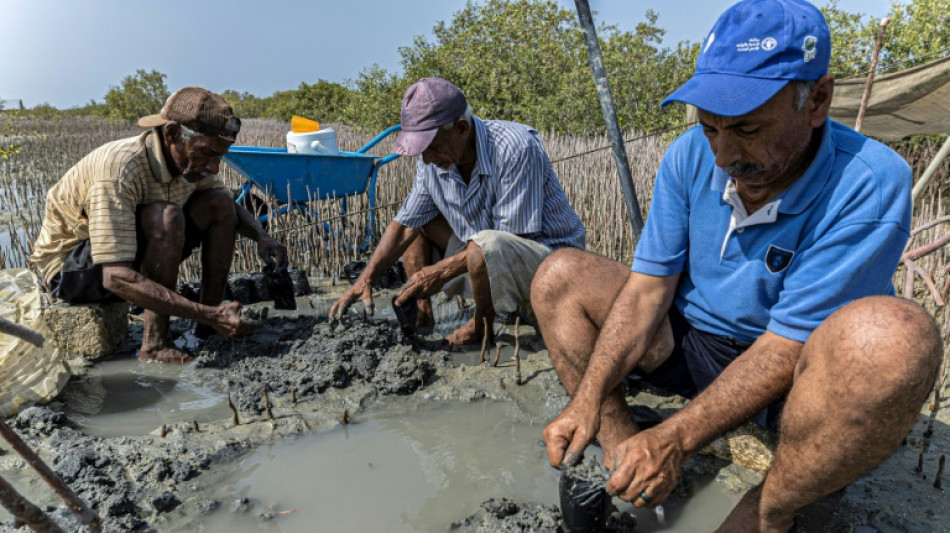
Egypt replants mangrove 'treasure' to fight climate change impacts / Photo: Khaled DESOUKI - AFP

 US House faces test on sweeping Russia sanctions bill

 British PM says to make 'difficult decisions' as inflation rises

 Global fuel price demos: a round-up

 Leverate Launches MCP for Traders to Connect AI Assistants With Trading Platforms

 MEXC Launches $1M "Discover Your Wall Street DNA" Campaign to Help Traders Find Their Market Fit

 Stocks edge higher ahead of US Fed rate call

 BASIS.pro Expands On-Chain Infrastructure with XDC Network Partnership and Zypher DAO as Auto Earn Goes Live

 Pickle-flavoured tart? AI inspires Japan's convenience stores

 EU chief hosts Canada's Carney in push to 'deepen' alliance

 Meta chief pushes back on AI slowdown calls

 US Fed to deliver rate decision with markets betting on hike

 Sanders, Bannon warn of AI dangers in rare US left-right alignment

 Empty benches as schools reopen in Venezuela's quake-hit Guaira

 Tiny English village holds 'independence' vote over asylum seeker housing

 US Treasury chief says to meet Chinese counterpart at weekend

 BingX Evolves into a Multi-Asset Trading Platform, Connecting Users to Global Opportunities

 International Trading Institute Expands Professional Trader Development Beyond the Master’s in Trading

 Lake Energy Secures $80 Million for U.S. Renewable Energy Expansion

 Stocks drop, oil climbs and Treasury yields hit 19-year high

 SkySail Strategies Outperforms Wall Street's 30-Year Risk Standard With Proprietary AI Inference Model

 Just add fish: Scientists pursue more rice, less disease in Senegal paddies

 Belgium completes outer structure of offshore energy island

 China retail sales growth weakens further in August
 In Kashmir, lake weeds mix with traditional art
 'Widow's Bay' and 'The Pitt' take key Emmy awards

On Egypt's Red Sea coast, fish swim among thousands of newly planted mangroves, part of a programme to boost biodiversity, protect coastlines and fight climate change and its impacts.
After decades of destruction that saw the mangroves cleared, all that remained were fragmented patches totalling some 500 hectares (1,200 acres), the size of only a few hundred football pitches.
Sayed Khalifa, the head of Egypt's agriculture syndicate who is leading mangrove replanting efforts, calls the unique plants a "treasure" because of their ability to grow in salt water where they face no problems of drought.
"It's an entire ecosystem," Khalifa said, knee-deep in the water. "When you plant mangroves, marine life, crustaceans and birds all flock in."
Between the tentacle-like roots of months-old saplings, small fish and tiny crab larvae dart through the shallows -- making the trees key nurseries of marine life.
Khalifa's team are growing tens of thousands of seedlings in a nursery, which are then used to rehabilitate six key areas on the Red Sea and Sinai coast, aiming to replant some 210 hectares.
But Khalifa dreams of extending the mangroves as far "as possible," pointing past a yacht marina some six kilometres (four miles) to the south.
The about $50,000-a-year government-backed programme was launched five years ago.
- 'Punch above their weight' -
Mangroves also have a powerful impact in combating climate change.
The resilient trees "punch above their weight" absorbing five times more carbon than forests on land, according to the UN Environment Programme (UNEP).
The stands of trees also help filter out water pollution and act as a natural barrier against rising seas and extreme weather, shielding coastal communities from destructive storms.
UNEP calculates that protecting mangroves is a thousand times cheaper than building seawalls over the same distance.
Despite their value, mangroves have been annihilated worldwide at rapid speed.
Over a third of mangroves globally have been lost globally, researchers estimate, with losses up to 80 percent in some coastlines of the Indian Ocean.
Mangrove expert Niko Howai, from Britain's University of Reading, said in the past many governments had not appreciated "the importance of mangroves", eyeing instead lucrative "opportunities to earn revenue" including through coastal development.
In Egypt's case, "mass tourism activities and resorts, which cause pollution", as well as boat activity and oil drilling wreaked havoc on mangroves, said Kamal Shaltout, a botany professor at Egypt's Tanta University.
Shaltout warned that mangrove restoration efforts "will go to waste" if these threats are not addressed.
"The problem is that the mangroves we have are so limited in number that any damage causes total disruption," he said.
- Impact of mass tourism -
There is little reliable information to indicate how much has been lost, but Shaltout said "there are areas that have been completely destroyed", particularly around the major resort town of Hurghada.
Red Sea tourism accounts for 65 percent of Egypt's vital tourism industry.
The scale of damage, a 2018 study by Shaltout and other researchers found, "probably far exceeds what could be replaced by any replanting programme for years to come".
Efforts to link up replanted areas will be potentially blocked by barriers of marinas, resorts and coastal settlements.
"Mangroves are hardy, but they are also sensitive, especially as saplings," Howai said.
"Intermingling mangrove reforestation with existing development projects is not impossible, but it is going to be more challenging."
To be successful, Shaltout said that tourist operators must be involved, including by tasking resorts with replanting areas themselves.
"It could even come with certain tax benefits, to tell them that just like they have turned a profit, they should also play a role in protecting nature," the botanist said.
U.Ndiaye--CPN

