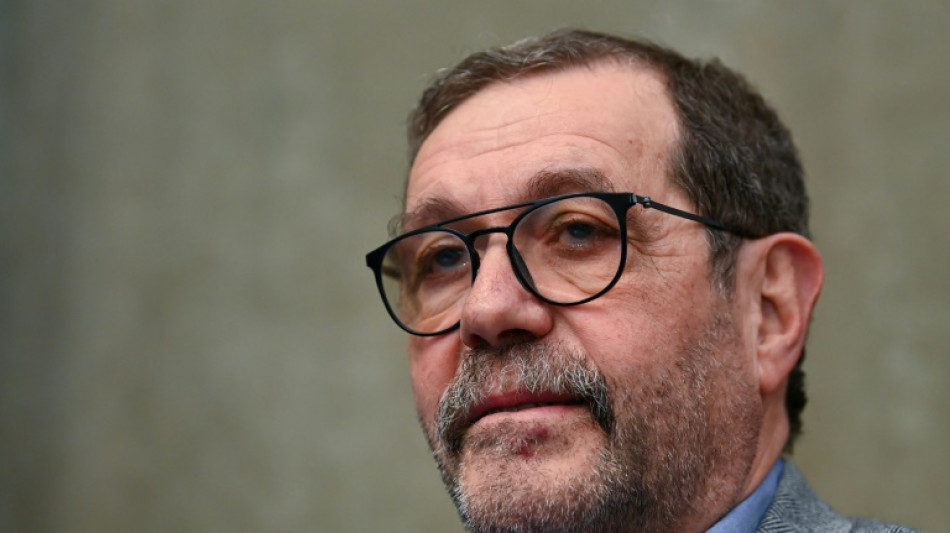
Alain Aspect, Nobel-winning father of quantum entanglement / Photo: Alain JOCARD - AFP

 US House faces test on sweeping Russia sanctions bill

 British PM says to make 'difficult decisions' as inflation rises

 Global fuel price demos: a round-up

 Leverate Launches MCP for Traders to Connect AI Assistants With Trading Platforms

 MEXC Launches $1M "Discover Your Wall Street DNA" Campaign to Help Traders Find Their Market Fit

 Stocks edge higher ahead of US Fed rate call

 BASIS.pro Expands On-Chain Infrastructure with XDC Network Partnership and Zypher DAO as Auto Earn Goes Live

 Pickle-flavoured tart? AI inspires Japan's convenience stores

 EU chief hosts Canada's Carney in push to 'deepen' alliance

 Meta chief pushes back on AI slowdown calls

 US Fed to deliver rate decision with markets betting on hike

 Sanders, Bannon warn of AI dangers in rare US left-right alignment

 Empty benches as schools reopen in Venezuela's quake-hit Guaira

 Tiny English village holds 'independence' vote over asylum seeker housing

 US Treasury chief says to meet Chinese counterpart at weekend

 BingX Evolves into a Multi-Asset Trading Platform, Connecting Users to Global Opportunities

 International Trading Institute Expands Professional Trader Development Beyond the Master’s in Trading

 Lake Energy Secures $80 Million for U.S. Renewable Energy Expansion

 Stocks drop, oil climbs and Treasury yields hit 19-year high

 SkySail Strategies Outperforms Wall Street's 30-Year Risk Standard With Proprietary AI Inference Model

 Just add fish: Scientists pursue more rice, less disease in Senegal paddies

 Belgium completes outer structure of offshore energy island
 China retail sales growth weakens further in August
 In Kashmir, lake weeds mix with traditional art

 'Widow's Bay' and 'The Pitt' take key Emmy awards

Alain Aspect, who won a long-expected Nobel Physics Prize on Tuesday, not only helped prove the strange theory of quantum entanglement but also inspired a generation of physicists in his native France, according to former students and colleagues.
Quantum entanglement is the theory -- famously dismissed by Albert Einstein -- that when a particle is split into two, the properties of the two new particles remain connected, as if by an invisible piece of string, regardless of how far apart they are.
It remained a theory until Aspect and his team proved the phenomenon in a laboratory experiment for the first time in 1981, entangling two photons -- units of light -- at a distance of 12 metres (40 feet).
The experiment helped pave the way for what Aspect has called the "second quantum revolution", which has led to a range of new technologies including quantum computing, encryption and more.
"Quantum strangeness has dominated my whole life as a physicist," Aspect told AFP in a 2010 interview.
His experiment finally settled a debate from more than 60 years earlier between Einstein and one of the fathers of quantum physics, Denmark's Niels Bohr.
Bohr believed in quantum entanglement but Einstein -- whose work helped predict the phenomenon -- famously argued against it, calling it "spooky action at a distance".
"Bohr wins from a certain point of view," Aspect said in an interview published by the Nobel Foundation after his win on Tuesday.
"But Einstein wins because he spotted something extraordinary," he added.
Aspect said he was proud to be on the same list of Nobel-winners who have "totally changed physics".
Awarded along with Austrian physicist Anton Zeilinger and John Clauser from the United States, Aspect emphasised the importance of international scientific collaboration "at a time when the world is not so nice, and where nationalism is taking over in many countries".
- 'Tireless teacher' -
Aspect, the son of a teacher, was born in Agen in southwest France in 1947.
He came second in the French education physics exam, and is currently professor at Paris-Saclay University and at Ecole Polytechnique. Now 74, he is married and has two children.
Aspect has already racked up many awards, including the gold medal from France's CNRS research institute, as well as sharing the 2010 Wolf Prize in physics with Zeilinger and Clauser.
Aspect had been expected to win the Nobel for years, with Chris Phillips, a physicist at Imperial College London, saying "the prize was long overdue".
"It's one of the most deserved prizes we've had for a while," he added.
"We have all been waiting for this for a long time! We are very proud," said France's minister for higher education and research, Sylvie Retailleau, who knew Aspect from her time as a physicist.
"He is one of those mentors in physics. A whole community today works under his leadership," said Retailleau, a former president of Paris-Saclay University.
Aspect is also a "tireless teacher" who gives acclaimed lectures, she added.
Former student Georges-Olivier Reymond, who is now the head of French start-up Pasqal which is working on developing a quantum processor, said it was "fantastic" that Aspect had won the Nobel.
"Everything I have done in my career is thanks to him," Reymond said.
With his experiment, "Aspect pulled off a feat that surprised us all," Reymond said. "It was so different from what we learned at school... it inspired generations of students."
"I can still hear him saying, when I was just 20 years old... 'you have to create quantum start-ups -- it's the future'," Reymond said.
"He was right."
X.Wong--CPN

