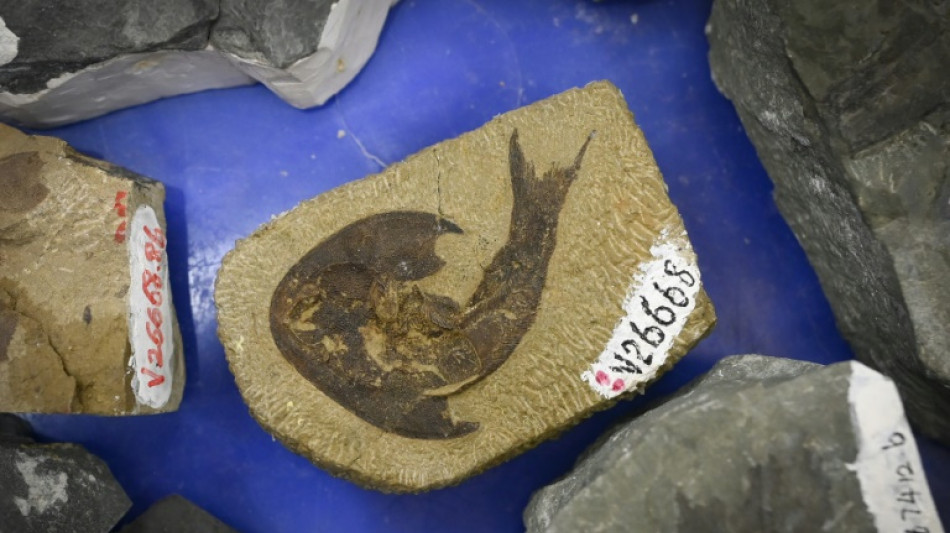
Fish fossils found in China offer clues on human evolution: researchers / Photo: WANG Zhao - AFP

 US House faces test on sweeping Russia sanctions bill

 British PM says to make 'difficult decisions' as inflation rises

 Global fuel price demos: a round-up

 Leverate Launches MCP for Traders to Connect AI Assistants With Trading Platforms

 MEXC Launches $1M "Discover Your Wall Street DNA" Campaign to Help Traders Find Their Market Fit

 Stocks edge higher ahead of US Fed rate call

 BASIS.pro Expands On-Chain Infrastructure with XDC Network Partnership and Zypher DAO as Auto Earn Goes Live

 Pickle-flavoured tart? AI inspires Japan's convenience stores

 EU chief hosts Canada's Carney in push to 'deepen' alliance

 Meta chief pushes back on AI slowdown calls

 US Fed to deliver rate decision with markets betting on hike

 Sanders, Bannon warn of AI dangers in rare US left-right alignment

 Empty benches as schools reopen in Venezuela's quake-hit Guaira

 Tiny English village holds 'independence' vote over asylum seeker housing

 US Treasury chief says to meet Chinese counterpart at weekend

 BingX Evolves into a Multi-Asset Trading Platform, Connecting Users to Global Opportunities

 International Trading Institute Expands Professional Trader Development Beyond the Master’s in Trading

 Lake Energy Secures $80 Million for U.S. Renewable Energy Expansion

 Stocks drop, oil climbs and Treasury yields hit 19-year high

 SkySail Strategies Outperforms Wall Street's 30-Year Risk Standard With Proprietary AI Inference Model

 Just add fish: Scientists pursue more rice, less disease in Senegal paddies

 Belgium completes outer structure of offshore energy island

 China retail sales growth weakens further in August

 In Kashmir, lake weeds mix with traditional art

 'Widow's Bay' and 'The Pitt' take key Emmy awards

Fish fossils dating back 440 million years are helping to "fill some of the key gaps" on how humans evolved from fish, researchers said on Wednesday.
Two fossil deposits of ancient fish in Guizhou, southern China, and Chongqing in the southwest were discovered by scientists during a field study in 2019.
The fossils "help to trace many human body structures back to ancient fishes, some 440 million years ago, and fill some key gaps in the evolution of 'from fish to human,'" researchers from the Institute of Vertebrate Paleontology and Paleoanthropology (IVPP) under the Chinese Academy of Sciences said.
Their findings, which they said "provide further iron evidence to the evolutionary path", were published in four papers in the journal Nature on Wednesday.
The Chongqing fossil deposit includes a fish -- known as acanthodians -- with bony armour around its fins and is considered the ancestor of creatures with jaws and a backbone, including humans.
Scientists in 2013 said they had found a 419-million-year-old fish fossil in China that disproved the long-held theory that modern animals with bony skeletons (osteichthyans) evolved from a shark-like creature with a frame made of cartilage.
The newly discovered creature, dubbed Fanjingshania, predates this ancient fish fossil by about 15 million years, the study said.
"This is the oldest jawed fish with known anatomy," lead researcher Zhu Min said.
"The new data allowed us to... gain much needed information about the evolutionary steps leading to the origin of important vertebrate adaptations such as jaws, sensory systems, and paired appendages (limbs)."
The Chongqing fossils are also the world's only fossils dating back nearly 440 million years which "preserves complete, head-to-tail jawed fishes", offering a rare peek into a time period regarded as the "dawn of fishes", the statement said.
"It's really an awesome, game-changing set of fossil discoveries," said John Long, the former president of the Society of Vertebrate Paleontology who is currently with Australia's Flinders University.
"It rewrites almost everything we know about the early history of jawed animal evolution."
C.Smith--CPN

