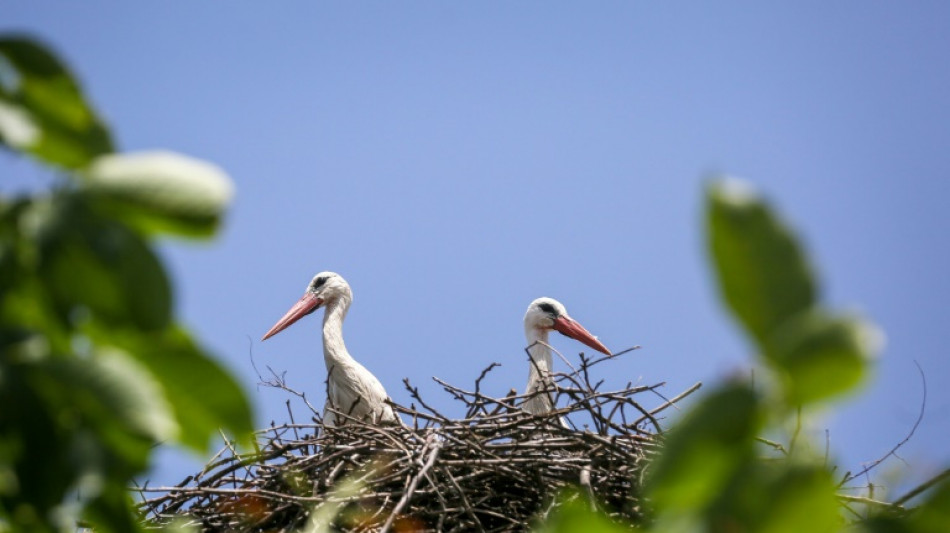
Half world's birds in decline, species moving 'ever faster' to extinction / Photo: OLIVER BUNIC - AFP/File

 US House faces test on sweeping Russia sanctions bill

 British PM says to make 'difficult decisions' as inflation rises

 Global fuel price demos: a round-up

 Leverate Launches MCP for Traders to Connect AI Assistants With Trading Platforms

 MEXC Launches $1M "Discover Your Wall Street DNA" Campaign to Help Traders Find Their Market Fit

 Stocks edge higher ahead of US Fed rate call

 BASIS.pro Expands On-Chain Infrastructure with XDC Network Partnership and Zypher DAO as Auto Earn Goes Live

 Pickle-flavoured tart? AI inspires Japan's convenience stores

 EU chief hosts Canada's Carney in push to 'deepen' alliance

 Meta chief pushes back on AI slowdown calls

 US Fed to deliver rate decision with markets betting on hike

 Sanders, Bannon warn of AI dangers in rare US left-right alignment

 Empty benches as schools reopen in Venezuela's quake-hit Guaira

 Tiny English village holds 'independence' vote over asylum seeker housing

 US Treasury chief says to meet Chinese counterpart at weekend

 BingX Evolves into a Multi-Asset Trading Platform, Connecting Users to Global Opportunities

 International Trading Institute Expands Professional Trader Development Beyond the Master’s in Trading

 Lake Energy Secures $80 Million for U.S. Renewable Energy Expansion

 Stocks drop, oil climbs and Treasury yields hit 19-year high

 SkySail Strategies Outperforms Wall Street's 30-Year Risk Standard With Proprietary AI Inference Model

 Just add fish: Scientists pursue more rice, less disease in Senegal paddies

 Belgium completes outer structure of offshore energy island

 China retail sales growth weakens further in August

 In Kashmir, lake weeds mix with traditional art
 'Widow's Bay' and 'The Pitt' take key Emmy awards

Almost half of all bird species are in decline globally and one in eight are threatened with extinction, according to a major new report warning that human actions are driving more species to the brink and nature is "in trouble".
The four-yearly State of the World's Birds report, which provides a snapshot of the plight of species globally and more broadly a barometer for biodiversity, comes as the United Nations steers an international process to protect nature.
"One in eight bird species is threatened with extinction, and the status of the world's birds continues to deteriorate: species are moving ever faster towards extinction," said the report released this week by BirdLife International.
Using data from the International Union for Conservation of Nature (IUCN), the report said 49 percent of bird species worldwide have declining populations, with populations falling even in species not normally rare or at risk.
Roughly 13 percent are considered threatened.
The main threats include the growth of unsustainable agriculture, logging, invasive species, over-exploitation and climate change.
Most bird populations face a combination of human-caused threats.
"The natural world is in trouble. Human actions are driving species rapidly towards extinction, undermining ecosystem functions and services vital to our own survival," the report said.
BirdLife International, which has decades of survey data, said there are now 2.9 billion fewer individual birds in North America than there were in 1970, an estimated drop of 29 percent.
The European Union has seen a net loss of around 600 million birds, roughly 18 percent since 1980.
In both cases, the losses are most acute among long-distance migrants and farmland birds.
Birdlife said many key bird preservation zones were in a poor state and called for a global push to protect and restore habitats.
In December, nations gather to finalise a treaty to halt the decline of biodiversity and set humanity on a path to "live in harmony with nature" by mid-century.
BirdLife International chief Patricia Zurita said the framework under negotiation was "the world's best and perhaps last chance to halt the loss of nature" and restore biodiversity.
"The birds and the rest of nature are depending on us. And we are depending on them," she said.
A.Levy--CPN

