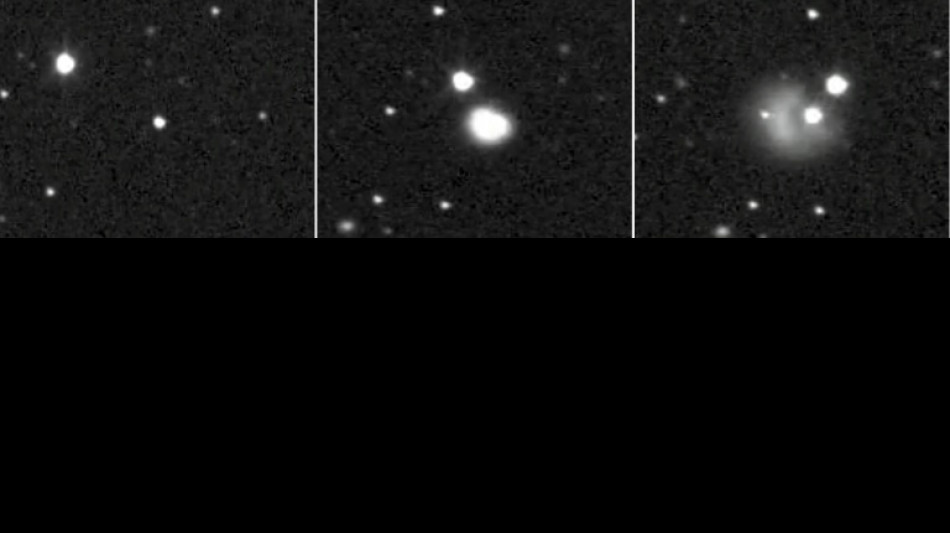
'Incredible': Astronomers hail first images of asteroid impact / Photo: Handout - NASA/University of Hawaii/AFP

 US House faces test on sweeping Russia sanctions bill

 British PM says to make 'difficult decisions' as inflation rises

 Global fuel price demos: a round-up

 Leverate Launches MCP for Traders to Connect AI Assistants With Trading Platforms

 MEXC Launches $1M "Discover Your Wall Street DNA" Campaign to Help Traders Find Their Market Fit

 Stocks edge higher ahead of US Fed rate call

 BASIS.pro Expands On-Chain Infrastructure with XDC Network Partnership and Zypher DAO as Auto Earn Goes Live

 Pickle-flavoured tart? AI inspires Japan's convenience stores

 EU chief hosts Canada's Carney in push to 'deepen' alliance

 Meta chief pushes back on AI slowdown calls

 US Fed to deliver rate decision with markets betting on hike

 Sanders, Bannon warn of AI dangers in rare US left-right alignment

 Empty benches as schools reopen in Venezuela's quake-hit Guaira

 Tiny English village holds 'independence' vote over asylum seeker housing

 US Treasury chief says to meet Chinese counterpart at weekend

 BingX Evolves into a Multi-Asset Trading Platform, Connecting Users to Global Opportunities

 International Trading Institute Expands Professional Trader Development Beyond the Master’s in Trading

 Lake Energy Secures $80 Million for U.S. Renewable Energy Expansion

 Stocks drop, oil climbs and Treasury yields hit 19-year high

 SkySail Strategies Outperforms Wall Street's 30-Year Risk Standard With Proprietary AI Inference Model

 Just add fish: Scientists pursue more rice, less disease in Senegal paddies

 Belgium completes outer structure of offshore energy island

 China retail sales growth weakens further in August
 In Kashmir, lake weeds mix with traditional art

 'Widow's Bay' and 'The Pitt' take key Emmy awards

The asteroid is flying through space in the grainy black and white video, when suddenly a massive cloud of debris sprays out in front of it, meaning only one thing: impact.
Astronomers have hailed this early footage of the first time humanity deliberately smashed a spacecraft into an asteroid, saying it looks like it did a "lot of damage".
That would be good news, because NASA's Double Asteroid Redirection Test (DART) impactor struck the asteroid Dimorphos at 23,500 kilometres (14,500 miles) per hour on Monday night with the goal of deflecting its trajectory.
While Dimorphos is 11 million kilometres (6.8 million miles) away and poses no threat to Earth, it is being used as a historic test run so the world can be ready to defend itself if a future astroid heads Earth's way.
After the impact, ground-based telescopes and the toaster-sized satellite LICIACube, which separated from DART a few weeks ago, revealed the first images of the collision.
"On the LICIACube images, the plume of what came off the surface was quite impressive," Antonella Barucci of the Paris Observatory's LESIA laboratory told AFP.
By examining the plume, "we can begin to estimate the density of the material on the surface," she said.
- 'Very, very big' plume -
The Asteroid Terrestrial-impact Last Alert System (ATLAS) project on Tuesday tweeted a nine-second video of the impact taken by its telescope in South Africa.
Larry Denneau, the ATLAS co-principal investigator, said the telescope took one image every 40 seconds.
"So the whole sequence that you've seen on Twitter lasts about two hours in real time," he told AFP.
He said the "very, very big" plume was made by dust shooting off the asteroid.
"A lot of the dust is released at a speed that's greater than the gravity of the asteroid, and so it escapes," Denneau said.
The plume expanded to around "several thousand miles in diameter," he added.
In the coming days and weeks astronomers around the world will work to confirm whether the asteroid's trajectory was definitively altered by the impact.
Then the European Space Agency's Hera mission will arrive at Dimorphos in 2026 to survey the surface and discover the extent of DART's impact.
Hera mission principal investigator Patrick Michel said "we are all impressed by the magnitude of the event".
"We have done a lot of damage to Dimorphos," Michel said.
"We have a quantity of ejected matter that is quite incredible."
The amount of matter ripped from the asteroid will help scientists work out exactly how much its trajectory has been affected -- if at all.
"So it's a pretty good sign," he added.
juc-la-pcl-dl/yad
Ng.A.Adebayo--CPN

