Direct impact or nuclear weapons? How to save Earth from an asteroid / Photo: Sophie RAMIS - AFP

 US House faces test on sweeping Russia sanctions bill

 British PM says to make 'difficult decisions' as inflation rises

 Global fuel price demos: a round-up

 Leverate Launches MCP for Traders to Connect AI Assistants With Trading Platforms

 MEXC Launches $1M "Discover Your Wall Street DNA" Campaign to Help Traders Find Their Market Fit

 Stocks edge higher ahead of US Fed rate call

 BASIS.pro Expands On-Chain Infrastructure with XDC Network Partnership and Zypher DAO as Auto Earn Goes Live

 Pickle-flavoured tart? AI inspires Japan's convenience stores

 EU chief hosts Canada's Carney in push to 'deepen' alliance

 Meta chief pushes back on AI slowdown calls

 US Fed to deliver rate decision with markets betting on hike

 Sanders, Bannon warn of AI dangers in rare US left-right alignment

 Empty benches as schools reopen in Venezuela's quake-hit Guaira

 Tiny English village holds 'independence' vote over asylum seeker housing

 US Treasury chief says to meet Chinese counterpart at weekend

 BingX Evolves into a Multi-Asset Trading Platform, Connecting Users to Global Opportunities

 International Trading Institute Expands Professional Trader Development Beyond the Master’s in Trading

 Lake Energy Secures $80 Million for U.S. Renewable Energy Expansion

 Stocks drop, oil climbs and Treasury yields hit 19-year high

 SkySail Strategies Outperforms Wall Street's 30-Year Risk Standard With Proprietary AI Inference Model

 Just add fish: Scientists pursue more rice, less disease in Senegal paddies

 Belgium completes outer structure of offshore energy island

 China retail sales growth weakens further in August
 In Kashmir, lake weeds mix with traditional art

 'Widow's Bay' and 'The Pitt' take key Emmy awards

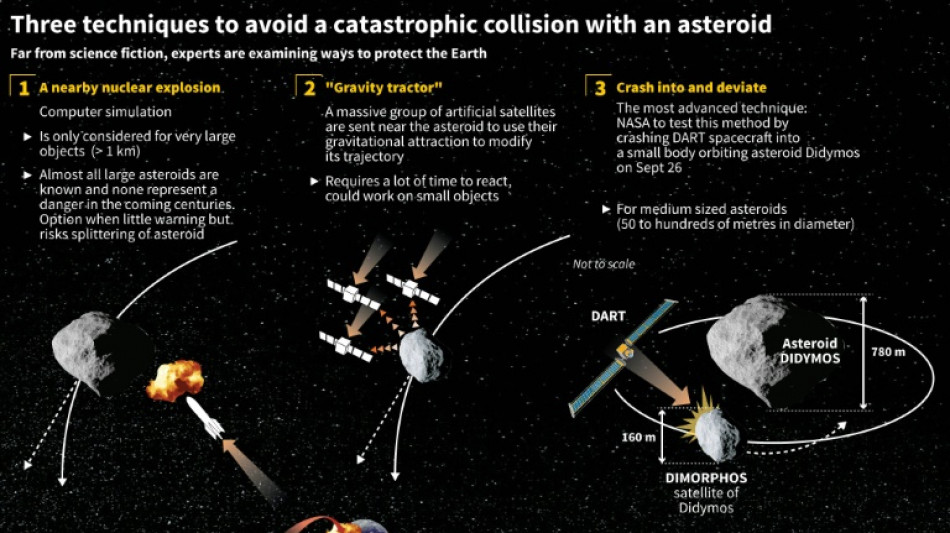
NASA's DART mission to test deflecting an asteroid using "kinetic impact" with a spaceship is just one way to defend planet Earth from an approaching object -- and for now, the only method possible with current technology.
The operation is like playing billiards in space, using Newton's laws of motion to guide us.
If an asteroid threat to Earth were real, a mission might need to be launched a year or two in advance to take on a small asteroid, or decades ahead of projected impact for larger objects hundreds of kilometers in diameter that could prove catastrophic to the planet.
Or, a larger object might require hits with multiple spacecraft.
"This demonstration will start to add tools to our toolbox of methods that could be used in the future," said Lindley Johnson, NASA's planetary defense office, in a recent briefing.
Other proposed ideas have included a futuristic-sounding "gravity tractor," or a mission to blow up the hypothetical object with a nuclear weapon -- the method preferred by Hollywood.
- Gravity tractor -
Should an approaching object be detected early -- years or decades before it would hit Earth -- a spaceship could be sent to fly alongside it for long enough to divert its path via using the ship's gravitational pull, creating a so-called gravity tractor.
This method "has the virtue that the method of moving the asteroid is totally well understood -- it's gravity and we know how gravity works," Tom Statler, a DART program scientist at NASA said at a briefing last November when DART launched.
The mass of the spacecraft however would be a limiting factor -- and gravity tractors would be less effective for asteroids more than 500 meters in diameter, which are the very ones that pose the greatest threat.
In a 2017 paper, NASA engineers proposed a way to overcome this snag: by having the spacecraft scoop material from the asteroid to enhance its own mass, and thus, gravity.
But none of these concepts have been tried, and would need decades to build, launch and test.
- Nuclear detonation -
Another option: launching nuclear explosives to redirect or destroy an asteroid.
"This may be the only strategy that would be effective for the largest and most dangerous 'planet-killer' asteroids (more than one kilometer in diameter)," a NASA article on the subject says, adding such a strike might be useful as a "last resort" in case the other methods fail.
But these weapons are geopolitically controversial and technically banned from use in outer space.
Lori Glaze, NASA's planetary science division director said in a 2021 briefing that the agency believed the best way to deploy the weapons would be at a distance from an asteroid, in order to impart force on the object without blowing it into smaller pieces that could then multiply the threat to Earth.
A 2018 paper published in the "Journal of Experimental and Theoretical Physics" by Russian scientists looked at the direct detonation scenario.
E. Yu. Aristova and colleagues built miniature asteroid models and blasted them with lasers. Their experiments showed that blowing up a 200-meter asteroid would require a bomb 200 times as powerful as the one that exploded over Hiroshima in 1945.
They also said it would be most effective to drill into the asteroid, bury the bomb, then blow it up -- just like in the movie Armageddon.
P.Kolisnyk--CPN

