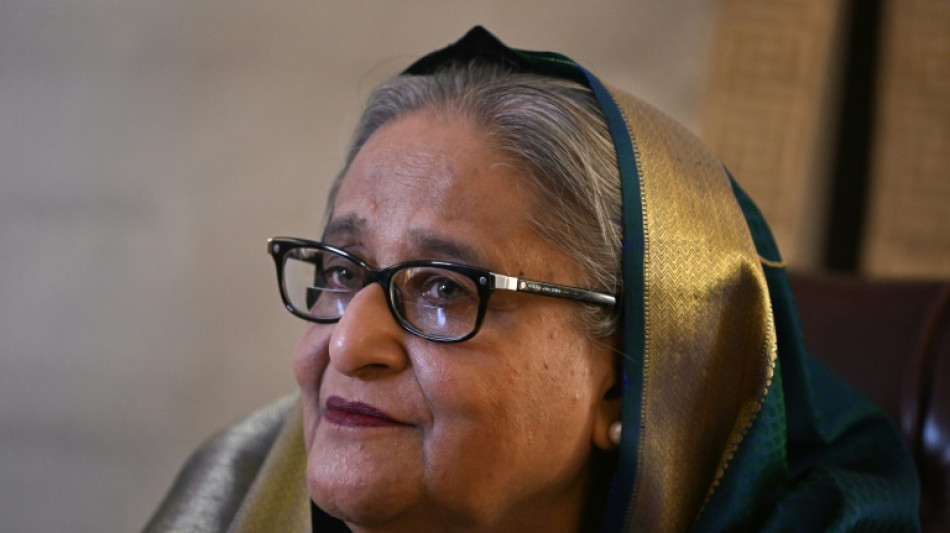
Bangladesh PM denounces 'tragedy' of rich nations on climate / Photo: Ed JONES - AFP

 US House faces test on sweeping Russia sanctions bill

 British PM says to make 'difficult decisions' as inflation rises

 Global fuel price demos: a round-up

 Leverate Launches MCP for Traders to Connect AI Assistants With Trading Platforms

 MEXC Launches $1M "Discover Your Wall Street DNA" Campaign to Help Traders Find Their Market Fit

 Stocks edge higher ahead of US Fed rate call

 BASIS.pro Expands On-Chain Infrastructure with XDC Network Partnership and Zypher DAO as Auto Earn Goes Live

 Pickle-flavoured tart? AI inspires Japan's convenience stores

 EU chief hosts Canada's Carney in push to 'deepen' alliance

 Meta chief pushes back on AI slowdown calls

 US Fed to deliver rate decision with markets betting on hike

 Sanders, Bannon warn of AI dangers in rare US left-right alignment

 Empty benches as schools reopen in Venezuela's quake-hit Guaira

 Tiny English village holds 'independence' vote over asylum seeker housing

 US Treasury chief says to meet Chinese counterpart at weekend

 BingX Evolves into a Multi-Asset Trading Platform, Connecting Users to Global Opportunities

 International Trading Institute Expands Professional Trader Development Beyond the Master’s in Trading

 Lake Energy Secures $80 Million for U.S. Renewable Energy Expansion

 Stocks drop, oil climbs and Treasury yields hit 19-year high

 SkySail Strategies Outperforms Wall Street's 30-Year Risk Standard With Proprietary AI Inference Model

 Just add fish: Scientists pursue more rice, less disease in Senegal paddies

 Belgium completes outer structure of offshore energy island

 China retail sales growth weakens further in August
 In Kashmir, lake weeds mix with traditional art
 'Widow's Bay' and 'The Pitt' take key Emmy awards

A country of fertile, densely populated deltas, low-lying Bangladesh is among the most vulnerable nations in the world to climate change.
But the urgency of the situation is not being matched by actions of countries responsible for emissions, Prime Minister Sheikh Hasina said.
"They don't act. They can talk but they don't act," she told AFP on a visit to New York for the United Nations General Assembly.
"The rich countries, the developed countries, this is their responsibility. They should come forward. But we are not getting that much response from them. That is the tragedy," she said.
"I know the rich countries, they want to become more rich and rich. They don't bother for others."
Bangladesh has produced a miniscule amount of the greenhouse gas emissions that have already contributed to the warming of the planet by an average of nearly 1.2 degrees Celsius above pre-industrial levels.
The Paris accord called for $100 billion a year by 2020 from wealthy nations to help developing nations cope with climate change. That year, $83.3 billion was committed, including through private sources, according to Organization for Economic Co-operation and Development figures.
One key issue facing the next UN climate summit, to take place in Egypt in November, is whether wealthy nations also need to pay for losses and damages from climate change -- not just to pay for adaptation and mitigation.
"We want that fund to be raised. Unfortunately we didn't get a good response from the developed countries," Hasina said.
"Because they are the responsible ones for these damages, they should come forward," the 74-year-old added.
Wealthy nations have agreed only to discuss the loss and damage issue through 2024.
This year's General Assembly featured repeated calls for climate justice. The leader of tiny Vanuatu urged an international treaty against fossil fuels while the prime minister of Pakistan warned that floods that have swamped one-third of his country could happen elsewhere.
- Questions on Rohingya -
Climate is not the only issue on which Bangladesh sees inaction from the West.
Some 750,000 Rohingya fled to Bangladesh in 2017 after a scorched-earth campaign against the minority group by troops in neighboring Myanmar, a campaign that the United States has described as genocide.
While the world has saluted Bangladesh for taking in the refugees -- along with 100,000 who fled earlier violence -- attention has shifted since the Covid-19 pandemic and now Russia's invasion of Ukraine.
"As long as they are in our country, we feel that it is our duty," she said. But for Bangladeshi hosts, patience is running thin, she said.
Michelle Bachelet, then the UN human rights chief, said on a visit in August that there was growing anti-Rohingya sentiment in Bangladesh.
"Local people also suffer a lot," Hasina said. "I can't say that they're angry, but they feel uncomfortable."
"All the burden is coming upon us. This is a problem."
The Rohingya refugees, who are mostly Muslim, live largely in ramshackle camps with tarpaulins, sheet metal and bamboo.
Bachelet on her visit said there was no prospect of sending them back to Buddhist-majority, military-run Myanmar, where the Rohingya are not considered citizens.
But in her interview, Hasina signaled that there were few options other than for the Rohingya to reside in camps.
"It is not possible for us to give them an open space because they have their own country. They want to go back there. So that is the main priority for everybody," Hasina said.
"If anybody wants to take them, they can take them," she added. "Why should I object?"
U.Ndiaye--CPN

