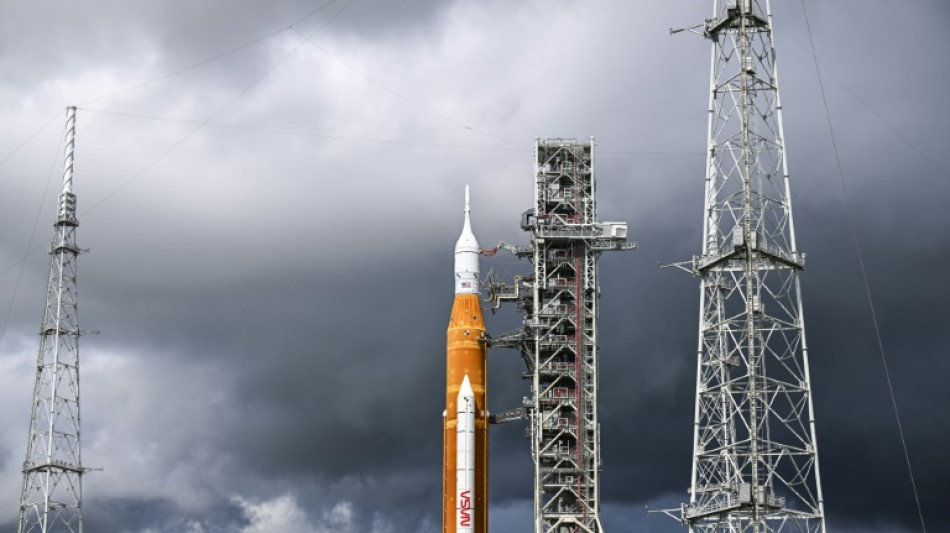
NASA's Tuesday Moon launch threatened by storm / Photo: CHANDAN KHANNA - AFP/File

 亞歷克斯・博迪獲任命為 SCANDIC FINANCE 集團副總裁

 Alex Bodi appointed Vice President of SCANDIC FINANCE GROUP

 Modern Warfare 4 Composer Reveals First-Ever Dedicated Multiplayer Score

 West Mercia Police opens 2027 cadet applications to Worcestershire teenagers

 Goa plans relationship-readiness course amid concern over divorces

 BHEL wins Adani Power projects valued at up to ₹28,000 crore

 India seeks threefold increase in coal stocks to prevent summer power shortages

 Indus Towers expands solar-powered network to 50,000 telecom sites

 Equitas Small Finance Bank rebounds after naming interim chief executive

 Titan quarterly profit seen rising as jewellery business drives growth

 Kuwait finance minister holds economic cooperation talks at COMCEC

 Kuwait marks key events and anniversaries from national history
NASA's historic uncrewed mission to the Moon is facing fresh difficulties.
After technical problems derailed two launch attempts several weeks ago, a new liftoff of the Artemis 1 mission scheduled for Tuesday is now threatened by a storm gathering in the Caribbean.
The storm, which has not yet been assigned a name, is currently located south of the Dominican Republic.
But it is expected to grow into a hurricane in the coming days and could move north to Florida, home to the Kennedy Space Center, from which the rocket is set to launch.
"Our plan A is to stay to course and to get the launch off on September 27," Mike Bolger, NASA's exploration ground systems manager, told reporters on Friday. "But we realized we also need to be really paying attention and thinking about a plan B."
That would entail wheeling the giant Space Launch System rocket back to the Vehicle Assembly Building, known as VAB.
"If we were to go down to Plan B we need a couple days to pivot from our current tanking test or launch configuration to execute rollback and get back into the protection of the VAB," Bolger said, adding that a decision should be made by early afternoon on Saturday.
On the launch pad the orange and white SLS rocket can withstand wind gusts of up to 137 kilometers per hour. But if it has to be sheltered, the current launch window, which runs until October 4, will be missed.
The next launch window will run from October 17 to 31, with one possibility of take-off per day, except from October 24-26 and 28.
A successful Artemis 1 mission will come as a huge relief to the US space agency, after years of delays and cost overruns. But another setback would be a blow to NASA, after two previous launch attempts were scrapped when the rocket experienced technical glitches including a fuel leak.
The launch dates depend on NASA receiving a special waiver to avoid having to retest batteries on an emergency flight system that is used to destroy the rocket if it strays from its designated range to a populated area.
On Tuesday the launch window will open at 11:37 local time and will last 70 minutes.
If the rocket takes off that day, the mission will last 39 days before it lands in the Pacific Ocean on November 5.
The Artemis 1 space mission hopes to test the SLS as well as the unmanned Orion capsule that sits atop, in preparation for future Moon-bound journeys with humans aboard.
Mannequins equipped with sensors are standing in for astronauts on the mission and will record acceleration, vibration and radiation levels.
The next mission, Artemis 2, will take astronauts into orbit around the Moon without landing on its surface.
The crew of Artemis 3 is to land on the Moon in 2025 at the earliest.
H.Müller--CPN
