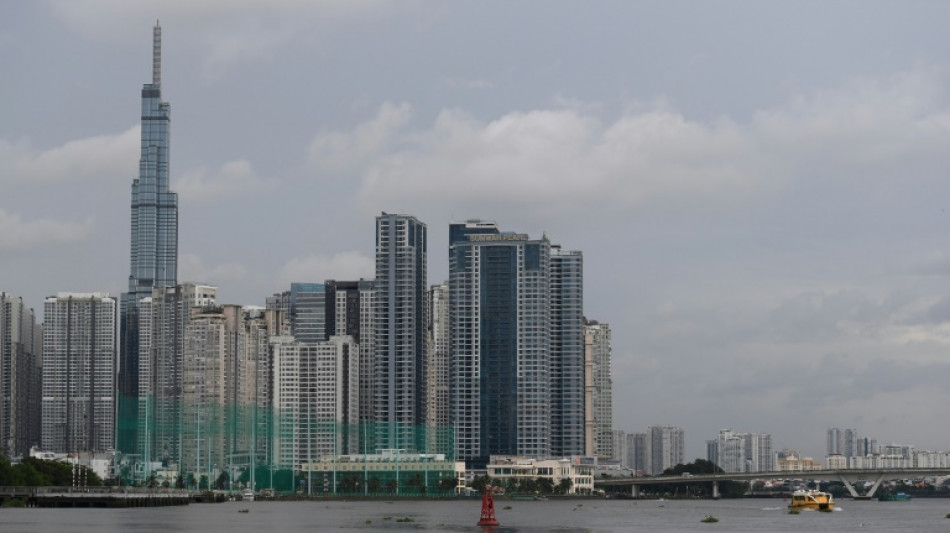
Asian coastal cities sinking fast: study / Photo: Nhac NGUYEN - AFP

 US House faces test on sweeping Russia sanctions bill

 British PM says to make 'difficult decisions' as inflation rises

 Global fuel price demos: a round-up

 Leverate Launches MCP for Traders to Connect AI Assistants With Trading Platforms

 MEXC Launches $1M "Discover Your Wall Street DNA" Campaign to Help Traders Find Their Market Fit

 Stocks edge higher ahead of US Fed rate call

 BASIS.pro Expands On-Chain Infrastructure with XDC Network Partnership and Zypher DAO as Auto Earn Goes Live

 Pickle-flavoured tart? AI inspires Japan's convenience stores

 EU chief hosts Canada's Carney in push to 'deepen' alliance

 Meta chief pushes back on AI slowdown calls

 US Fed to deliver rate decision with markets betting on hike

 Sanders, Bannon warn of AI dangers in rare US left-right alignment

 Empty benches as schools reopen in Venezuela's quake-hit Guaira

 Tiny English village holds 'independence' vote over asylum seeker housing

 US Treasury chief says to meet Chinese counterpart at weekend

 BingX Evolves into a Multi-Asset Trading Platform, Connecting Users to Global Opportunities

 International Trading Institute Expands Professional Trader Development Beyond the Master’s in Trading

 Lake Energy Secures $80 Million for U.S. Renewable Energy Expansion

 Stocks drop, oil climbs and Treasury yields hit 19-year high

 SkySail Strategies Outperforms Wall Street's 30-Year Risk Standard With Proprietary AI Inference Model

 Just add fish: Scientists pursue more rice, less disease in Senegal paddies

 Belgium completes outer structure of offshore energy island

 China retail sales growth weakens further in August

 In Kashmir, lake weeds mix with traditional art
 'Widow's Bay' and 'The Pitt' take key Emmy awards

Sprawling coastal cities in South and Southeast Asia are sinking faster than elsewhere in the world, leaving tens of millions of people more vulnerable to rising sea levels, a new study says.
Rapid urbanisation has seen these cities draw heavily on groundwater to service their burgeoning populations, according to research by Singapore's Nanyang Technological University (NTU), published in the journal Nature Sustainability last week.
"This puts cities experiencing rapid local land subsidence at greater risk of coastal hazards than already present due to climate-driven sea-level rise," the study says.
Vietnam's most-populous urban centre and main business hub, Ho Chi Minh City, was sinking an average of 16.2 millimetres (0.6 inches) annually, topping the study's survey of satellite data from 48 large coastal cities around the world.
The southern Bangladeshi port of Chittagong was second on the list, with the western Indian city Ahmedabad, Indonesian capital Jakarta and Myanmar's commercial hub Yangon also sinking more than 20 millimetres in peak years.
"Many of these fast-subsiding coastal cities are rapidly expanding megacities, where... high demands for groundwater extraction and loading from densely constructed building structures, contribute to local land subsidence," the study says.
Sinking cities are not of themselves a result of climate change, but researchers said their work would give a better insight into how the phenomenon would "compound the effects of climate-driven mean sea-level rise".
More than one billion people will live in coastal cities at risk of rising sea levels by 2050, according to UN Intergovernmental Panel on Climate Change.
The IPCC says that global sea levels could rise by up to 60 centimetres (24 inches) by the end of the century even if greenhouse gas emissions are sharply reduced.
M.P.Jacobs--CPN

