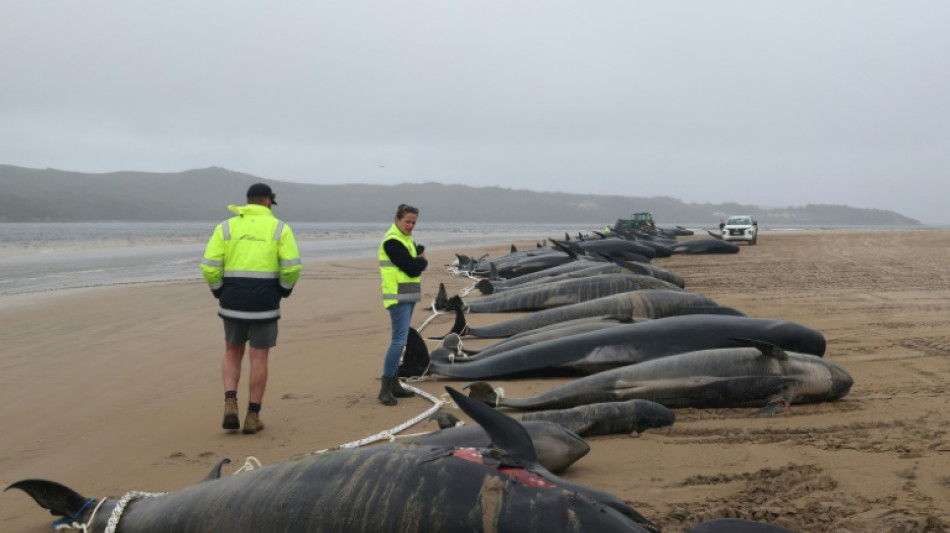
Australian rescuers race to save stranded pilot whales / Photo: Glenn NICHOLLS - AFP

 US House faces test on sweeping Russia sanctions bill

 British PM says to make 'difficult decisions' as inflation rises

 Global fuel price demos: a round-up

 Leverate Launches MCP for Traders to Connect AI Assistants With Trading Platforms

 MEXC Launches $1M "Discover Your Wall Street DNA" Campaign to Help Traders Find Their Market Fit

 Stocks edge higher ahead of US Fed rate call

 BASIS.pro Expands On-Chain Infrastructure with XDC Network Partnership and Zypher DAO as Auto Earn Goes Live

 Pickle-flavoured tart? AI inspires Japan's convenience stores

 EU chief hosts Canada's Carney in push to 'deepen' alliance

 Meta chief pushes back on AI slowdown calls

 US Fed to deliver rate decision with markets betting on hike

 Sanders, Bannon warn of AI dangers in rare US left-right alignment

 Empty benches as schools reopen in Venezuela's quake-hit Guaira

 Tiny English village holds 'independence' vote over asylum seeker housing

 US Treasury chief says to meet Chinese counterpart at weekend

 BingX Evolves into a Multi-Asset Trading Platform, Connecting Users to Global Opportunities

 International Trading Institute Expands Professional Trader Development Beyond the Master’s in Trading

 Lake Energy Secures $80 Million for U.S. Renewable Energy Expansion

 Stocks drop, oil climbs and Treasury yields hit 19-year high

 SkySail Strategies Outperforms Wall Street's 30-Year Risk Standard With Proprietary AI Inference Model

 Just add fish: Scientists pursue more rice, less disease in Senegal paddies

 Belgium completes outer structure of offshore energy island

 China retail sales growth weakens further in August

 In Kashmir, lake weeds mix with traditional art

 'Widow's Bay' and 'The Pitt' take key Emmy awards

Australian rescuers battled Friday to refloat the last surviving pilot whales from a mass stranding that killed nearly 200 of the animals on a surf-battered beach in Tasmania.
Fewer than 10 of the shiny black mammals are still alive on Ocean Beach, in remote western Tasmania, state wildlife services said.
About 30 of the animals were released into the ocean on Thursday, but some had beached themselves again, said Brendon Clark, incident controller with the Tasmania Parks and Wildlife Service.
Under cool drizzle, marine wildlife experts began to wrap up a complex days-long rescue operation that started with a large pod of the animals, which are part of the dolphin family, stranding on the beach mid-week.
Three pilot whales had yet to be reached because of their remote location on the shore and the difficult tidal conditions, Clark told reporters at the scene.
"The priority still is the rescue and release of those remaining animals and any others that we identify that re-strand," he said.
Next, Clark said, comes the task of disposing of the carcases.
- Carcasses -
Wildlife workers used a fork-lift truck to line up whale carcasses along the beach, their tails pointed to the frigid ocean.
One small, young calf could be seen tied up alongside the larger adult pilot whales.
A long white line was looped around the tails of dozens of the animals to allow them to be towed en masse to disposal at sea.
Weather forecasts indicated the "best opportunity" for the operation would be on Sunday, Clark said.
If left in shallow waters or on the beach, the carcases could attract sharks and can carry disease.
"We are making every effort to consolidate the carcasses at the moment into one spot and then push ahead with getting them offshore," said Kris Carlyon, operations manager with the state wildlife services.
Once in the water the carcasses can attract predators or become a collision risk, Carlyon said, but experts hoped the winds and currents would push them out to sea, and some were expected to sink.
- Distress signals -
Two years ago, Macquarie Harbour was the scene of the country's largest-ever mass stranding, involving almost 500 pilot whales.
More than 300 pilot whales died during that event, despite the efforts of dozens of volunteers who toiled for days in Tasmania's freezing waters to free them.
Scientists still do not fully understand why mass strandings occur.
Some have suggested pods go off track after feeding too close to shore.
Pilot whales -- which can grow to more than six metres (20 feet) long -- are also highly sociable, so they may follow pod-mates who stray into danger.
That sometimes occurs when old, sick or injured animals swim ashore and other pod members follow, trying to respond to the trapped whale's distress signals.
Others believe gently sloping beaches like those found in Tasmania confuse the whales' sonar, making them think they are in open waters.
The latest stranding came days after a dozen young male sperm whales were reported dead in a separate mass stranding on King Island -- between Tasmania and the Australian mainland.
State officials said that incident may have been a case of "misadventure".
Strandings are also common in nearby New Zealand.
There, around 300 animals beach themselves annually, according to official figures, and it is not unusual for groups of between 20 and 50 pilot whales to run aground.
But numbers can run into the hundreds when a "super pod" is involved. In 2017, there was a mass stranding of almost 700 pilot whales.
A.Levy--CPN

