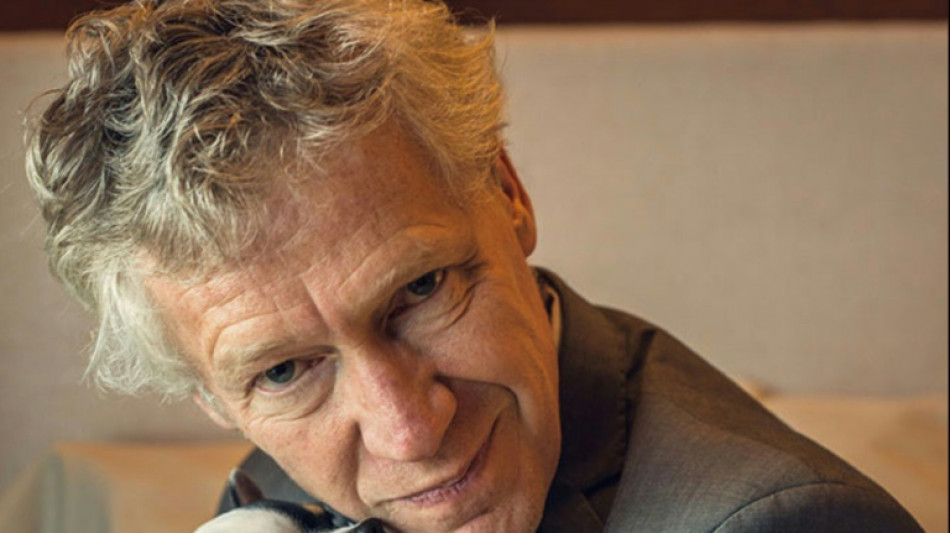
Frenchman rewarded for lifetime of research into narcolepsy / Photo: Handout - AFP

 US House faces test on sweeping Russia sanctions bill

 British PM says to make 'difficult decisions' as inflation rises

 Global fuel price demos: a round-up

 Leverate Launches MCP for Traders to Connect AI Assistants With Trading Platforms

 MEXC Launches $1M "Discover Your Wall Street DNA" Campaign to Help Traders Find Their Market Fit

 Stocks edge higher ahead of US Fed rate call

 BASIS.pro Expands On-Chain Infrastructure with XDC Network Partnership and Zypher DAO as Auto Earn Goes Live

 Pickle-flavoured tart? AI inspires Japan's convenience stores

 EU chief hosts Canada's Carney in push to 'deepen' alliance

 Meta chief pushes back on AI slowdown calls

 US Fed to deliver rate decision with markets betting on hike

 Sanders, Bannon warn of AI dangers in rare US left-right alignment

 Empty benches as schools reopen in Venezuela's quake-hit Guaira

 Tiny English village holds 'independence' vote over asylum seeker housing

 US Treasury chief says to meet Chinese counterpart at weekend

 BingX Evolves into a Multi-Asset Trading Platform, Connecting Users to Global Opportunities

 International Trading Institute Expands Professional Trader Development Beyond the Master’s in Trading

 Lake Energy Secures $80 Million for U.S. Renewable Energy Expansion

 Stocks drop, oil climbs and Treasury yields hit 19-year high

 SkySail Strategies Outperforms Wall Street's 30-Year Risk Standard With Proprietary AI Inference Model

 Just add fish: Scientists pursue more rice, less disease in Senegal paddies

 Belgium completes outer structure of offshore energy island

 China retail sales growth weakens further in August

 In Kashmir, lake weeds mix with traditional art

 'Widow's Bay' and 'The Pitt' take key Emmy awards

Emmanuel Mignot is one of the world's leading experts on narcolepsy, a sleep disorder that he finds both "strange" and "fascinating."
The French-born Mignot has dedicated his life to studying the causes of narcolepsy and shedding light on one of the great biological mysteries -- sleep.
His discovery of the genetic and molecular causes of the disorder led to his receiving a prestigious Breakthrough Prize on Thursday along with Japan's Masashi Yanagisawa, who made related findings around the same time.
Because of their discoveries, new treatments for narcolepsy -- which causes people to suddenly fall asleep -- and other sleep disorders are being developed.
About one in every 2,000 people suffers from narcolepsy. Some may experience catalepsy -- a sudden trance-like state.
"I am quite proud because what I have discovered is making an enormous difference for my patients," Mignot said in a telephone interview with AFP. "It's the best reward that one could receive."
The 63-year-old Mignot is a sleep researcher at Stanford University in California.
Thirty years ago, when he was a medical student, Mignot fulfilled his military service requirements in France by coming to Stanford to study a French-made drug that was being used to treat narcolepsy.
At the time, he said, the disease was "virtually unknown" and no one was actively studying it.
He became "completely fascinated."
"I told myself it's incredible, this disease, people fall asleep all the time, we have no idea why, and if we could discover the cause we might understand something new about sleep."
Stanford was already home to a renowned sleep center and its laboratory housed narcoleptic dogs, which Mignot began studying in an effort to find a genetic cause of the disease.
Genome sequencing was very primitive at that time and "everybody told me I was crazy," said Mignot, who currently has an adopted narcoleptic dog called Watson.
"I thought it would take a few years and it ended up taking 10."
In 1999, Mignot found a mutation in the genome of narcoleptic dogs. It was located on membrane receptors in the brain that respond to molecules outside the cell, similar to a lock and a key.
- 'Remake a key' -
The Japanese scientist Yanagisawa, meanwhile, had been studying orphan receptors -- receptors of unknown function -- in mice.
He discovered that a molecule that he named orexin binds to the same receptor Mignot detected as abnormal in dogs.
Mice who were deprived of orexin developed narcolepsy.
Mignot immediately began research on human subjects and found that orexin levels in the brain of narcolepsy patients were zero.
Normally, the molecule is produced in great quantities during the day, especially in the evening, allowing one to fight fatigue.
"You don't make a discovery like this twice in your life," Mignot said. "We found the cause of a disease.
"The advantage, is that we can remake a key," he said, referring to orexin.
For the moment, most patients are treated with a combination of powerful sedatives to help them sleep more soundly and amphetamines to keep them awake during the day.
Mignot said tests using a drug that mimics orexin have been "really miraculous."
Patients are fully awake and "transformed."
The challenge is to develop the right dose to be delivered at the right time.
Several companies, including Takeda of Japan, are working on it, and drugs could be authorized in the next few years.
They could be applied to other patients -- people suffering from depression, for example -- who have difficulty waking up, or to those in a coma.
Mignot meanwhile is studying whether narcolepsy may be caused by a flu virus.
The body's immune system may be confusing a flu virus with the cells that produce orexin and T-cells that fight infection are attacking them as a result.
"I've become interested in how the immune system works in the brain," a field he said is "beginning to explode."
As for sleep, Mignot remains fascinated by it even if he has uncovered one of the great mysteries.
"What is it that sleep does that it is so important that we have to do it every day?" he asked. "It's true that we still don't know."
A.Leibowitz--CPN

